
If your back squat has stalled, your lower back grumbles after leg day, or you just want bigger quads, the front squat is worth learning. It works your legs as hard as the back squat with less strain on your knees and back, and it keeps you honest: lean forward and the bar lets you know straight away. Here’s how to do it, which grip to use, how many sets and reps to start with, and how it compares with the back squat.
- Bar position: resting on the front of your shoulders, close to your throat, elbows high
- Grip: clean grip (fingertips under the bar), crossed arms or straps; pick whichever lets you keep your elbows up
- The move: brace, sit straight down between your heels with your chest up, then stand by driving your elbows up
- Works: quads most, plus glutes, inner thighs and the upper back that holds the bar
- Beginners: 3 sets of 5–8 with an empty or light bar, twice a week
- Bar rolling forward?: your elbows have dropped; lift them and keep your chest up
How to do a front squat
- Set the bar in a rack at about upper-chest height. Step under it so it sits on the front of your shoulders, touching your throat. The bar rests on your shoulders, not your hands.
- Take your grip (see below) and drive your elbows up until your upper arms are about parallel to the floor.
- Unrack and step back two short steps. Feet about shoulder-width, toes turned out slightly.
- Brace. Big breath into your stomach, trunk tight.
- Squat. Sit straight down between your heels, knees forward and out over your toes, chest and elbows up. Go as deep as you can with your back neutral, ideally below parallel.
- Stand up by driving through your whole foot and pushing your elbows towards the ceiling.
The upright torso is the point. If you lean forward, the bar rolls towards your hands. Think “elbows up” for every rep, especially the hardest part of the way up.
How to hold the bar: three grips
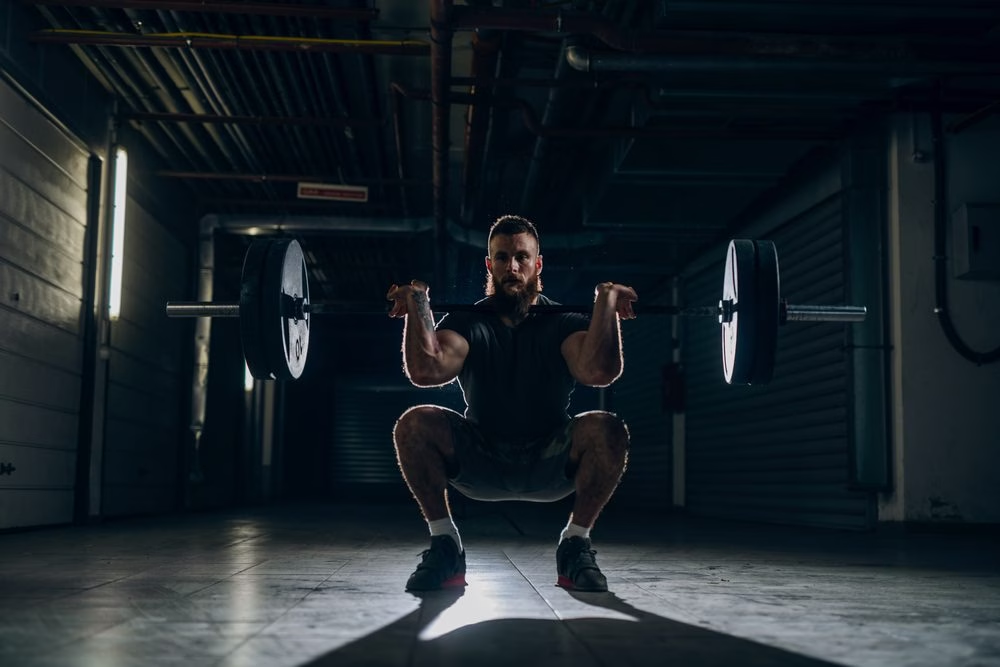
- Clean grip. Hands just outside your shoulders, bar on your fingertips, elbows high. The most secure grip and the standard for Olympic lifting, but it needs flexible wrists, triceps and lats. Two or three fingers under the bar is enough. To learn the lifts this grip comes from, start with our guide to what Olympic weightlifting is.
- Cross-arm grip. Cross your arms in front of you and rest your hands on top of the bar on the opposite shoulders. Easier on the wrists, but the bar is less secure as the weight goes up.
- Strap grip. Loop lifting straps around the bar and hold the ends. A good compromise if your wrists won’t bend far enough for the clean grip.
If none of these works yet, a goblet squat with a kettlebell or dumbbell at your chest teaches the same upright position. Our sumo squat guide covers the goblet hold.
Common front squat mistakes
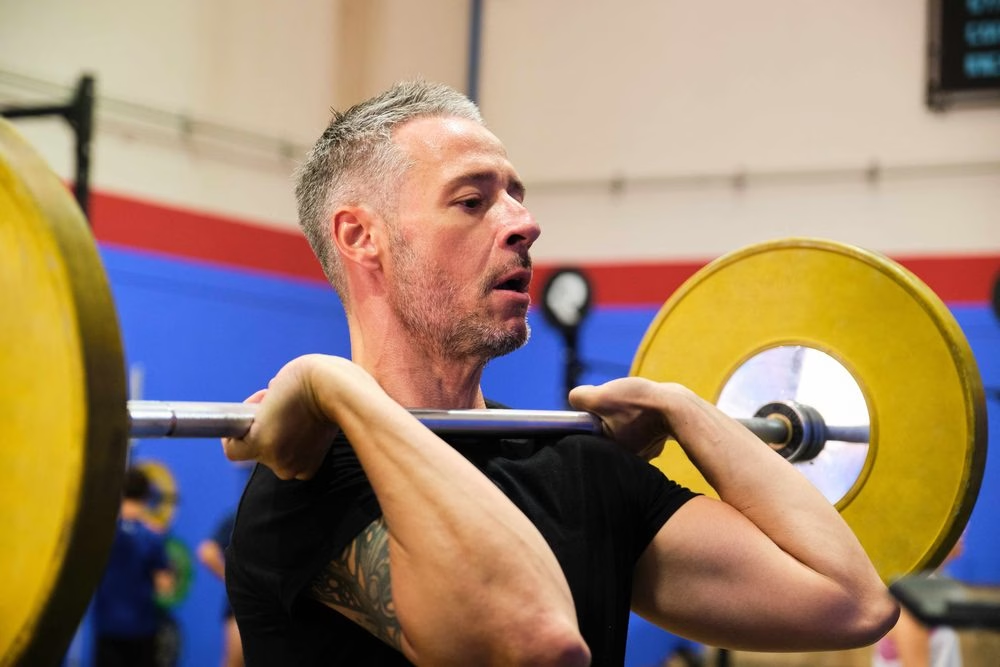
- Elbows dropping. The number one fault. As soon as they drop, your chest follows and the bar rolls forward.
- Holding the bar in your hands. It belongs on your shoulders. Gripping it hard strains your wrists.
- Heels lifting. Usually stiff ankles. Raise your heels slightly on small plates or wear weightlifting shoes while you work on mobility.
- Cutting depth. The front squat is meant to go deep; a short squat misses most of the benefit.
- Loading like a back squat. You’ll lift less. Start light and add weight in small jumps.
Front squat vs back squat
The front squat works your legs just as hard as the back squat but is easier on your knees and back. In a study of 15 trained lifters, the two produced the same overall muscle activity, but the front squat put significantly less compressive force through the knee, and the authors suggested it may suit people with knee problems (Gullett and colleagues, 2009). A 2020 study of 11 university athletes found that at the same weight, the back squat loaded the hips more and the front squat the knees, but when each lift used the same percentage of its own maximum, the demands on the knee were about the same (Krzyszkowski and Kipp, 2020).
| Front squat | Back squat | |
|---|---|---|
| Bar position | Front of the shoulders | Upper back |
| Torso | Upright | More forward lean |
| Bias | Quads, upper back | Hips, glutes, lower back |
| Weight you can lift | Less | More |
| Mobility needed | Wrists, ankles, upper back | Shoulders, hips |
| Best for | Quads, upright squatting, Olympic lifting | Maximum strength and load |
What muscles does the front squat work?
- Quadriceps: the main movers, because your knees bend further forward to keep you upright.
- Glutes and inner thighs: extend your hips out of the bottom.
- Upper back: holds your chest up and the bar in place.
- Abs: brace hard to stop you folding forward under a bar held in front.
Sets and reps for beginners
Start with 3 sets of 5–8 with an empty 20 kg bar (or a lighter technique bar), twice a week, and add 2.5–5 kg a session while every rep stays upright and deep. That matches the American College of Sports Medicine’s advice of 2–3 days a week for novices (ACSM, 2009), and Australia’s guidelines ask adults to do muscle-strengthening work on at least two days a week (Department of Health).
A front squat leg session
| Exercise | Sets and reps |
|---|---|
| 1. Front squat | 4 x 5 |
| 2. Romanian deadlift | 3 x 8 |
| 3. Reverse lunge | 3 x 8 each leg |
| 4. Single-leg glute bridge | 2 x 10 each side |
| 5. Plank | 3 x 30–45 sec |
For single-leg work with more load, try the Bulgarian split squat. To add power, do a few sets of box jumps before your front squats, while your legs are fresh.
Front squat FAQ
Why are front squats so hard?
Your upper back and abs have to hold the bar in front of you, and any loss of position shows up straight away. Most people’s legs can handle more than their upper back can hold at first.
Are front squats better for your knees?
They put less compressive force through the knee at the same effort, according to the 2009 study above, which is why they’re often suggested for lifters with knee issues. If you have knee pain, get it assessed first; the Spanish squat is a strap-supported quad exercise physios use for sore knees.
My wrists hurt in the front squat. What should I do?
Use only your fingertips under the bar, let the bar sit on your shoulders, or switch to the cross-arm or strap grip. Stretching your wrists, triceps and lats helps the clean grip over time.
Can I front squat with dumbbells?
Yes: rest a dumbbell on each shoulder with your elbows up. It’s a good home version, though balance limits how heavy you can go.
Sources: Gullett, Tillman, Gutierrez and Chow (2009), Journal of Strength and Conditioning Research; Krzyszkowski and Kipp (2020), Journal of Sports Sciences; American College of Sports Medicine position stand (2009), Medicine & Science in Sports & Exercise; Australia’s physical activity and exercise guidelines for adults. Checked 29 October 2026.