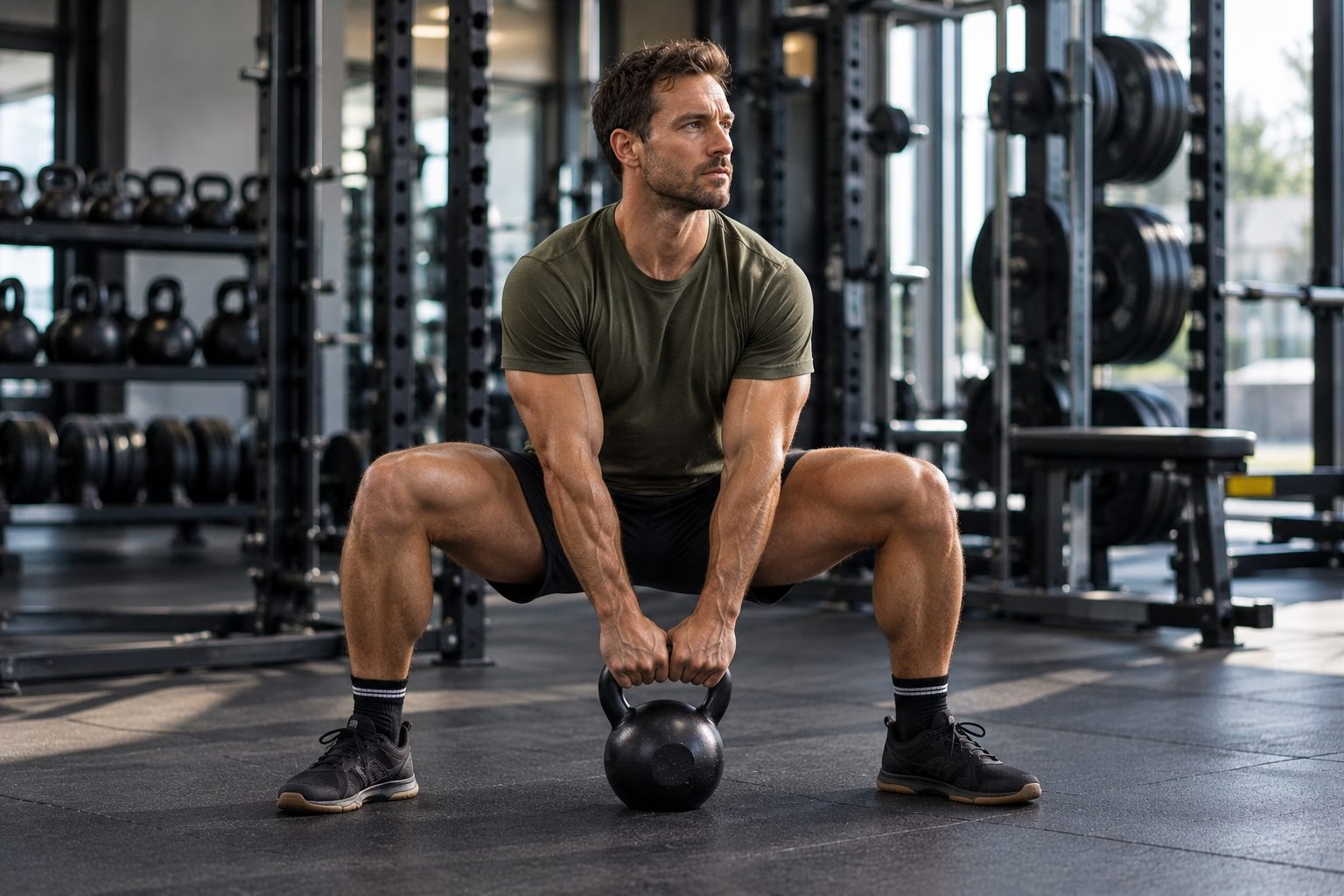

Widen your feet, turn your toes out and you’ve got a sumo squat. It’s the same basic movement as any squat, but the wide stance changes what works hardest: more of your inner thighs and glutes, and an upright torso that many men find easier on the lower back than a narrow squat. It’s also one of the easiest squats to learn with a single kettlebell or dumbbell, which makes it a good home exercise. Here’s how to do it, what the research says it works, and how to make it harder.
- Stance: feet about one and a half times shoulder width, toes turned out 30 to 45 degrees
- The move: sit straight down between your heels, knees pushed out over your toes, chest up; stand by driving through your whole foot
- Works: quads and glutes like any squat, with more work for the inner thighs (adductors)
- Beginners: 3 sets of 10–12 holding a kettlebell or dumbbell at your chest, two or three times a week
- Go deep: squatting to full depth builds more glute and inner-thigh muscle than half squats
- Knees caving in? Turn your toes out a little more and push your knees towards your little toes
How to do a sumo squat
- Set your feet. Stand with your feet about one and a half times shoulder width apart and turn your toes out 30 to 45 degrees. Wider isn’t better: go only as wide as lets you squat deep with your knees tracking over your toes.
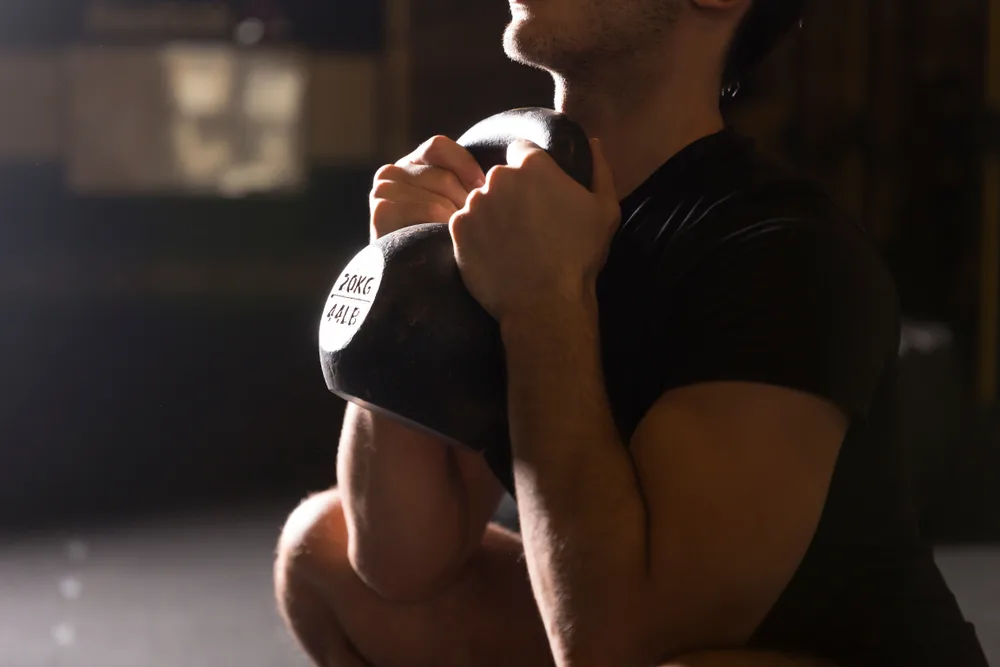
- Hold the weight. For a goblet sumo squat, hold a kettlebell by the horns or a dumbbell by one end, high against your chest, elbows pointing down.
- Brace. Take a breath into your stomach and tighten your trunk as if you’re about to be poked in the gut.
- Sit down between your heels. Push your knees out in line with your toes and lower your hips straight down, keeping your chest up. Go as deep as you can while your back stays neutral and your heels stay down: ideally thighs at least parallel to the floor.
- Stand up. Drive through your whole foot, keep your knees out and squeeze your glutes at the top without leaning back.
Breathe out as you stand. Because your shins stay more upright than in a narrow squat, the sumo squat tends to keep your torso more vertical, so you’ll feel it more in your hips and inner thighs and less at the front of your knees.
Common sumo squat mistakes
- Knees caving in. The most common fault. Your knees should point the same way as your toes all the way down and up. If they collapse inwards, go lighter, turn your toes out a little more and think about spreading the floor apart with your feet.
- Feet too wide. An extreme stance often cuts your depth short and can strain your hips. If you can’t get your thighs to parallel, bring your feet in.
- Toes pointing forward. With a wide stance and straight feet, your knees can’t track over your toes. Turn them out to match the angle your knees naturally go.
- Half reps. Stopping well short of parallel leaves most of the benefit on the table (see the research below).
- Leaning forward. If the weight pulls your chest down, hold it higher and closer, or go lighter.
- Heels lifting. Keep your weight spread across your whole foot. If your heels rise, you’re probably too deep for your current mobility: shorten the range a little and build it up.
What muscles does the sumo squat work?
- Quadriceps: the front of your thighs, which straighten your knees.
- Gluteus maximus: the big muscle of your backside, which straightens your hips as you stand.
- Adductors: the inner-thigh muscles. Besides pulling your legs together, the biggest of them, the adductor magnus, helps extend your hips, so it works hard when you stand up out of a deep squat.
- Trunk muscles: your abs and back muscles keep your spine still, especially with a weight held at your chest.
The research backs the idea that a wide stance shifts some of the work, but less than gym lore suggests. In a study of nine male lifters squatting with narrow, shoulder-width and wide stances, stance width changed the activity of the adductor longus (an inner-thigh muscle) and the glutes but made no difference to the quadriceps (McCaw and Melrose, 1999). A study of six experienced lifters found the same pattern for the glutes: of eight thigh and hip muscles measured, only the gluteus maximus changed, and it was most active at the widest stance, both unloaded and at 70% of their maximum (Paoli and colleagues, 2009).
Depth may matter more than stance. When 17 men trained twice a week for 10 weeks, the group doing full squats grew their adductors by 6.2% and their glutes by 6.7% on MRI scans, against 2.7% and 2.2% for the group doing half squats. Their quads grew by about the same amount either way (Kubo and colleagues, 2019). Those were regular squats, not sumo squats, but the lesson carries over: whichever stance you use, go deep.
Sumo squat vs regular squat
Neither is better; they bias the work slightly differently. The regular, shoulder-width squat is the standard lower-body strength exercise and the one to load heaviest over time. The sumo squat brings in more inner thigh and glute, keeps your torso more upright, and suits men with long thighs or stiff ankles who struggle to squat deep with a narrow stance. A good plan uses both, or uses the sumo squat as the second squat of the week. If you want a single-leg option too, our Bulgarian split squat guide covers the best one. For a squat that keeps your torso upright and goes easier on your back, try the front squat.
Sumo squat variations and progressions
Move to the next step when you can do every set at the top of the rep range with good depth and your knees tracking out.
| Exercise | Sets and reps | How |
|---|---|---|
| 1. Bodyweight sumo squat | 3 x 15 | Hands clasped at your chest; learn the stance and depth |
| 2. Goblet sumo squat | 3 x 10–12 | Kettlebell or dumbbell held at your chest |
| 3. Dumbbell sumo squat | 3 x 8–12 | One heavy dumbbell hanging between your legs |
| 4. Paused goblet sumo squat | 3 x 8 | Two-second pause at the bottom, no bounce |
| 5. Wide-stance barbell back squat | 3–4 x 5–8 | The same stance with the bar on your back |
Goblet sumo squat
The best place to start with weight. Holding the bell at your chest acts as a counterweight that helps you sit upright and deep. A kettlebell held by the horns or a dumbbell held vertically by one end both work.
Dumbbell sumo squat
Once the goblet hold limits you, let one heavy dumbbell hang at arm’s length between your legs, gripped by the top plate. You can go heavier because your arms aren’t holding it up at your chest. For a longer range, stand with each foot on a low, sturdy step so the dumbbell can go below floor level.
Wide-stance barbell back squat
The same stance with a barbell on your upper back, and the version you can keep loading for years. Learn it with an empty bar and use a rack with safety arms.
Sets and reps for beginners
Start with 3 sets of 10–12 goblet sumo squats, two or three times a week, with at least a day between sessions. Pick a weight that leaves two or three good reps in the tank at the end of each set. That frequency matches the American College of Sports Medicine’s advice of 2–3 days a week for novices (ACSM, 2009), and Australia’s guidelines ask adults to do muscle-strengthening work on at least two days a week (Department of Health). Add a little weight when all your sets feel solid.
A 20-minute lower-body workout
Do the exercises in order with about 60 seconds’ rest between sets. You need a kettlebell or dumbbell, a bench or sturdy chair, and a mat. Twice a week is enough to start.
| Exercise | Sets and reps |
|---|---|
| 1. Goblet sumo squat | 3 x 10 |
| 2. Bulgarian split squat | 3 x 8 each side |
| 3. Kettlebell swing | 3 x 15 |
| 4. Single-leg glute bridge | 2 x 10 each side |
| 5. Side plank | 2 x 30 sec each side |
- Goblet sumo squat: or whichever step of the progression you’re on.
- Bulgarian split squat: rear foot on the bench, drop your back knee towards the floor.
- Kettlebell swing: a fast hip hinge for the glutes and hamstrings. Learn it with our kettlebell workout.
- Single-leg glute bridge: on your back, one foot planted, drive your hips up through that heel. Our glute bridge guide has the progressions.
- Side plank: for the trunk muscles that keep your hips level.
If you want to build size, our guide to bulking covers how much to eat and how to progress your training.
Sumo squat FAQ
Do sumo squats work the inner thighs?
Yes, more than a narrow squat does: a wide stance increases activity in the inner-thigh adductors (McCaw and Melrose, 1999). Squatting deep matters too, because full squats built more adductor muscle than half squats in a 10-week trial (Kubo and colleagues, 2019). They won’t burn fat off your inner thighs in particular; that comes down to overall fat loss.
Are sumo squats good for your glutes?
Yes. In both stance studies above, the gluteus maximus was more active with a wide stance, and the deeper you go, the more it grows. For extra glute work, add hip thrusts or glute bridges.
What’s the difference between a sumo squat and a sumo deadlift?
Both use a wide stance with your toes out. In a sumo squat you hold the weight at your chest or between your legs and sit down and stand up. In a sumo deadlift you lift a barbell from the floor with your hands inside your knees, which loads your hips and back more and lets you lift much heavier.
How wide should my stance be?
Start at about one and a half times shoulder width with your toes out 30 to 45 degrees, then adjust. The right width is the widest one where you can still reach parallel with your knees over your toes and your heels down. Hip shape varies a lot between people, so there’s no single correct stance.
Why do sumo squats hurt my knees?
Usually because your knees are caving in or pointing a different way from your toes, which twists the joint. Match your toe angle to your knees, go lighter and narrow your stance a little. If the pain continues, stop and see a physio or GP.
Sources: McCaw and Melrose (1999), Medicine & Science in Sports & Exercise; Paoli, Marcolin and Petrone (2009), Journal of Strength and Conditioning Research; Kubo, Ikebukuro and Yata (2019), European Journal of Applied Physiology; American College of Sports Medicine position stand (2009), Medicine & Science in Sports & Exercise; Australia’s physical activity and exercise guidelines for adults. Checked 29 October 2026.