


Want to jump higher, move more explosively or just make leg day feel less like a grind? Box jumps train your legs to produce force fast, and the research shows jump training like this adds real height to your jump. The catch: most people do them wrong, for too many reps when they’re tired or onto a box that’s far too tall. Here’s how to do box jumps properly, how high your box should be, how many to do, and what to do if you don’t have a box.
- The move: quick dip and arm swing, jump, land softly on the box in a quarter squat, stand up, then step or jump down
- Box height: start low (30–45 cm); you should land in the same quarter squat you jumped from, not a deep squat
- Works: the power of your glutes, quads and calves, plus landing control
- Beginners: 3–4 sets of 3–5 jumps, fully rested, once or twice a week
- Getting down: jumping down is fine when you’re fresh, so land softly; step down when you’re tired or the box is tall
- No box?: jump squats train the same power on flat ground
How to do a box jump
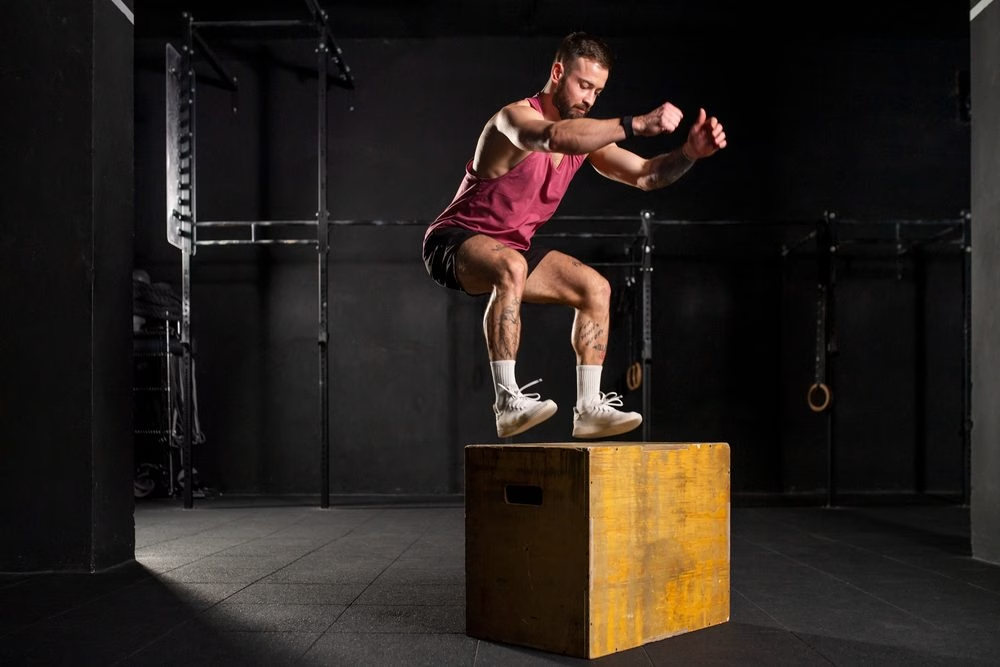
- Stand about a foot from a sturdy box or plyo box, feet hip-width apart.
- Dip and swing. Drop quickly into a quarter squat, hinging at the hips, and swing your arms back.
- Jump. Drive your arms forward and up and explode through your hips, knees and ankles.
- Land softly with your whole foot on the box, knees bent and pushed out over your toes, in the same quarter-squat position you jumped from.
- Stand up tall on the box to finish the rep.
- Get down and reset. Most people jump down, and that’s fine when you’re fresh: land softly on the balls of your feet with your knees bent. Step down one foot at a time when you’re tired or the box is tall.
The landing tells you if the box is right. If you have to tuck your knees to your chest and land in a deep squat, the box is too high: you’re training hip flexibility, not jump height.
How high should your box be?
| Level | Box height | Notes |
|---|---|---|
| New to jumping | 30–45 cm | A low step or soft plyo box; focus on landing quietly |
| Regular trainee | 45–60 cm | The usual gym box range |
| Athletic, experienced | 60–75 cm+ | Only if your landing still looks like your take-off |
Common box jump mistakes
- Box too high. The most common one. Pick a height you land on easily.
- Jumping down when you’re tired. Jumping off the box is how almost everyone does it, and it’s fine for a few fresh reps. But every jump down adds a landing from box height, and that goes through your knees and Achilles. When your legs are tired or the box is tall, step down.
- High reps for fitness. Box jumps are a power exercise. As you tire, your landings get sloppy and your shin is the first thing to hit the box edge. Keep the reps low and rest.
- Knees caving in on landing. Land with your knees out over your toes. If they collapse, lower the box.
- Landing loud. A heavy thud means you’re not absorbing the landing. Land as quietly as you can.
What box jumps do

Box jumps are a plyometric exercise: the quick dip and jump uses your muscles’ stretch and recoil to produce force fast. A meta-analysis of 26 studies found plyometric training improved vertical jump height in healthy people by about 5–9% depending on the type of jump, with the biggest effect, about 8.7%, on the standard countermovement jump (Markovic, 2007; full text).
The box itself mainly makes the landing easier: you land higher than you took off, so you come down with less force than you would from a jump on flat ground. That’s why box jumps are a good first plyometric exercise.
Jump squats: the no-box option
A jump squat is a bodyweight squat that finishes in a jump. It trains the same explosive hip and knee extension on flat ground.
- Stand with your feet shoulder-width apart.
- Squat down to about a quarter or half squat, arms back.
- Jump as high as you can, swinging your arms up.
- Land softly back into the squat and go straight into the next rep, or reset each time.
Because you land on the floor, jump squats are harder on your legs than box jumps. Start with 3 sets of 5 and add reps slowly. Holding light dumbbells makes them harder, but keep the weight small.
How to program box jumps
Do them early in a session, after a warm-up and before heavy lifting, while you’re fresh. Quality matters more than volume: 3–4 sets of 3–5 jumps with a full minute or two of rest is plenty. Once or twice a week is enough alongside normal strength training; the American College of Sports Medicine recommends strength work 2–3 days a week for beginners (ACSM, 2009) and Australia’s guidelines ask for muscle-strengthening work on at least two days a week (Department of Health).
| Exercise | Sets and reps | Rest |
|---|---|---|
| 1. Box jump | 4 x 4 | 90 sec |
| 2. Goblet sumo squat | 3 x 8 | 60–90 sec |
| 3. Jump squat | 3 x 5 | 60–90 sec |
| 4. Reverse lunge | 3 x 8 each leg | 60 sec |
| 5. Plank | 3 x 30–45 sec | 45 sec |
For the squat, see our sumo squat guide.
Box jumps FAQ
Do box jumps increase vertical jump?
Plyometric training as a whole does, by about 5–9% on average in the meta-analysis above. Box jumps are one part of that, along with jump squats, bounding and depth jumps.
Are box jumps bad for your knees?
Landing on the box is usually gentler than landing on the floor. Problems come from boxes that are too high, landing with your knees caving in and jumping down for high reps. If you have knee pain, see a physio first.
How many box jumps should I do?
For power, 12–20 good-quality jumps in a session is plenty. Stop when your jumps or landings get worse.
What can I use instead of a box?
A sturdy step, a stable bench or a stack of plates for low jumps, or do jump squats. Never use anything that can slide or tip.
Sources: Markovic (2007), British Journal of Sports Medicine; American College of Sports Medicine position stand (2009), Medicine & Science in Sports & Exercise; Australia’s physical activity and exercise guidelines for adults. Checked 29 October 2026.