Spoilers: this covers every challenge in Physical 100: Italy, including the final and the winner.
Also known as: Physical Italia: da 100 a 1 (in Italy), Habilidad física 100: Italia (Netflix in Spanish) and 100 % Physique : Italie (Netflix in French).
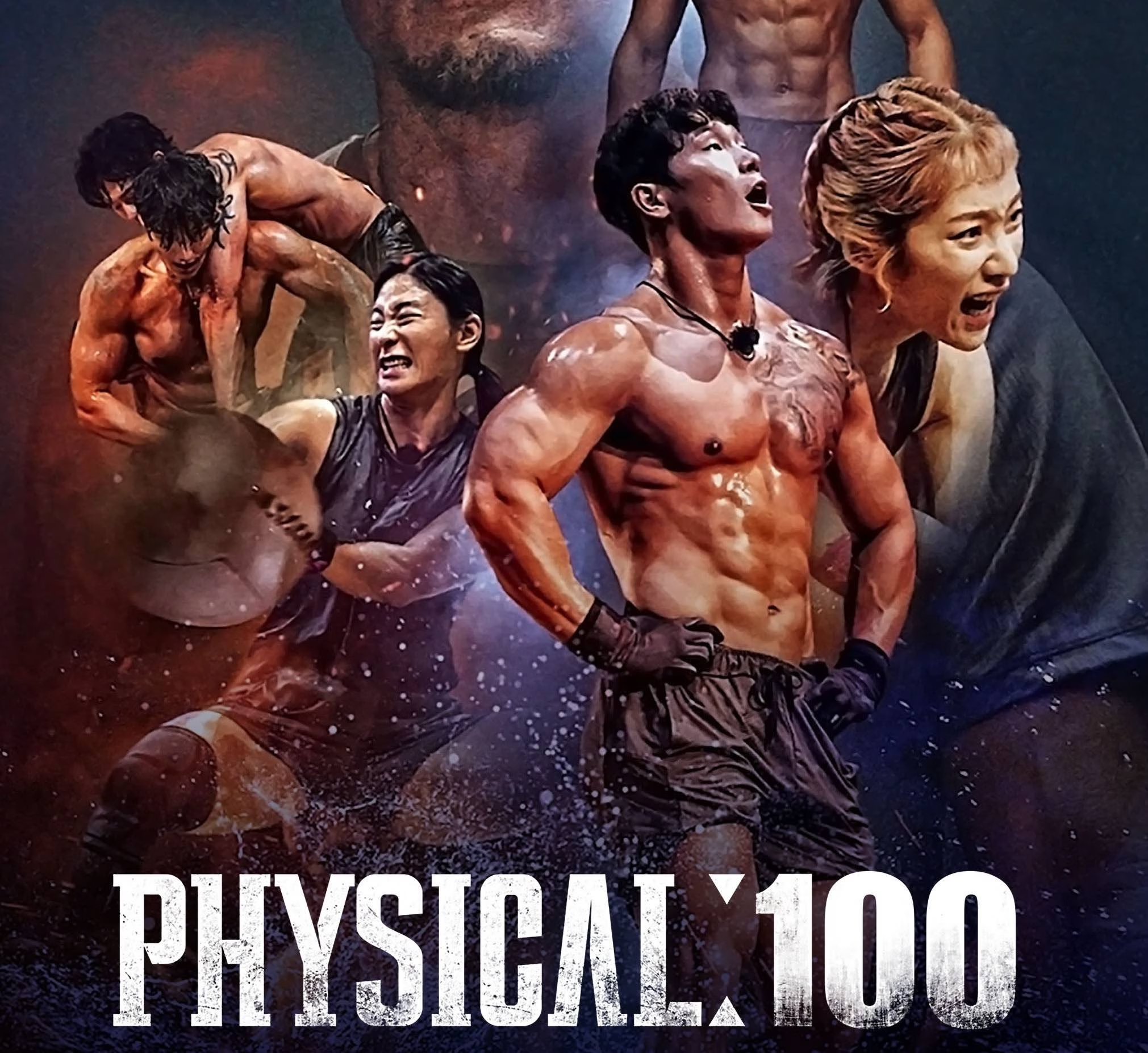
Physical 100: Italy took 100 athletes into an arena at Turin’s Lingotto and cut them to six in seven episodes. It opened with a plank that lasted nearly an hour and a half, sent Olympic champions home in three-minute fights over a ball, and made teams haul a chariot loaded to 145 kg. The last big test before the final was an hour-long hang above a pool.
Here’s every challenge in order: how it worked, who won and who went out, what it tests, and how to build that quality in a normal gym. For who’s who, see the Physical 100: Italy cast guide. For the final six and the result, see our Italy winner page.
All the challenges at a glance
- 1The grid plankEp 1Hold a plank on a grid of bars above a pool, dodging lasersElisa Fuliano won at 1 hr 27 min100 → 80
- 2The duelsEps 2–3One-on-one: three minutes to hold one ball, in a strength or agility arenaJury Chechi, Elisabetta Canalis and Luis Sal out80 → 40
- 3The Forgotten TempleEp 4Teams of five rebuild a bridge and carry sand across it for 12 minutesFour teams out40 → 20
- 4The Pillars of HerculesEp 5One athlete per losing team holds two pillars upright as they fill with waterAlvise Rigo saved his team4 teams → 1 back
- 5The chariot raceEp 6Teams of four haul a chariot, one at a time, from 100 kg up to 145 kgTwo teams out, two cuts24 → 14
- 6The Grid of HeroesEp 7Hang from bars above the pool; the first eight to drop are outManuel Lombardo won at about an hour14 → 6
- 7The finalEp 8Obstacle-course heats, then the last showdownEmanuele Bruno won; Tommaso Nisi runner-up6 → 1
- Isometric endurance: the plank, the pillars and the hang are all about holding a position for longer than feels possible
- Strength for your bodyweight: the heaviest men went out early in the plank and struggled in the hang
- Grip: the plank, the duels, the pillars and the Grid of Heroes all end when the hands give out
- Pulling and leg drive: the chariot and the sandbag bridge reward people who can move heavy things quickly
- Teamwork: two of the biggest rounds were decided by teams, not individuals
1. The grid plank (the opening test)
How it works
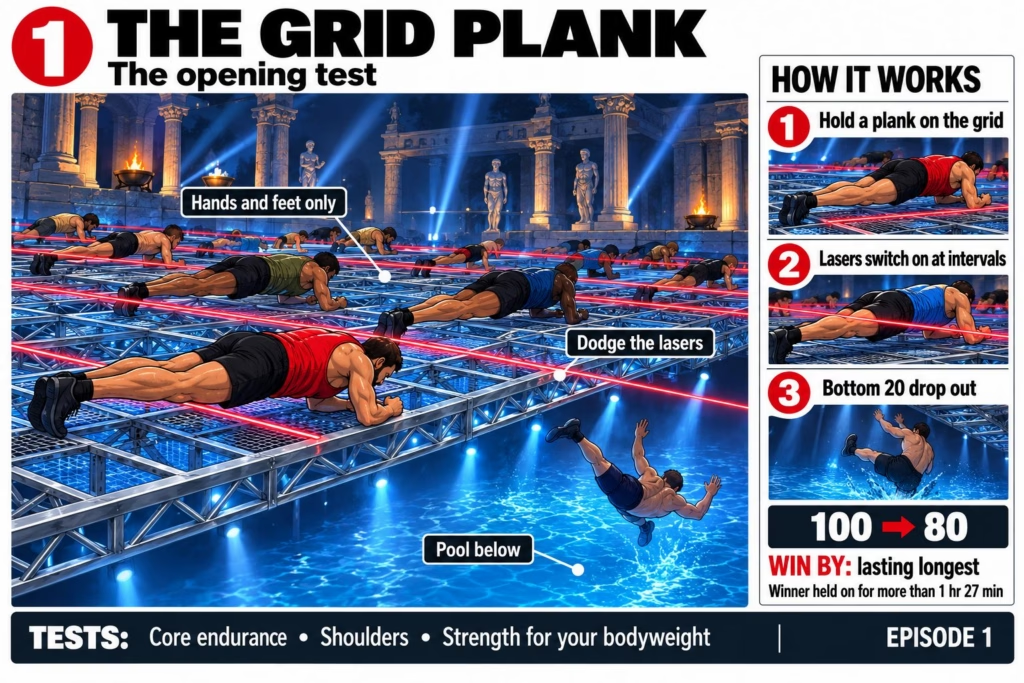
All 100 contestants started in a plank on a suspended grid of metal bars above a pool: hands gripping one bar, feet resting on another, body held straight over the gap. At intervals, laser beams switched on across the grid, and contestants had to keep holding without touching them.
It was the longest single effort of the series. The bottom 20 went home, and the finishing order set up the next round’s choices.
Who won and who went out
- Won by: CrossFit athlete Elisa Fuliano, after more than an hour and 27 minutes
- Out: 20 contestants, including Italian strongman champion Andrea Invernizzi (156 kg), powerlifter Mauro Oldani, bodybuilder Gabriele Di Via and skeleton racer Valentina Margaglio
What it tests: Trunk and shoulder endurance, grip (the hands hold a bar the whole time), strength relative to bodyweight, and the patience to keep still under fatigue. It’s no accident that big strength athletes went out and a CrossFit athlete won.
How to train for it:
- Plank progressions: build straight-arm planks to 2–3 minutes before chasing longer holds. To copy the show, grip something instead of pressing into the floor: dumbbell handles, or a barbell set low in a rack.
- Harder variations for less time: long-lever planks (hands further forward), plank shoulder taps and bear-crawl holds with knees an inch off the floor.
- Hollow-body holds on your back train the same line from the other side.
- Spread the work: three or four sets a few times a week beats one maximal attempt.
2. The duels (strength and agility arenas)
How it works
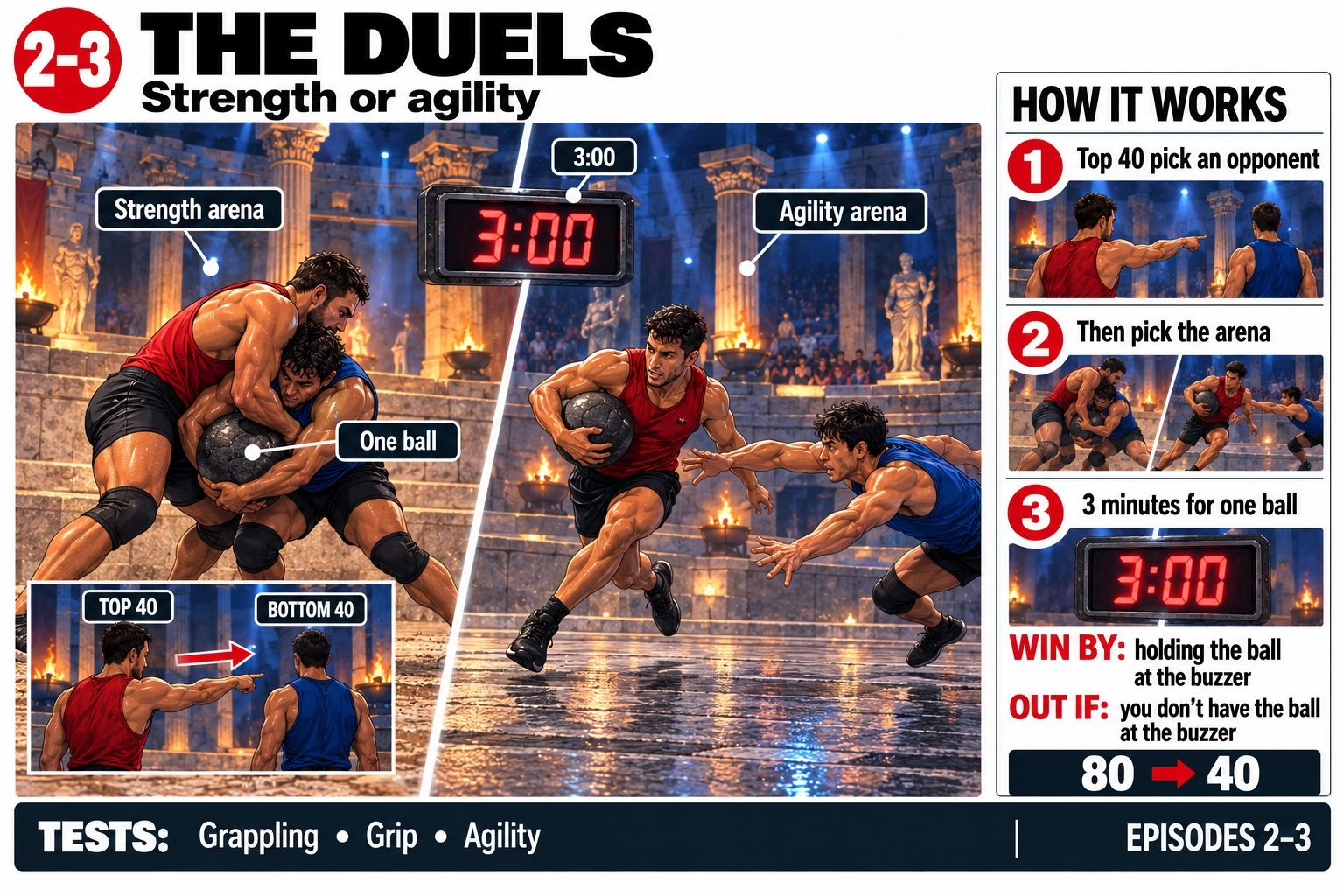
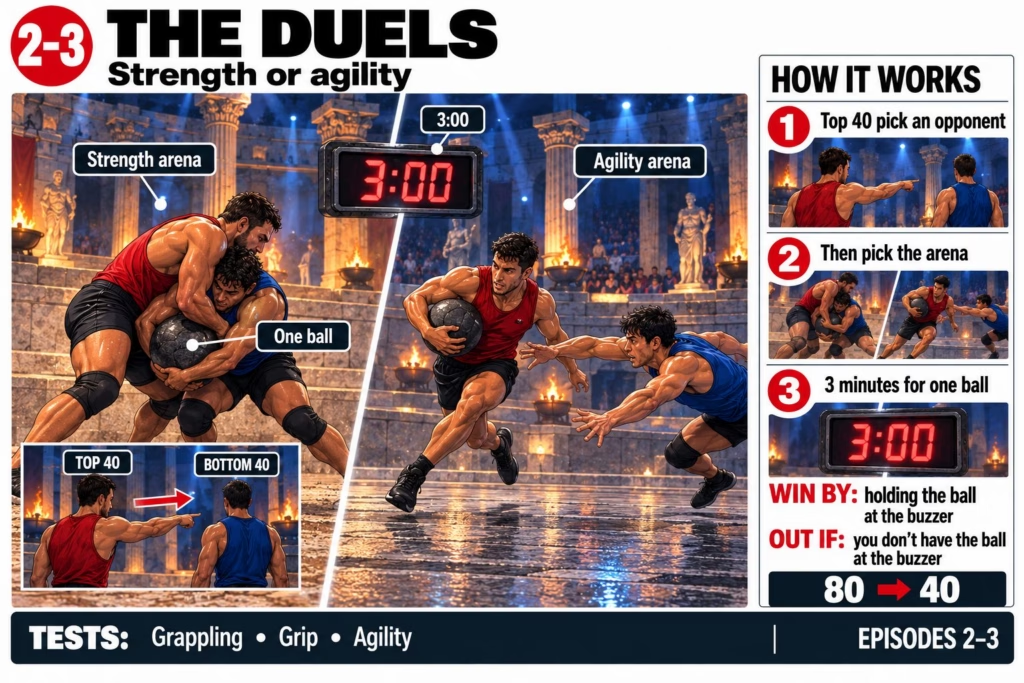
The top 40 from the plank each picked an opponent from the bottom 40, and chose the arena: one built for strength, one for agility. Each duel lasted three minutes, and whoever had control of the ball when time ran out went through. The loser went home.
Who won and who went out
- 80 contestants went in and 40 came out
- Olympic rings champion Jury Chechi chose MMA fighter Ivano Salerno in the agility arena, and lost
- Elisabetta Canalis lost to Elisa Fuliano, and YouTuber Luis Sal lost to powerlifter Filippo Pici, both in the strength arena
- Gymnast Andrea Cingolani beat bodybuilder Beatrice Beni
What it tests: Grappling strength, grip and a strong trunk in the strength arena; speed, footwork and reactions in the agility arena. Choosing the right opponent and arena mattered as much as fitness.
How to train for it:
- If you can, take a few wrestling, judo or jiu-jitsu classes: nothing else teaches you how to hold on to something someone else wants.
- Bear-hug sandbag carries are the closest gym version of clutching a ball against resistance.
- For agility, short shuttle runs and change-of-direction drills, in 20-second bursts.
- Condition for the time: 3-minute rounds with 1 minute of rest.
3. The Forgotten Temple (the sandbag bridge)
How it works
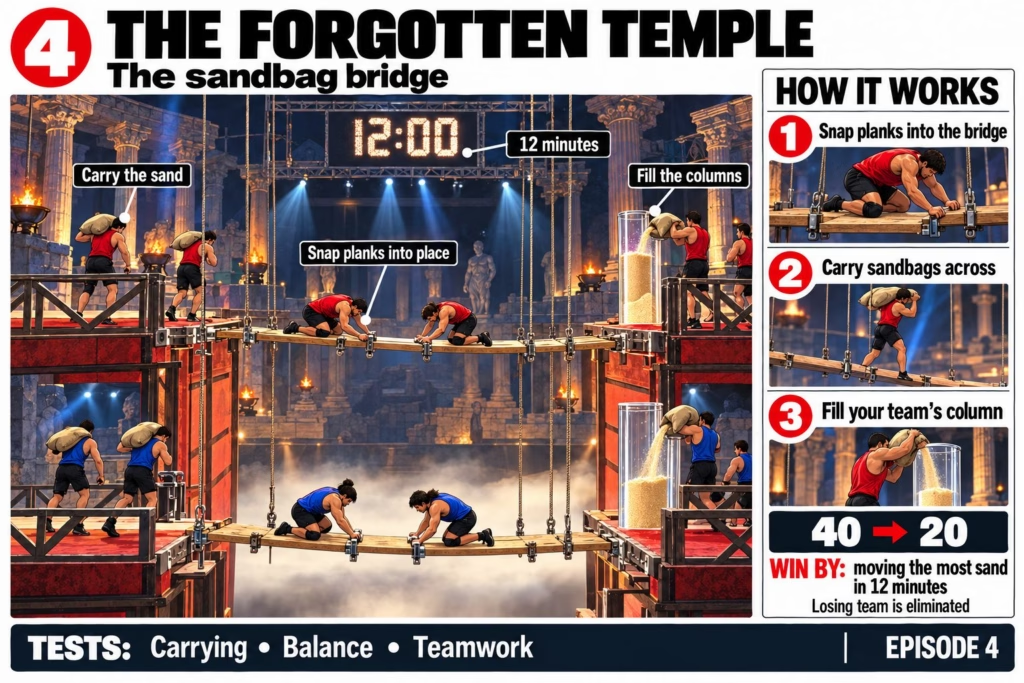
The 40 survivors were split into eight teams of five, led by Emanuele Biviano, Elisa Fuliano, Paolo Masella, Andrea Minguzzi, Filippo Pici, Alvise Rigo, Sebastian Rodwell and Daniele Scatizzi.
Teams raced head to head. Each had to rebuild a tilting bridge, cross it carrying sandbags, and pour the sand into columns. After 12 minutes, the team that had moved the most sand won, and the losing team went out whole.
Who won and who went out
- Won: the teams of Scatizzi, Rodwell, Masella and Minguzzi
- Out: the teams of Pici, Fuliano, Biviano and Rigo, 20 athletes in all (for now: see the next challenge)
What it tests: Carrying heavy, awkward loads over unstable footing, repeatedly, while coordinating with four other people. Balance and teamwork counted as much as raw strength.
How to train for it:
- Sandbag carries in every position: bear hug, on the shoulder and on the back. Our sandbag workout is a good start.
- Balance under load: step-ups and walking lunges holding a sandbag, then carries along a line.
- Team drills if you train in a group: shuttle relays with a shared load, on a count.
4. The Pillars of Hercules (the comeback round)
How it works
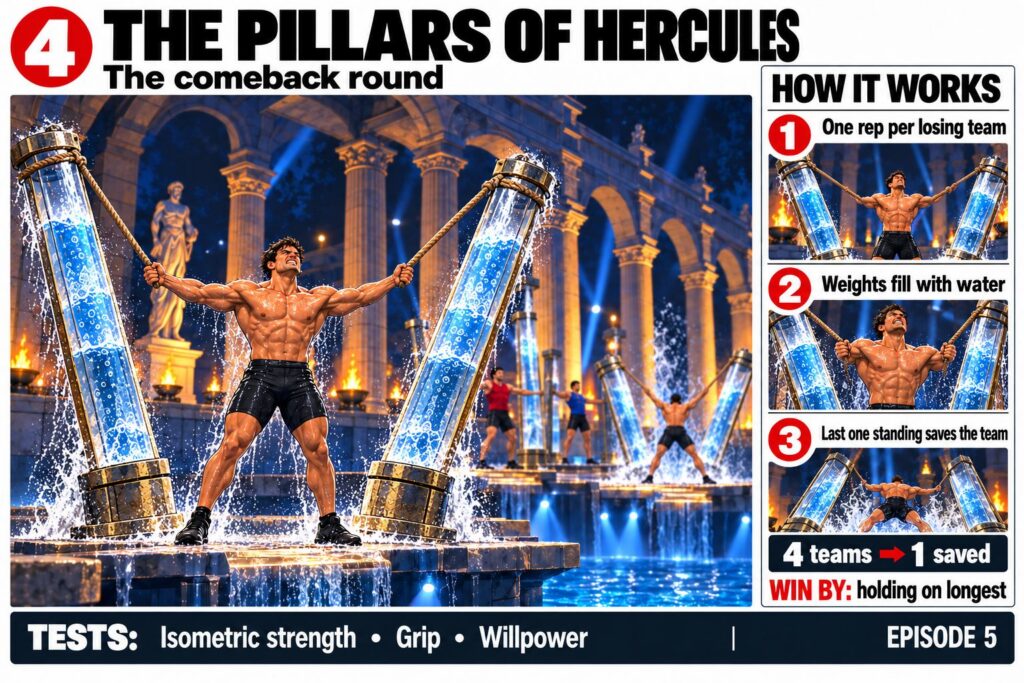
The comeback round. Each of the four losing teams chose one representative, who stood between two huge pillars with a D-shaped handle in each hand, like the handles on a gym cable machine, each one attached to a pillar. Arms spread, they had to keep both pillars upright as the pillars gradually filled with water and got heavier. The last one still holding saved their whole team.
Who won and who went out
- Won by: actor and former rugby player Alvise Rigo, who outlasted Elisa Fuliano, Paolo Innocenti and Filippo Pici, in that order
- Back in: Rigo’s team, including Federica Pellegrini, minus windsurfing champion Marco Begalli, whom Rigo cut
- Also: the four winning captains each had to cut one of their own. Emanuele Bruno, Pietro Checchi, Tommaso Nisi and Sara Del Prete formed a new team of “rejects” under Bruno, leaving 24 athletes in six teams of four
What it tests: Isometric strength and grip that has to last while the load keeps climbing, and the stubbornness to hold on for a team, not just yourself.
How to train for it:
- Heavy holds for time: dumbbells or a trap bar at your sides, held until your grip goes.
- The closest gym version: stand between the two stacks of a cable crossover machine with a D-handle in each hand, arms out wide, and hold for time. Add a little weight each week.
- Grip work: towel hangs and plate pinches (see the grip strength guide).
- Train with a ladder: add a little load or time each week, just as the pillars did.
5. The chariot race (up to 145 kg)
How it works
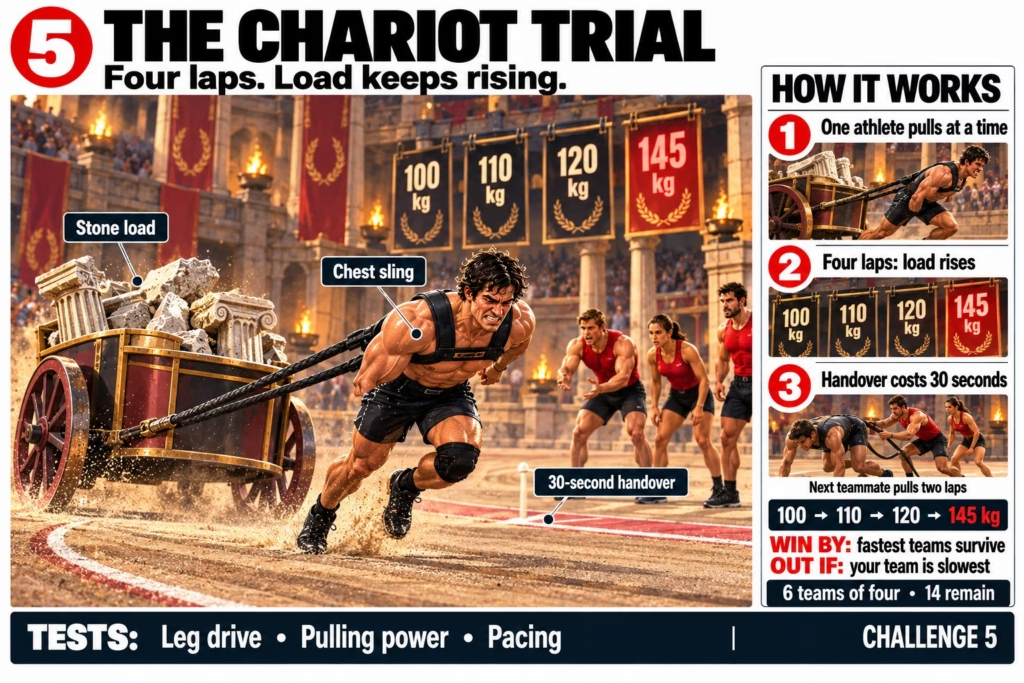
Six teams of four had to drag a chariot around four laps, with one athlete harnessed to it at a time. The load rose every lap: 100 kg, then 110, 120 and finally 145 kg. An athlete who couldn’t finish could hand over after a 30-second penalty, leaving the next teammate to pull two laps.
Who won and who went out
- Won their heat outright: Emanuele Bruno’s team of rejects
- Out: Alvise Rigo’s team, nine seconds behind Andrea Minguzzi’s, which took Federica Pellegrini with it; and Daniele Scatizzi’s team, which needed more than 15 minutes
- Cuts: the two teams that qualified on time each had to drop one member. Olympic judo medallist Rosalba Forciniti was cut, and Matteo Sartori chose to save DJ Giulio Domi. 14 were left
What it tests: Leg drive, hip extension and pulling power under a heavy load, plus pacing across four laps and a team order that puts the strongest pullers on the heaviest laps.
How to train for it:
- Heavy sled pushes and sled drags: two of the HYROX stations and the closest thing to a chariot in most gyms.
- Harness or rope sled pulls, walking backwards and forwards.
- Hip hinge strength: deadlifts or kettlebell deadlifts, and hip thrusts.
- Short hill sprints for the first steps, where a heavy load is hardest to get moving.
6. The Grid of Heroes (the hang over the pool)
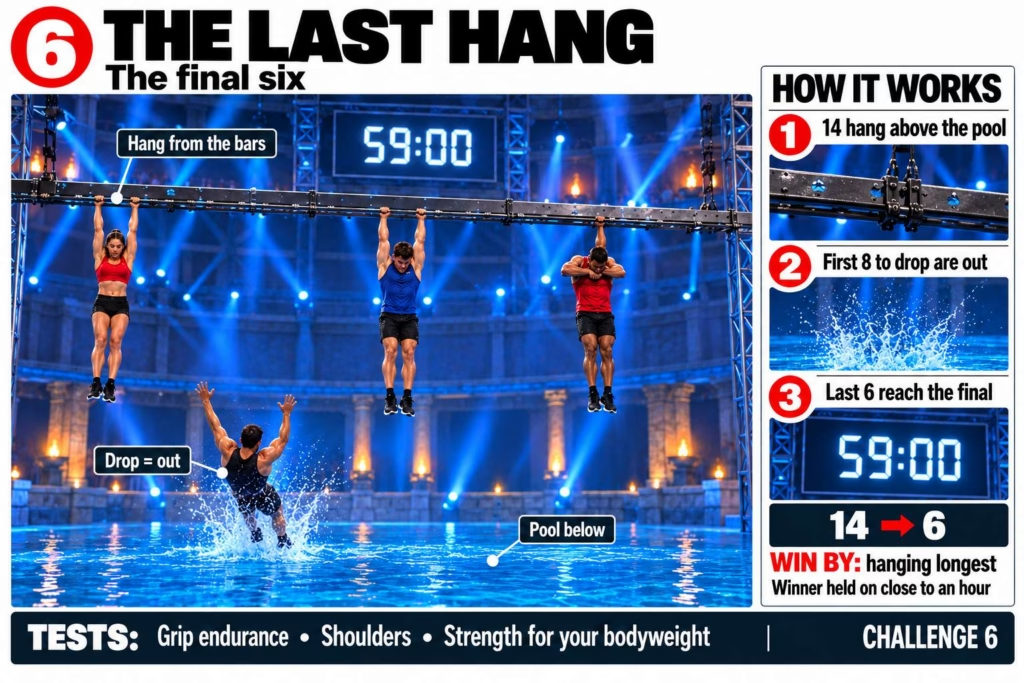
How it works
The last 14 had to hang from bars above the pool. The first eight to drop were out, and the last six went through to the final. After the opening plank, this was the other marathon of the series.
Who won and who went out
- Won by: judo champion Manuel Lombardo, at close to an hour, which let him choose his heat in the final
- Held on longest before him: surf champion Edoardo Papa
- Out: eight, including Sebastian Rodwell (about 53 minutes), Sara Del Prete, the last woman in the competition (about 36), world judo champion Susy Scutto (over 30) and Olympic wrestling champion Andrea Minguzzi (about 28)
- Final six: Manuel Lombardo, Tommaso Nisi, Edoardo Papa, Emanuele Bruno, Matteo Sartori and Giulio Domi
What it tests: Grip endurance, shoulder stability and strength relative to bodyweight. Lighter, strong, patient athletes have a real edge in any long hang.
How to train for it:
- Dead hangs, built with repeaters and towel hangs. Our dead hang guide has benchmarks and a six-week plan.
- Active hangs: pull the shoulders down away from the ears and hold. That’s the position that protects the joint over long holds.
- Farmer’s carries once a week for grip under load.
- Test your grip against age norms with the grip strength guide.
7. The final
Won by: Emanuele Bruno, who took the €100,000. Runner-up: Tommaso Nisi.
The final six started with an obstacle course run in two heats, and three men came through it. Surf champion Edoardo Papa withdrew from his heat almost immediately, and Bruno, by his own standards, struggled, but finished inside the time limit.
Next came an endurance pull-up test with no upper limit. Firefighter Tommaso Nisi outlasted everyone to take the first place in the final. Bruno then won a sudden-death pull-up tiebreak for the second, against footballer Matteo Sartori, who finished third.
The decider was a push-of-war: Bruno and Nisi faced each other on top of an aqueduct with a movable wall between them, each trying to drive it, and his opponent, backwards. According to The National’s recap, it went on for nearly two hours before Bruno finally pushed Nisi back.
It completes a remarkable turnaround. In episode 5, Bruno’s own team cut him; he came back captaining a team of rejects that won its chariot heat outright. Nisi was one of those rejects too, so the final came down to two men from the team nobody wanted. Bruno leaves with the €100,000.
Before that: the preview
The preview at the end of episode 7 shows the final opening with an obstacle course: 20 minutes to complete five laps, in two heats of three, with the winner of each heat going straight through. As the Grid of Heroes winner, Lombardo chose his heat: DJ Giulio Domi and footballer Matteo Sartori. That leaves Edoardo Papa, Emanuele Bruno and Tommaso Nisi in the other.
How Italy compares with Mexico
Both versions opened with a long individual test and a round of three-minute ball duels, and both gave eliminated athletes a way back. But Italy leaned harder on isometric endurance, with an hour-plus plank and an hour-long hang, while Mexico’s late rounds were more about running and carrying. See every Physical 100: Mexico challenge, or compare prizes and winners in every version of Physical 100.
A sample Physical 100: Italy training week
- Day 1 – Holds: plank progressions, hollow holds, then dead hangs.
- Day 2 – Engine: 30–45 minutes of easy cardio.
- Day 3 – Heavy pulling and pushing: sled drags and pushes, deadlifts, sandbag carries.
- Day 4 – Intervals: 3-minute rounds and shuttle runs.
- Day 5 – Grip and isometrics: repeaters, towel hangs, heavy holds for time.
- Days 6 and 7: rest, walking or an easy session.
Physical 100: Italy challenges FAQ
What was the first challenge in Physical 100: Italy?
A plank on a suspended grid of bars above a pool, hands gripping one bar and feet on another, while laser beams switched on at intervals. CrossFit athlete Elisa Fuliano won it, holding on for more than an hour and 27 minutes, and the bottom 20 went home.
What were the duels in Physical 100: Italy?
One-on-one, three-minute fights for control of a ball, in either a strength arena or an agility arena. Whoever held the ball at the end went through. Jury Chechi, Elisabetta Canalis and Luis Sal all went out in the duels.
What is the chariot race in Physical 100: Italy?
A team challenge in which one athlete at a time hauled a chariot over four laps, with the load rising from 100 kg to 145 kg. It knocked out Alvise Rigo’s team, including Federica Pellegrini.
What was the Grid of Heroes?
The episode 7 challenge: the last 14 hung from bars above the pool, and the first eight to drop were out. Manuel Lombardo won at close to an hour.
When is the Physical 100: Italy final?
Episode 8 was released on Netflix on 2 October 2026. Emanuele Bruno won the €100,000, with Tommaso Nisi runner-up.