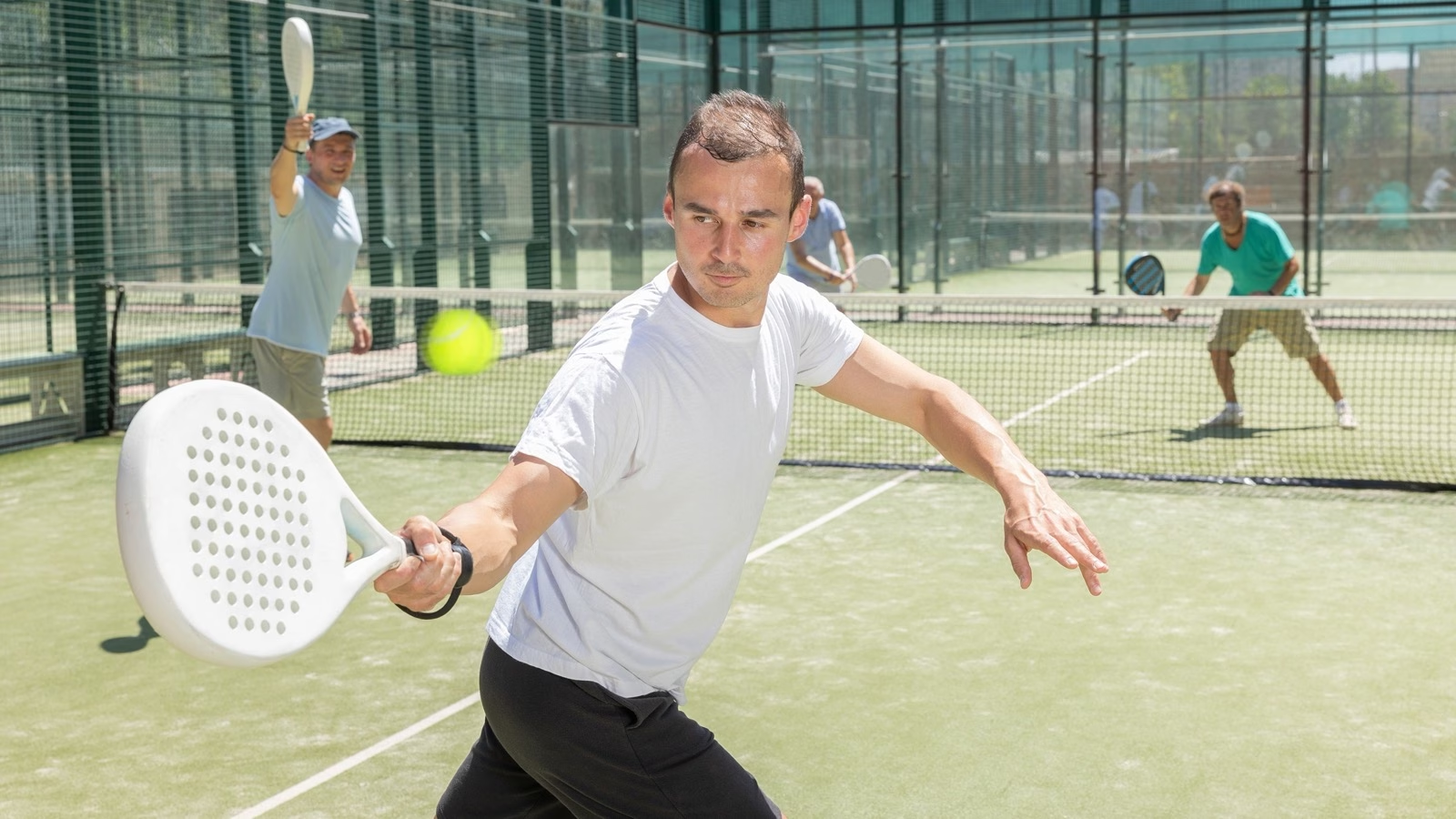
Padel is tennis played inside a glass box, and it’s one of the quickest racket sports to pick up. The serve is underarm, the court is about a third the size of a tennis court, and the walls keep the ball in play, so beginners get real rallies in their first hour. More than 90,000 Australians have already tried it.
Here’s what padel is, the rules you need, how it compares with pickleball and tennis, whether it’s a proper workout, and where to play in every Australian capital.
- What it is: a racket sport, usually doubles, on an enclosed court where the walls are part of the game
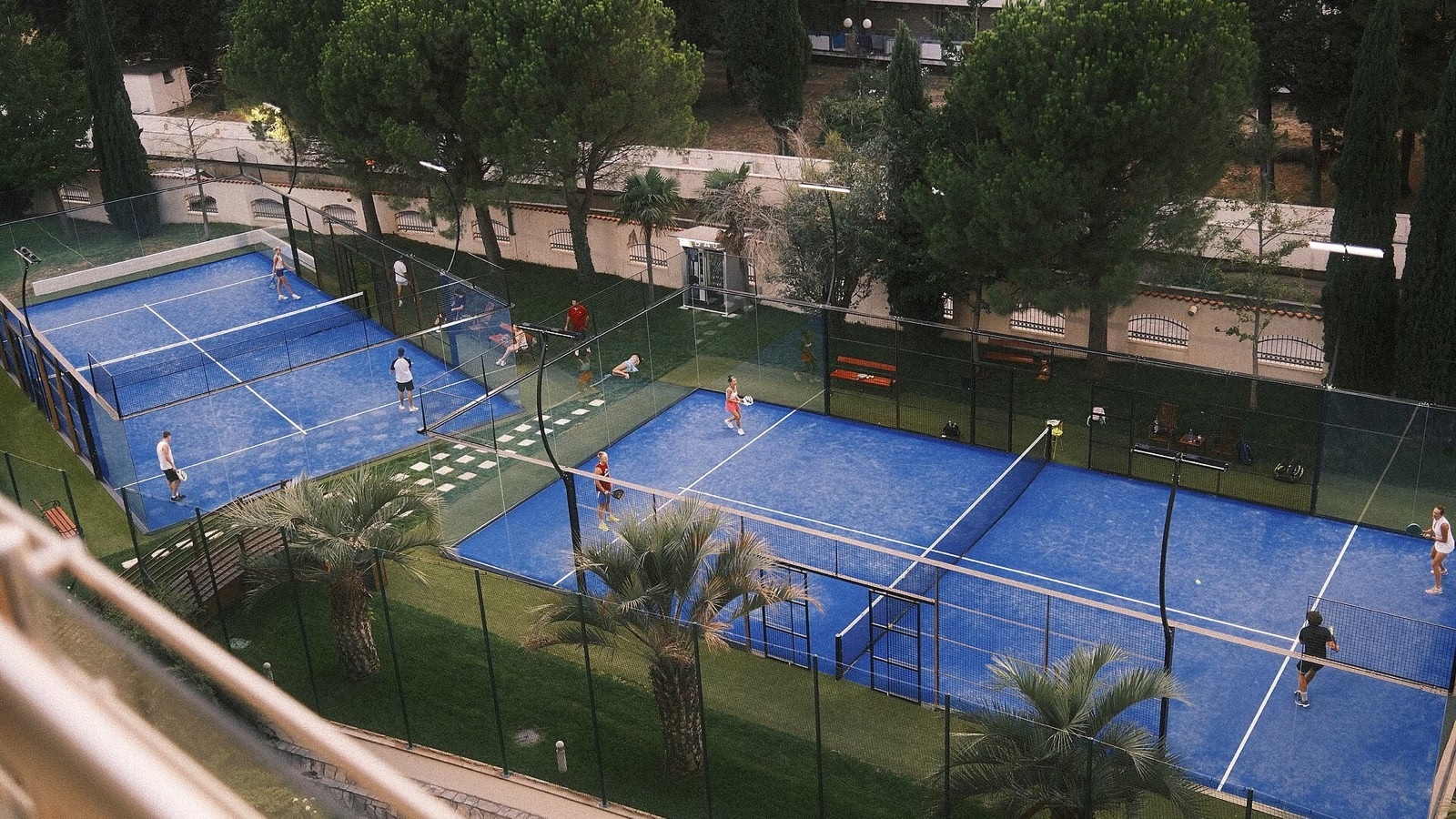
- Court: 20 m x 10 m, with 3 m walls at each end and mesh fencing up to 4 m
- Serve: underarm, after a bounce, hit at or below the waist
- Scoring: the same as tennis: 15, 30, 40, games and sets
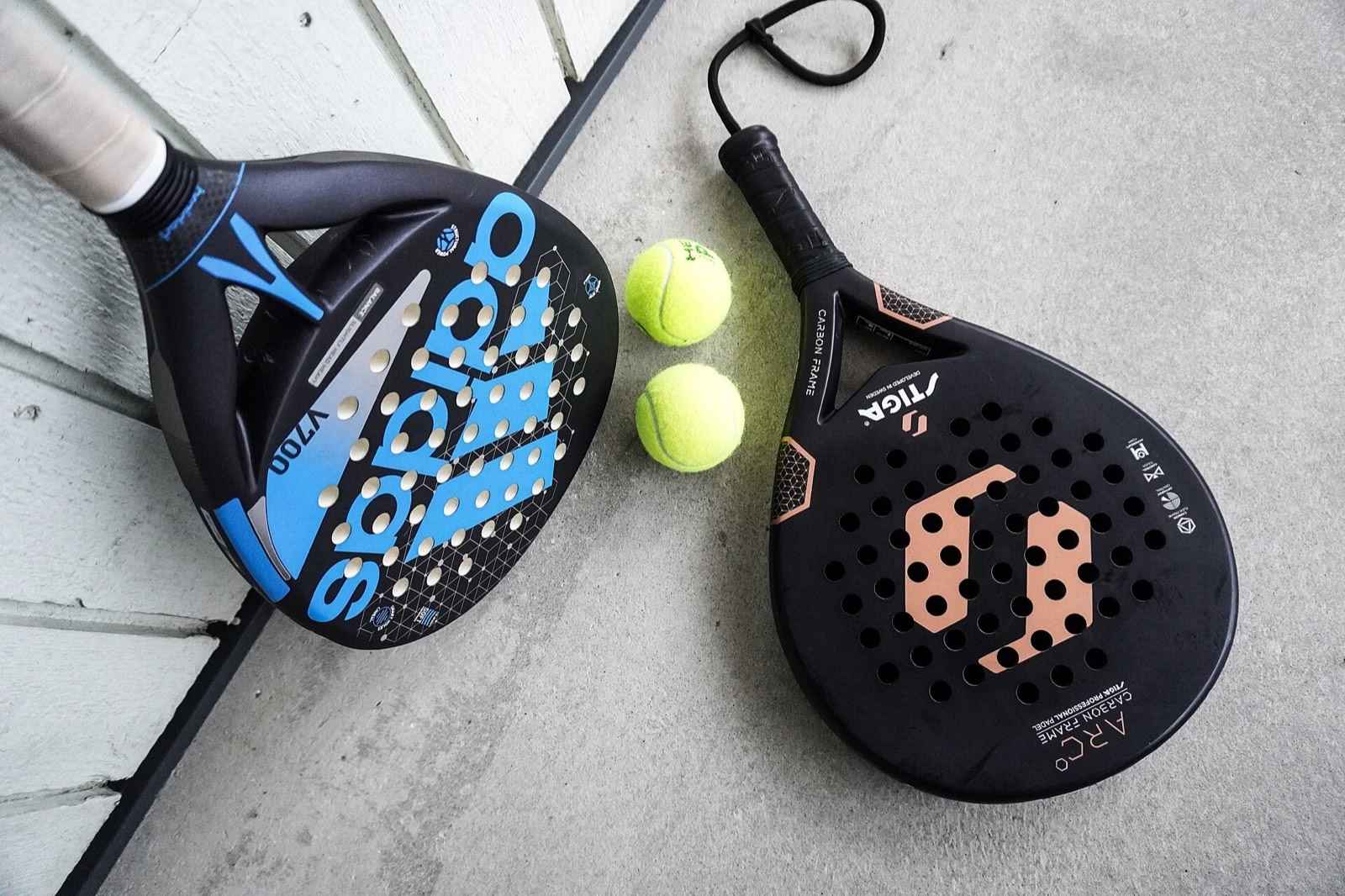
- Racket: solid, no strings, perforated with holes, no longer than 45.5 cm
- Ball: like a tennis ball, with slightly less pressure
- In Australia: 37 venues on Padel Australia’s court finder, in five states and the ACT
What is padel?
A mix of tennis and squash. Four players, two a side, hit a low-bounce ball over a net with solid rackets. The court is enclosed: glass walls at each end and mesh fencing along the sides. Once the ball has bounced on your side, you can play it off the glass, which keeps rallies going far longer than in tennis.
It’s spreading fast. The International Padel Federation’s 2026 World Padel Report puts it at more than 40 million players. In Australia, Padel Australia reported in December 2025 that more than 90,000 people had played, up 50% on the year before. Both are the sport’s own figures, so treat them as a direction of travel, not independent counts. In August 2026, Pat Rafter brought padel to the Sydney Opera House.
Padel rules: the basics
From the International Padel Federation rulebook (2026 edition) and Padel Australia:
- The serve: bounce the ball behind the service line and hit it underarm, at or below the waist. It goes diagonally into the opposite service box, like tennis, and you get two chances.
- A serve that hits the glass is good. One that hits the mesh is a fault. If it bounces in the box and then hits the fencing, it’s out.
- Let it bounce once: the receiver must let the serve bounce. After that, you can volley or play the ball off the bounce.
- The walls: after the ball bounces on your side, it can hit your walls or mesh and you can still return it. You can also hit your return off your own glass. Your shot must land in the opponents’ court before it touches their walls or mesh.
- You lose the point if the ball bounces twice on your side, you hit it into the net, or your shot hits the opponents’ wall or fence before their ground.
- Scoring: 15, 30, 40, game. Six games wins a set (by two), with a tie-break at 6-6, and matches are usually best of three sets. Many social games and some competitions use “golden point”: at 40-40, the next point wins the game.
Padel vs pickleball
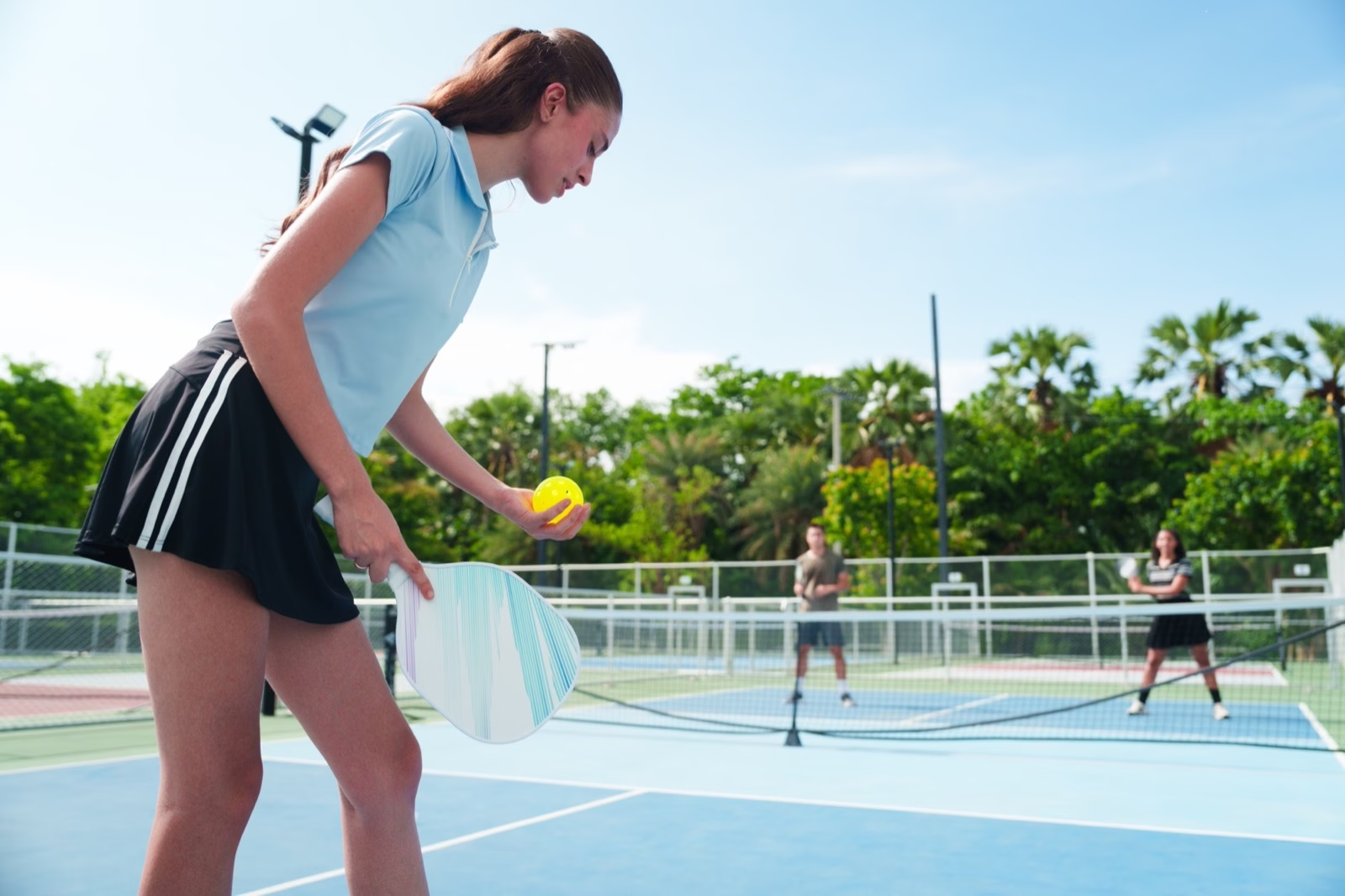
They’re the two fastest-rising racket sports, both mostly played as doubles, and they get mixed up all the time. The big difference is the walls: pickleball has none.
| Padel | Pickleball | |
|---|---|---|
| Court | 20 x 10 m | 44 x 20 ft (13.4 x 6.1 m) |
| Walls | Glass and mesh, in play | None |
| Ball | Low-pressure tennis-style ball | Light plastic ball with holes |
| Racket | Solid, perforated, max 45.5 cm | Flat paddle, no holes |
| Serve | Underarm, after a bounce | Underarm |
| Scoring | Like tennis | To 11, win by 2; only the serving side scores |
| Special rule | Play the ball off the walls | No volleying from the 7 ft “kitchen” by the net |
Our read: pickleball is the gentler game, all soft touch at the kitchen line. Padel is faster and more athletic, because the walls keep points alive and you’re always moving back for balls coming off the glass. If you want a workout, pick padel.
Padel vs tennis
Padel uses tennis scoring and a similar ball, but almost everything else makes it easier to start. The court is about a third the size of a tennis court, the serve is underarm, and the walls give you a second chance at balls that would be winners in tennis. Our read: a total beginner will rally in padel long before they would in tennis, and ex-tennis players pick it up fast, though most have to unlearn swinging at everything and learn to let the ball come off the glass.
Is padel a good workout?
Yes, at a decent level. A review of 13 studies covering 231 players found heart rates averaged around 70 to 80% of maximum during matches, with big differences between levels (Frontiers in Sports and Active Living). That’s solid aerobic work, with constant short sprints, stops and turns.
It won’t replace strength training, and a gentle social hit isn’t an interval session. But it’s an easy way to add an hour of hard movement that doesn’t feel like cardio. Warm up your shoulders and calves first: you’ll be lunging and twisting from the first point.
Where to play padel in Australia
These clubs are from Padel Australia’s court finder, checked 13 November 2026. New clubs open often, so check the finder for the latest. Hobart and Darwin had none listed.
Padel in Sydney
| Club (suburb) | Courts |
|---|---|
| Indoor Padel Sydney (Alexandria) | 18 (16 indoor) |
| Padel Club (North Rocks) | 6 indoor |
| Racqueteer (Lidcombe) | 6 indoor |
| Padel Spot (Minto) | 6 indoor |
| Play Nation (Smeaton Grange) | 6 indoor |
| Sidewall Social Padel Club (Marrickville) | 5 indoor |
| Tribe Padel Sydney (North Ryde) | 5 outdoor |
| Indoor Padel Northern Beaches (Cromer) | 4 indoor |
| Padel Point (Bankstown Aerodrome) | 4 indoor |
| Sydney Racquet Club (Moore Park) | 3 outdoor |
Padel in Melbourne
| Club (suburb) | Courts |
|---|---|
| Game4Padel (Port Melbourne) | 9 indoor |
| Game4Padel (Docklands) | 7 outdoor |
| Tribe Padel & Wellness (Bayside) | 7 indoor |
| Game4Padel (Richmond) | 6 outdoor |
| Colosso Brighton (Brighton East) | 6 outdoor |
| Nordic Padel (Tullamarine) | 5 indoor |
| Recess Padel Club (Port Melbourne) | 5 (4 indoor) |
| iPadel Reservoir (Reservoir) | 4 outdoor |
| South East Padel (Noble Park) | 3 outdoor |
| Colosso Westfield Southland (Cheltenham) | 3 outdoor |
Padel in Brisbane and Queensland
| Club (suburb) | Courts |
|---|---|
| Padel Brisbane (The Gap) | 4 outdoor |
| Padel Logan (Meadowbrook) | 4 outdoor |
| Padel Gold Coast at KDV (Carrara) | 6 outdoor |
| Racquet Club Gold Coast (Robina) | 4 outdoor |
| Ace Padel Clubs (Forest Glen, Sunshine Coast) | 4 indoor |
Padel in Perth
| Club (suburb) | Courts |
|---|---|
| Padel Crush (Wembley) | 4 outdoor |
| West Coast Padel (Dalkeith) | 3 outdoor |
| Padel Perth Reabold (Floreat) | 3 outdoor |
| Padel West (Melville) | 2 outdoor |
| Padel360 Cockburn (Yangebup) | Not listed |
Padel in Adelaide and Canberra
| Club (suburb) | Courts |
|---|---|
| Padel Fit (Thebarton, Adelaide) | 3 indoor, 1 outdoor |
| Voyager Playford (Elizabeth East, Adelaide) | 4 outdoor |
| Canberra Racquet Club (Fyshwick) | 6 indoor |
Padel FAQ
What is padel?
A racket sport, usually played as doubles, on a 20 x 10 m court enclosed by glass walls and mesh. It uses tennis scoring, an underarm serve and solid rackets, and you can play the ball off the walls.
Is padel the same as pickleball?
No. Pickleball has no walls, a smaller court, a plastic ball with holes and its own scoring to 11. Padel is played in a glass-walled box with a tennis-style ball and tennis scoring.
How big is a padel court?
20 m long and 10 m wide inside. The net is 88 cm high in the middle and 92 cm at the ends.
Is padel easier than tennis?
To start, yes. The smaller court, underarm serve and walls mean beginners rally quickly. Playing it well, reading the glass and working with a partner takes much longer.
Where can I play padel in Sydney, Melbourne, Brisbane or Perth?
See the club tables above, or Padel Australia’s court finder for the latest. Sydney’s biggest venue is Indoor Padel Sydney in Alexandria (18 courts), and Melbourne’s is Game4Padel in Port Melbourne (9 indoor courts).