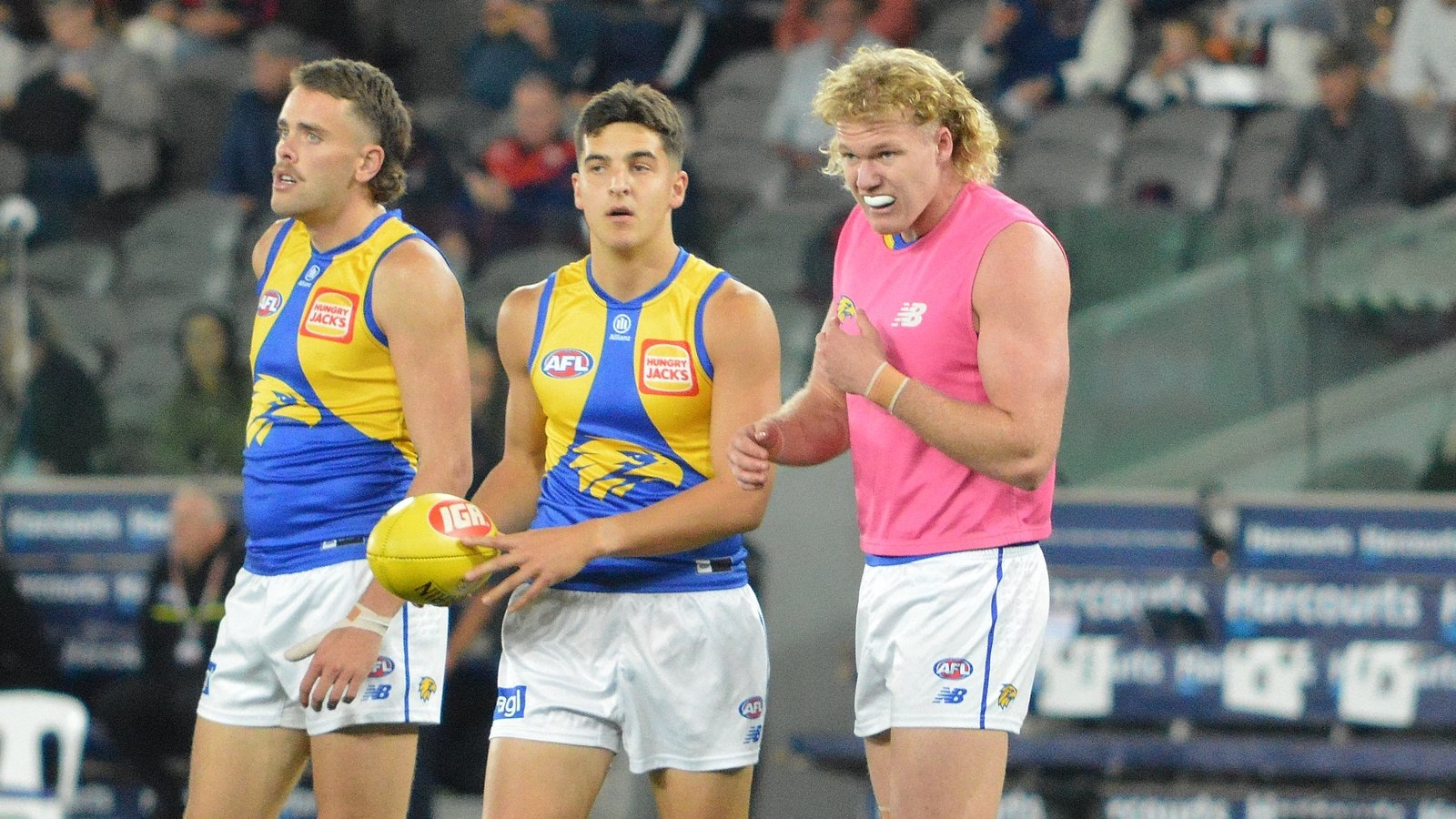

Could you run 200 metres flat out, then do it again on the next minute, 11 times? West Coast’s young players did it on day one of pre-season, and a photo of them on the turf afterwards started the AFL’s first fight of the summer. Here’s the test, what was said, and how to try it yourself.
- The test: 11 × 200 metres, one rep starting every minute
- Times: most players ran each 200m in 28 to 36 seconds, Reuben Ginbey said
- Rest: whatever is left of the minute: about 24 to 32 seconds (our maths)
- Who: West Coast’s first- to fourth-year players, Monday 9 November 2026
- The row: Brownlow Medallist Tom Mitchell called the photo “utterly embarrassing”; Ginbey said the players ran “a lot of PBs”
What happened at West Coast
The Eagles brought their first- to fourth-year players back on Monday for their first running test: 11 sprints over 200 metres. After the last one, the group dropped to the turf (AFL.com.au). A photo in The West Australian showed players crouched, on their hands and knees and on their backs (Zero Hanger).
Tom Mitchell, the 2018 Brownlow Medallist who played 207 games for Sydney, Hawthorn and Collingwood (AAP), posted a video on his Ball Magnets Instagram account. He called the image “utterly embarrassing” and “serious mental weakness”, and said: “There is no leadership there.” He said he’d done the same test, and that players can drop to their hands and knees but should “get straight up” (Zero Hanger).
A post shared by Ball Magnets and Tom Mitchell (@tommitchell6)
After the backlash he posted a follow-up to “clarify”. The best teams and players he played with, he wrote, “ALWAYS stayed on their feet after a maximal running test”, sometimes hunched over for a moment, but never down on their hands and knees or on their backs. “You would think just ONE player in the Eagles image would be standing to set a standard?” He predicted fewer players would be on the ground after the next test, which he said would show it’s mental (Ball Magnets).
What Reuben Ginbey said
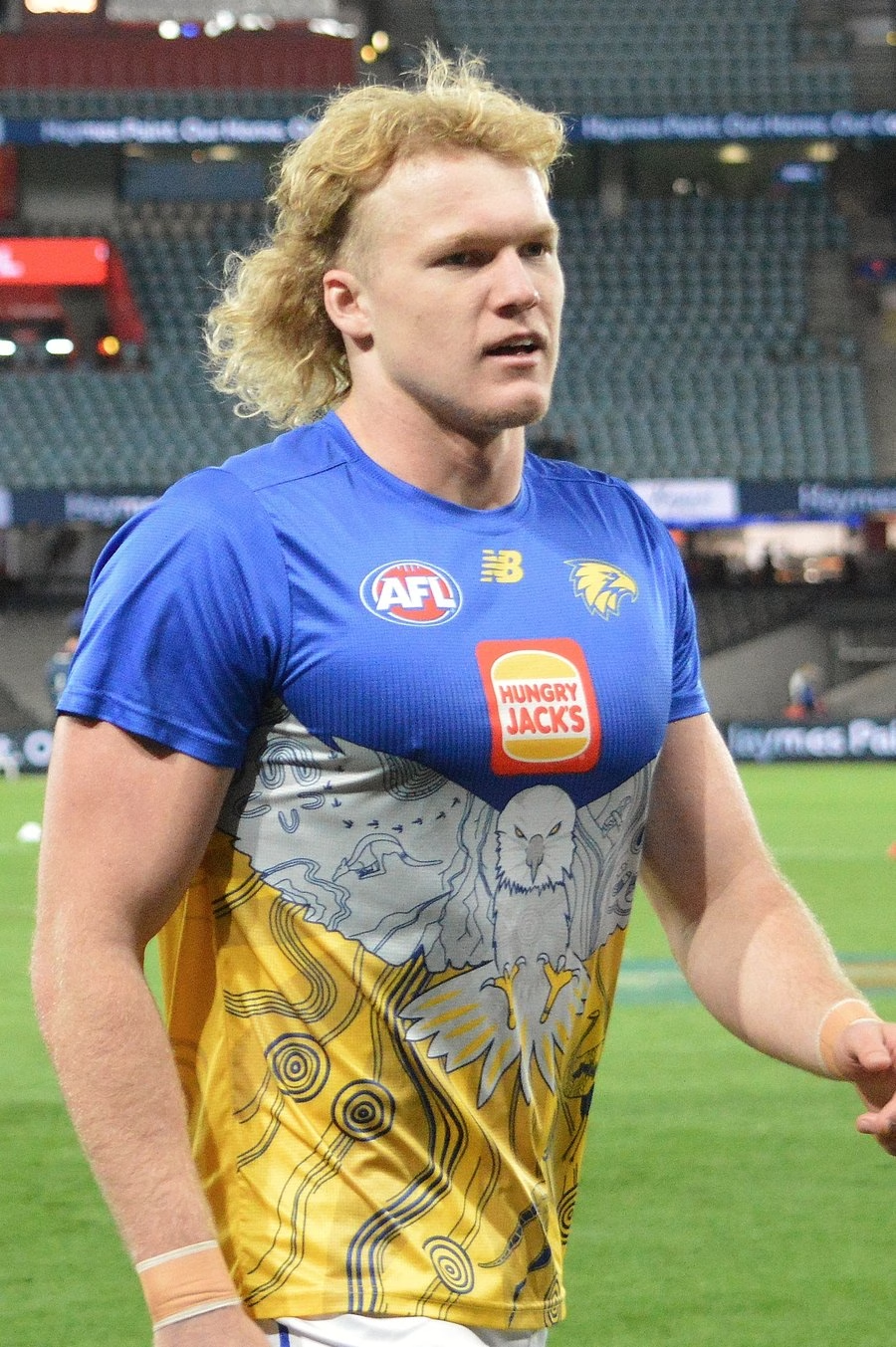
Ginbey is in West Coast’s leadership group and ran the test himself. “If that was a drill it would be a valid point, but that’s a time trial. You only do two of them a year,” he told SEN WA Breakfast. “I ran that test and I was down on my hands and knees for about 5-10 seconds. I think the boys ran great, a lot of PBs, and pretty much everyone hit their times in a hard test” (SEN).
He also set out the format: “This is 11x200m on the one minute… Boys do it between 28 and 36 seconds.” And: “I’d be disappointed in the boys if they run their hearts out and they’re all standing up” (Zero Hanger). Elsewhere he put it more bluntly: “Most people in their life have never run until they can’t stand or spew. I want to see the boys run until they drop” (AFL.com.au).
Former Melbourne player Jack Grimes backed him on SEN. His era’s hardest session at Melbourne was five 300-metre sprints on a five-minute clock. “If you’re doing a maximal anaerobic test like that and you’re walking around giving high fives straight afterwards, then you haven’t gone hard enough,” he said (SEN).
Our read: toughness or a test done properly?
Our read is that Ginbey’s right. A time trial is meant to be maximal. With reps of 28 to 36 seconds on a one-minute clock, the rest is about as long as the work, so the fatigue piles up rep after rep. If a player can stroll off after rep 11, they’ve left something out there, which is Grimes’s point.
Mitchell has a fair point that standards matter, and his prediction is testable: watch the next test. But his point about body language belongs to match day, when the opposition is watching. On day one of pre-season, in a time trial the players do only twice a year, the number on the watch is what counts. Ten seconds on the grass after the last rep doesn’t tell you much about a player’s mind. A slow last rep would.
How to try the 11 × 200m test
You don’t need an AFL club. You need a track or a flat 200m stretch, a stopwatch and a mate to call the minute. This is how we’d run it, based on the format Ginbey described.
- Warm up properly: 10 to 15 minutes of easy running, drills and three or four build-up strides. Don’t sprint cold
- Measure 200m: half a lap of a 400m track is the easiest way
- Start a rep every 60 seconds. Your rest is whatever is left of the minute
- Write down every time. Your score is how close your slowest rep is to your fastest
- Not ready for 11? Start with six reps, or one every 90 seconds, and build up
- Cool down with 10 minutes of easy jogging or walking
| Your 200m time | Rest before the next rep |
|---|---|
| 28 seconds | 32 seconds |
| 32 seconds | 28 seconds |
| 36 seconds | 24 seconds |
| 45 seconds | 15 seconds: try every 90 seconds instead |
It’s a maximal test. If you’re new to sprinting, older, or have a heart condition, talk to your doctor first. Feeling wrecked for a few minutes is normal. Muscle pain far worse than normal soreness, or dark urine in the days after, isn’t: read our guide to the warning signs of rhabdo.
How it compares with other running tests
The beep test measures how long you can keep going as the pace climbs. The 200m test is about holding speed while you tire. At the other end of the scale, the Norwegian 4×4 workout uses four-minute efforts at about 90% of your maximum heart rate to build the engine underneath. For more on what the body can take, see how far the human body can go.
West Coast 200m test FAQ
What is West Coast’s 200m running test?
Eleven 200-metre sprints, with a new rep starting every minute. Reuben Ginbey said the players ran each one in 28 to 36 seconds, and that it’s a time trial they do twice a year.
Why did Tom Mitchell criticise the Eagles?
He said a photo of players on the ground after the test showed “serious mental weakness” and no leadership, and that players should get straight back up.
Is it normal to collapse after a sprint test?
After a maximal repeat-sprint test, a few seconds on your hands and knees is common. Players and former players including Ginbey and Jack Grimes said it shows the test was done properly.
How fast is a good 200m rep?
West Coast’s players ran 28 to 36 seconds. For most gym-goers, holding the same time from the first rep to the 11th is a better goal than a fast first one.
Sources: AFL.com.au; AAP; Zero Hanger, 9 November; Zero Hanger, 11 November; SEN, 10 November. Images: DustyNail and DustyNail, Wikimedia Commons, CC BY-SA 4.0. Checked 12 November 2026.