Human beings are astonishing creatures. We can run for days, swim through cold seas, climb mountains without bottled oxygen and endure levels of physical punishment that seem almost impossible to understand. And we keep getting better at it.
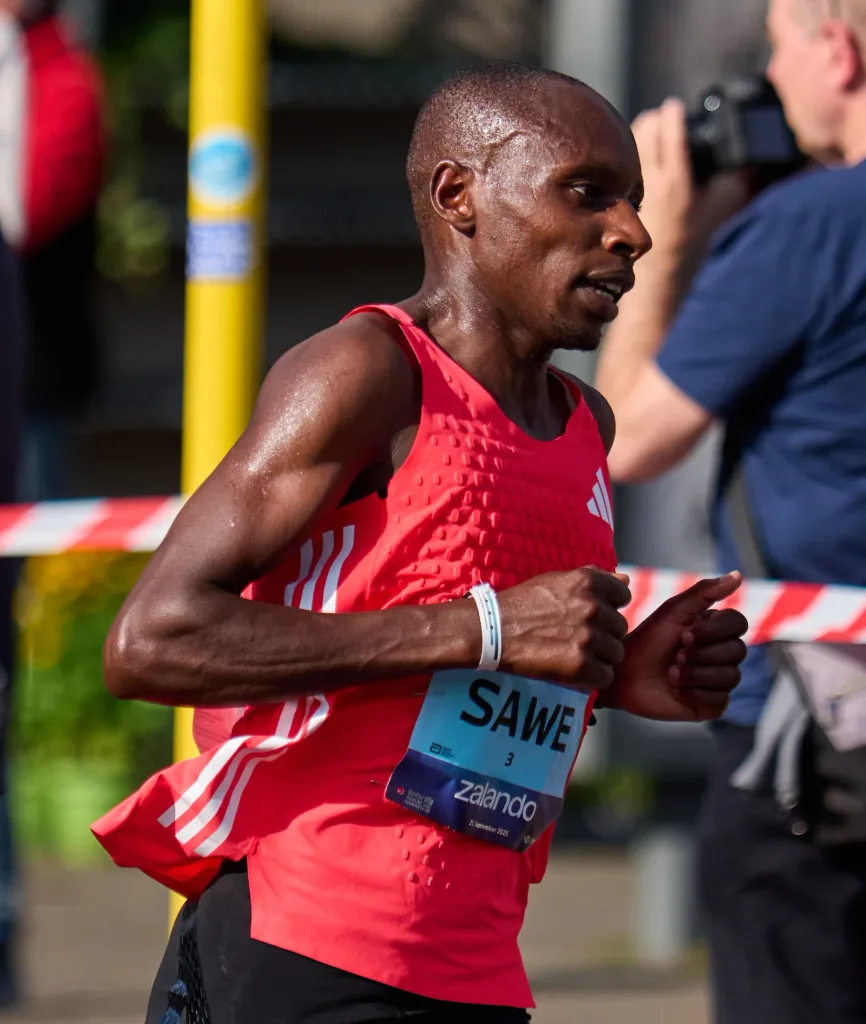
In April 2026, Kenya’s Sabastian Sawe won the London Marathon in 1:59:30, the first man to run under two hours in a record-eligible marathon (AP). A barrier that once seemed beyond human capability had fallen, and Ethiopia’s Yomif Kejelcha went under it too, 11 seconds behind him.
But speed is only part of the story. In Queensland in 2025, Phil Gore kept running for 119 hours: almost five days, 798 km, with only minutes between laps to eat or sleep. This October, two Belgians went five hours further. In the English Channel, the American Sarah Thomas swam for more than 54 hours to make four crossings without stopping.
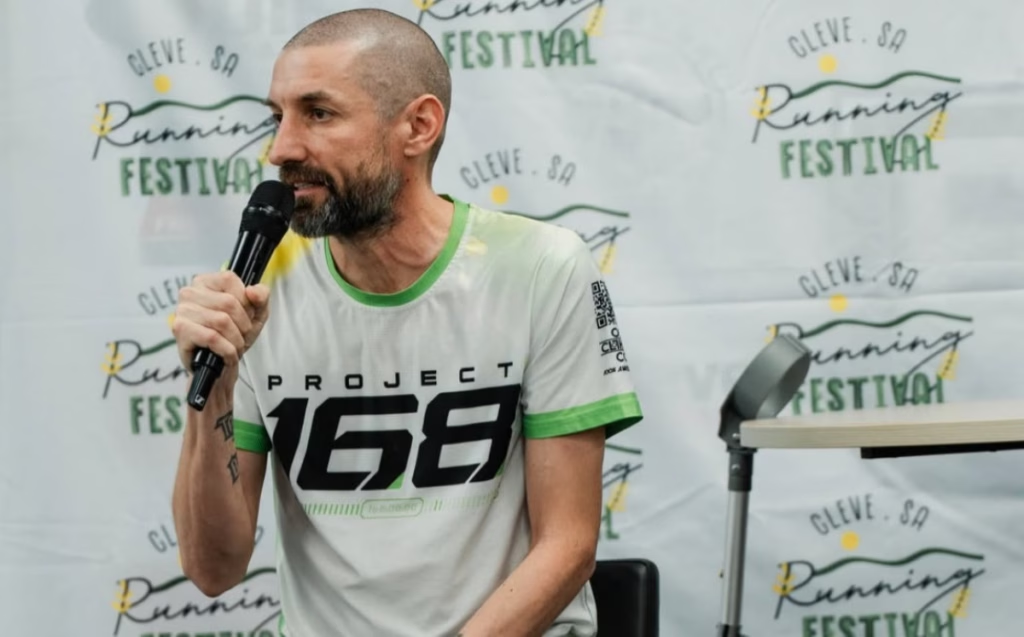
These aren’t just demonstrations of fitness. They’re experiments in what the body can endure, and under every one is a biological struggle. Muscles break down. Energy stores run low. The gut rebels. A brain starved of sleep starts seeing things. In heat, the body’s cooling can fail; in cold water, the fight is to hold core temperature long enough to survive. Sometimes the determination that lets an athlete do the extraordinary is the thing that puts them in danger. Over a sprint, a horse wins; over a long run in the heat, sometimes we do: see are you as fit as a racehorse?
So where is the limit? Muscles, heart, brain, fuel, or the willingness to keep going? The answer from the scientists who study these extremes is that there isn’t one limit. There are several, and which one gets you first depends on what you’re asking your body to do. This is the story of those limits and the athletes who test them.
- Time on your feet: 124 hours without a finish line (two Belgians, 2026, awaiting confirmation)
- Muscle: breakdown is normal; when it floods the blood, the kidneys are at risk
- Cold: the first minutes kill more than hypothermia does
- Heat: above about 40°C with confusion, it’s an emergency that cooling fixes, not drinking
- Sleep: days without it can bring hallucinations
- Fuel: about 2.5 times your resting energy burn, held for months, is near the ceiling
- Water: too much can be as dangerous as too little
- Oxygen: Everest’s summit has about a third of the oxygen at sea level
1. How long can humans keep moving?
The answer keeps changing. Lithuania’s Aleksandr Sorokin ran 319.614 km in 24 hours in Verona in 2022, the world record recognised by the sport’s governing body (IAU): about 4:30 per kilometre, held for a whole day. At the Self-Transcendence 3100 Mile Race in New York, run around a single 883 m city block, Finland’s Ashprihanal Aalto covered 4,989 km in 40 days and 9 hours in 2015, averaging almost 124 km a day (race organiser).
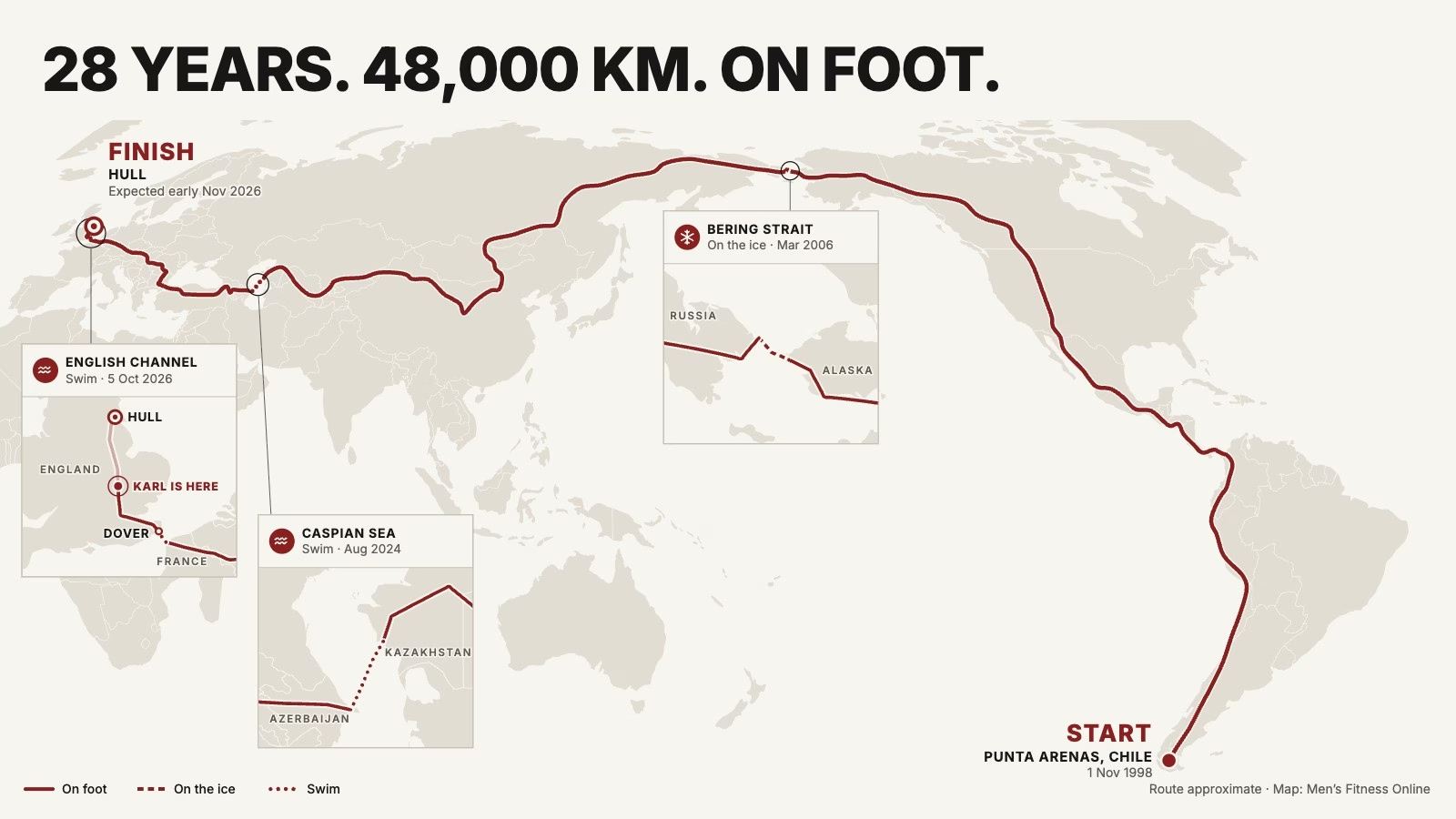
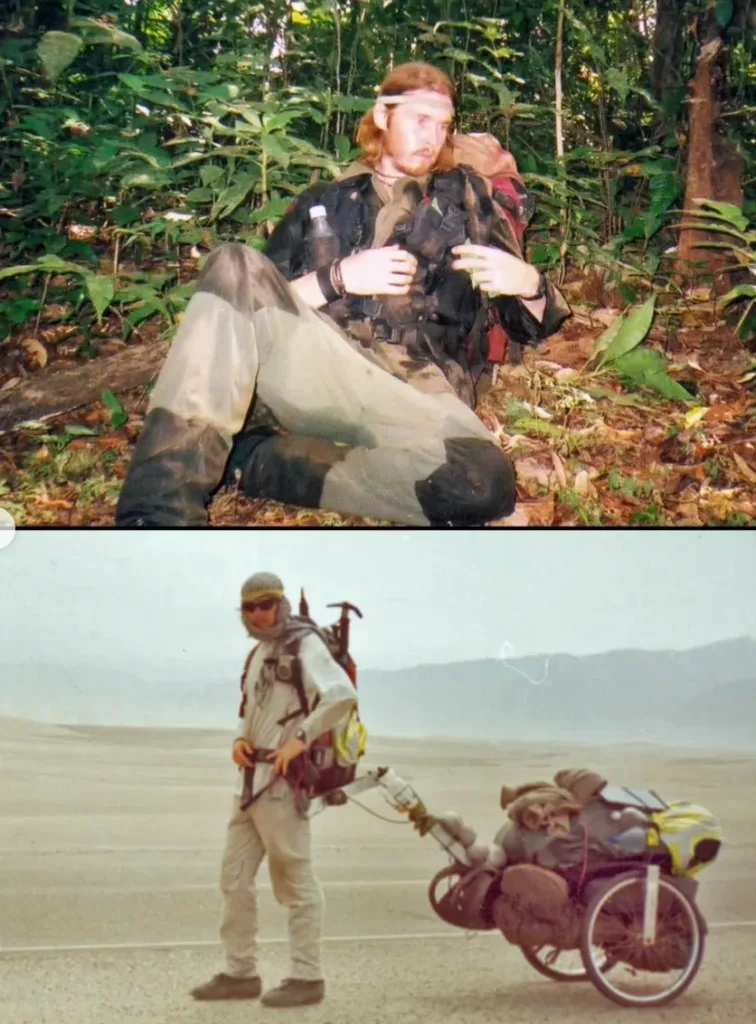
Measured in years, nobody has gone further than Karl Bushby. The former British paratrooper walked out of Punta Arenas, at the southern tip of Chile, on 1 November 1998, heading home to Hull on foot with one rule: no transport to move forward. Nearly 28 years and about 30,000 miles later, he is almost there.
The backyard ultra strips the question back furthest. Runners start a 6.7 km loop every hour, on the hour, until one is left, so there’s no distance to aim for. Gore’s 119, set at Dead Cow Gully in June 2025, is the last ratified world record. At the 2026 World Team Championships in October, Belgium’s Merijn Geerts and Ivo Steyaert ran 124 together, about 831 km, before both stopped on yard 125. That run is awaiting confirmation.
Final, 24 October 2026. The Backyard Ultra World Team Championships are over. Belgium’s Merijn Geerts and Ivo Steyaert ran 124 yards side by side at Retie, about 831 km in 124 hours, five more than Phil Gore’s world record of 119. Both stopped on yard 125, so neither won, and the run is awaiting official confirmation as a record.
The USA won the team title with 1,120 yards, ahead of Australia (1,069), Belgium (1,058) and Japan (1,038), whose Kazuhiro Kawahata won Japan’s race on 105, one short of his national record. Where the record stands · Full results.
What makes this possible is pace. Long-distance athletes run slowly enough that most of their energy comes from fat, which even a lean runner carries in vast amounts, rather than the limited glycogen stored in muscle and liver. Muscle damage builds up hour by hour, but at a low enough rate to keep going.
What stops them: rarely one dramatic failure. Our read, from watching backyard ultras unfold, is that it’s an accumulation: sleep, feet, stomach, and the hourly decision to stand on the start line again.
2. When your muscles start destroying themselves
Some muscle breakdown is normal. Hard exercise damages muscle fibres, the body repairs them, and that repair is how you adapt (Patel et al., 2009). Exertional rhabdomyolysis is when the damage goes too far: muscle cells break open and spill their contents, including the protein myoglobin and the enzyme creatine kinase (CK), into the blood. Filtered through the kidneys, large amounts of myoglobin can injure them.
It’s well documented in athletes and military recruits, but it can happen to anyone doing exercise they’re not used to (Scalco et al., 2016). Heat, humidity and sickle cell trait raise the risk. A 2026 study of 136 people treated in Oslo emergency departments found most cases followed strength training, not endurance events: 78% (Vangstad et al., 2026). That’s why it turns up after high-intensity gym classes, first sessions back and punishing workouts as well as ultras.
Keep it in proportion. Most cases are mild and resolve without lasting harm (Patel). In the Oslo study, 5 of the 136 (4%) developed acute kidney injury, and nobody whose kidney blood test was normal on arrival did. Repeated episodes are a reason to look for an underlying muscle disorder (Scalco).
What stops them: pain, if they’re lucky. The classic signs are severe muscle pain, weakness or swelling and dark, cola-coloured urine. Any of those after exercise needs medical assessment the same day.
- Severe muscle pain, weakness or swelling, or dark, cola-coloured urine after exercise: get medical help the same day.
- Confusion, collapse or odd behaviour in someone exercising in the heat: call 000 and cool them immediately, ideally in cold water.
- Someone pulled from cold water: keep them lying flat and get help, even if they seem fine.
3. How much cold can a human survive?
Sarah Thomas’s four-way Channel swim in September 2019 took 54 hours and 10 minutes, under Channel Swimming and Piloting Federation rules: costume, cap and goggles, no wetsuit. Tides stretched it to about 130 miles (209 km) of swimming (Guinness World Records). She had finished breast cancer treatment the year before.
Cold water attacks in stages (our guide, from Royal Life Saving Australia and the US National Center for Cold Water Safety). In the first one to four minutes comes cold shock: an involuntary gasp, runaway breathing and a spike in heart rate. Over the next 30 minutes or so the hands, arms and legs stop working, which is why strong swimmers drown. Hypothermia, a core temperature below 35°C, usually comes last. Even after rescue, the core can keep cooling.
Those stages explain one of the most remarkable cold-water survivals on record. Just after 10pm on 11 March 1984, the fishing boat Hellisey capsized off Heimaey, in Iceland’s Westman Islands, so fast the crew couldn’t send a distress call. Two of the five men never surfaced. The other three clung to the upturned keel, soaked, in air below freezing, then decided to swim for shore through 5–6°C water. Within 10 minutes, two of them were gone.
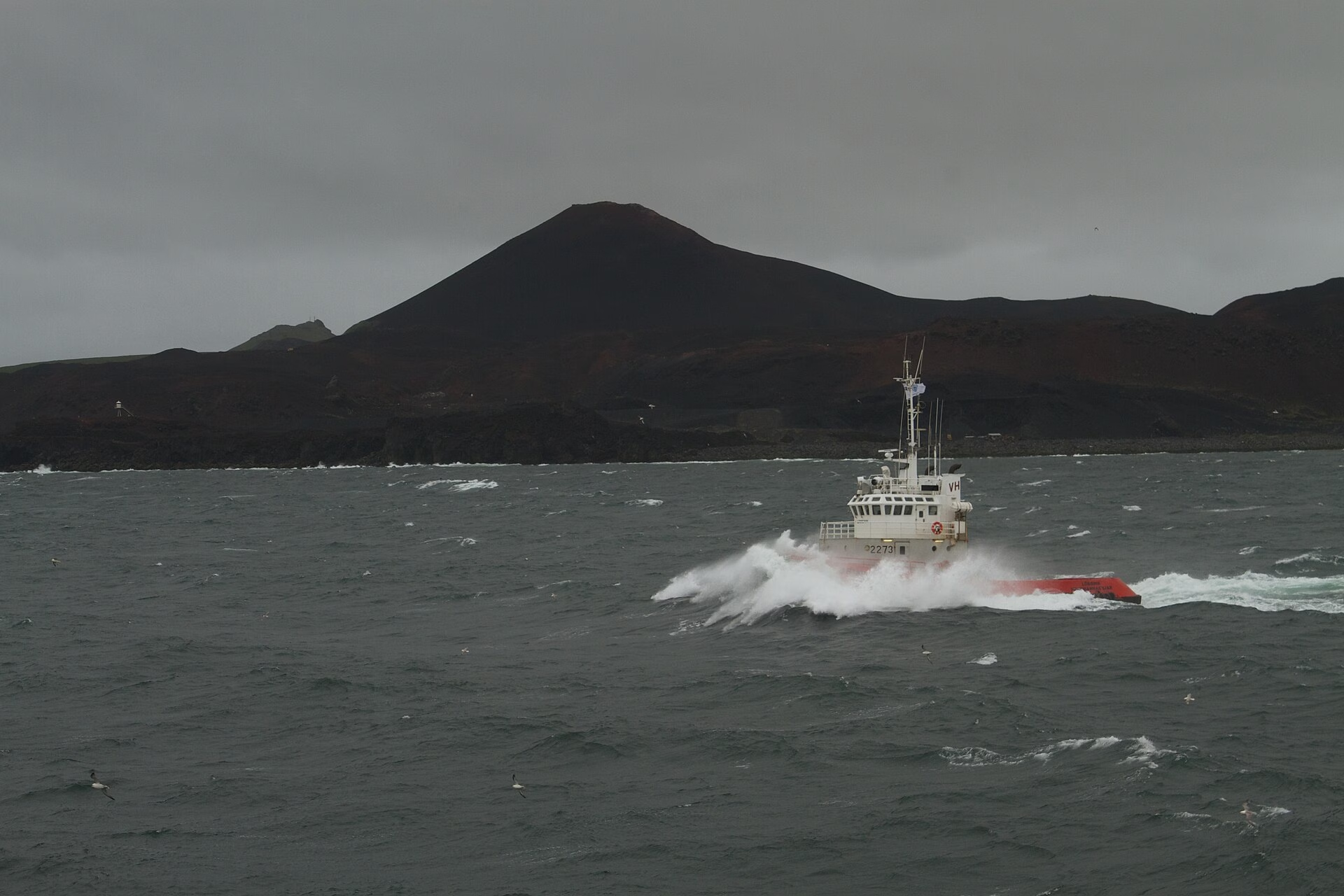
Guðlaugur Friðþórsson, 23, kept swimming for about six hours in a shirt, sweater and jeans, steering by a lighthouse. When cliffs blocked his first landing, he went back into the sea to find another. Then he walked barefoot across lava and snow and knocked on a door at about 7am. Hospital treated him for cuts and dehydration; he showed almost no sign of hypothermia (BBC Future).
Two things set him apart. He controlled the gasp of cold shock that likely drowned his crewmates, and said he stayed clear-headed the whole way. And he was built for it: about 125 kg, with a layer of fat around 2.5 cm thick over his abdomen, both insulation and fuel. Tests in London in 1985 found he had exceptional resistance to cold (Keatinge et al., 1986). “A man in the cold is not necessarily a cold man,” Mike Tipton, a physiologist at the University of Portsmouth, told BBC Future. Working hard, he said, the body produces heat like a 2 kW heater. Stop moving and the heater goes off.
That’s the difference between tolerating cold and surviving it. Channel swimmers train for years to blunt cold shock and to keep their arms moving in water most people couldn’t swim in for an hour. What training can’t do is stop the core from cooling once heat loss outruns heat production.
Getting out isn’t the end of it. Wet clothes in cold air keep stripping heat as the water evaporates, which is why Tipton’s team at Portsmouth recommends a cheap plastic survival bag over a foil space blanket: the bag holds the water in, so the body warms it instead of losing heat to evaporation.
What stops them: the hands and arms going, then the core temperature. On a long swim, crews watch for slurred speech and a slowing stroke as early warning.
4. How much heat can a human withstand?
Badwater 135 runs 135 miles from Badwater Basin in Death Valley, the lowest point in North America, to Whitney Portal, in mid-July. In 2024 daytime temperatures reached 120°F (48.8°C), and nights stayed above 100°F (AP). Its race director says nobody has died in it.
Exercise makes heat; the body sheds it by sweating and sending blood to the skin. When it can’t shed it fast enough, core temperature climbs. Exertional heat stroke is when it passes about 40°C and the brain is affected: confusion, collapse, aggression, odd behaviour (UK Faculty of Pre-Hospital Care consensus). It’s one of the most common causes of sudden death in athletes, and when cooling is delayed beyond 30 minutes, organ damage and death rise sharply (Belval et al., 2018).
That’s why the rule is to cool first and transport second. The treatment is getting the temperature down on the spot, ideally by immersing the person up to the neck in cold water. Drinking more water isn’t a cure: fluids don’t cool the core fast enough, and the consensus doesn’t recommend even cold intravenous fluids as a way to cool.
What stops them: the cooling system falling behind. Acclimatising to heat helps the body cope, but no amount of toughness raises the temperature at which the brain starts to fail.
5. What happens when the brain runs out of sleep?
In the 2018 Run Across Taiwan Ultra-Marathon, 246 km with a 44-hour cut-off, researchers followed eight runners. None slept more than 30 minutes during the race, and three of the eight reported visual hallucinations in the last 60 km (Huang et al., 2021). It’s a tiny study, so it says more about what can happen than how often.
A 2018 review of 21 sleep-deprivation studies, covering 760 people, found perceptual changes were almost universal, and that hallucinations and disordered thinking became more likely the longer people stayed awake (Waters et al., 2018). Ultrarunners describe similar experiences in the small hours of long races. At the Barkley Marathons, runners have 60 hours for five loops and the clock keeps running while they rest. In a backyard ultra, the gaps between laps are short enough that every hour of sleep is fought for in minutes.
What stops them: judgement, before legs. A runner who has lost track of where they are is a danger to themselves, on a mountain trail or a road.
6. Can you eat enough to keep going?
In 2019 a team led by Herman Pontzer and John Speakman looked at events from the Tour de France to polar expeditions and a five-month run across the United States. Over weeks and months, nobody sustained much more than about 2.5 times their basal metabolic rate, the energy the body burns at rest (Thurber et al., 2019). The trans-America runners burned about 600 calories a day fewer than predicted: their bodies had turned the dial down (Duke University).
Their explanation is the gut: beyond that level it can’t absorb enough food, so the body draws on its reserves. In 2025 the same group measured 14 elite ultra-endurance athletes for a year. The averages held, at 2.43 times over 30 weeks and 2.39 over 52, but four athletes went past 2.5, one reaching 2.74 (Best et al., 2025). The authors’ conclusion: exceeding the ceiling is possible, and rare.
In a single race the problem is more immediate. Athletes can burn several times their resting rate for a day or two, far more than they can eat, and the stomach often refuses food when it’s needed most.
What stops them: the gut, over weeks. Over a race, it’s usually the gut too: nausea and an inability to eat end more ultras than tired legs.
7. When drinking becomes dangerous
For years, endurance athletes were told to drink before they felt thirsty. At the 2002 Boston Marathon, researchers tested 488 finishers: 13% had low blood sodium, and 0.6% had critically low levels. The biggest risk factors were gaining weight during the race, which means drinking more than they lost, taking over four hours and being very light or heavy (Almond et al., 2005).
Exercise-associated hyponatraemia dilutes the blood’s sodium until the brain swells, causing confusion, seizures and, rarely, death. The current international consensus advice is simple: drink to thirst (Hew-Butler et al., 2015). It’s the clearest example of a sensible endurance strategy, taken too far, becoming the danger.
What stops them: well-meant overdrinking, mostly among slower, non-elite runners who are out longest.
8. How little oxygen can humans survive on?
Reinhold Messner and Peter Habeler first climbed Everest without bottled oxygen on 8 May 1978 (Guinness World Records). At the summit, each breath carries about a third of the oxygen it would at sea level. In 2009, researchers took blood from climbers at 8,400 m: the mean oxygen pressure in their arteries was 24.6 mmHg, against a typical sea-level value of around 90 to 100 (Grocott et al., 2009).
Acclimatising over weeks lets the body cope: faster breathing, more red blood cells. Climb too fast and fluid can leak into the brain or lungs. High-altitude cerebral oedema brings confusion and loss of coordination; pulmonary oedema brings breathlessness at rest and a cough. For both, the main treatment is to go down (Wilderness Medical Society guidelines, AAFP).
What stops them: oxygen, with the brain the first to suffer. Above 8,000 m, climbers aren’t adapting; they’re running out of time.
So what is the ultimate limit of human endurance?
Perhaps the most extraordinary thing is that we still don’t know exactly where it lies. We know muscles can fail, body temperature can become lethal, the brain can lose its grip on reality and the gut can struggle to supply enough energy to keep us moving. We also know that training, adaptation, experience and determination let people work at levels that would overwhelm most of us.
But there’s a difference between what the body can tolerate and what it can survive. The two aren’t interchangeable, and no amount of mental toughness makes anyone immune to physiology. Human endurance has many limits, and no single event tests all of them: the swimmer, the climber and the backyard runner are each finding a different one.
Every record tells us something about what the body can do. Every athlete who goes past their limits tells us something else. Somewhere between those two stories is the answer to one of sport’s best questions: just how far can we go?
What’s next
- Backyard Ultra World Team Championships 2026: full results; in Japanese, 日本代表の速報.
- Australian backyard ultras: the calendar, including Dead Cow Gully, where the world record was set.
- Big’s Backyard Ultra, the individual world championship: Tennessee, October 2027.
Human endurance: FAQ
What is the longest race in the world?
The Self-Transcendence 3100 Mile Race in New York, about 4,989 km around one city block, with a 52-day limit. The record is 40 days, 9 hours and 6 minutes, set by Ashprihanal Aalto in 2015.
How far can a human run in 24 hours?
The world record is 319.614 km, set by Aleksandr Sorokin in Verona in 2022.
Is there a limit to human endurance?
Over weeks and months, research suggests people can’t sustain much more than about 2.5 times their resting energy use, probably because the gut can’t absorb more food. A 2025 study found a few elite athletes slightly above it. In shorter events, heat, cold, sleep and muscle damage usually set the limit first.
What is rhabdomyolysis?
Severe muscle breakdown that releases myoglobin and other contents into the blood, which can damage the kidneys. Warning signs after exercise are severe pain, weakness, swelling and dark urine: get medical help the same day.
Can you drink too much water during a marathon?
Yes. Drinking more than you sweat can dilute blood sodium (hyponatraemia). In a 2002 Boston Marathon study, 13% of finishers tested had low sodium. Current advice is to drink to thirst.
This article is general information, not medical advice. Update log: 24 October 2026, first published.