
Running 6.7 km under an hour is not particularly intimidating. The problem is you have to do it again an hour later. Then again. Then again. At 2am. At 4am. Tomorrow afternoon. Tomorrow night.
Finish each loop with 20 minutes to spare and you get 20 minutes to eat, change socks, sit down, maybe close your eyes. Then the bell goes and you start another 6.7 km. Miss the start, fail to finish inside the hour or simply decide you’ve had enough, and your race is over.
There is no finish line waiting 50 km down the road. There isn’t even a finishing time. The race continues until everybody but one person has stopped.
And here’s the particularly cruel bit: only that final runner is officially a finisher. Everyone else gets a DNF.
Welcome to the backyard ultra, a wonderfully perverse form of endurance racing that has spread around the world, and one in which Australia has become remarkably good.
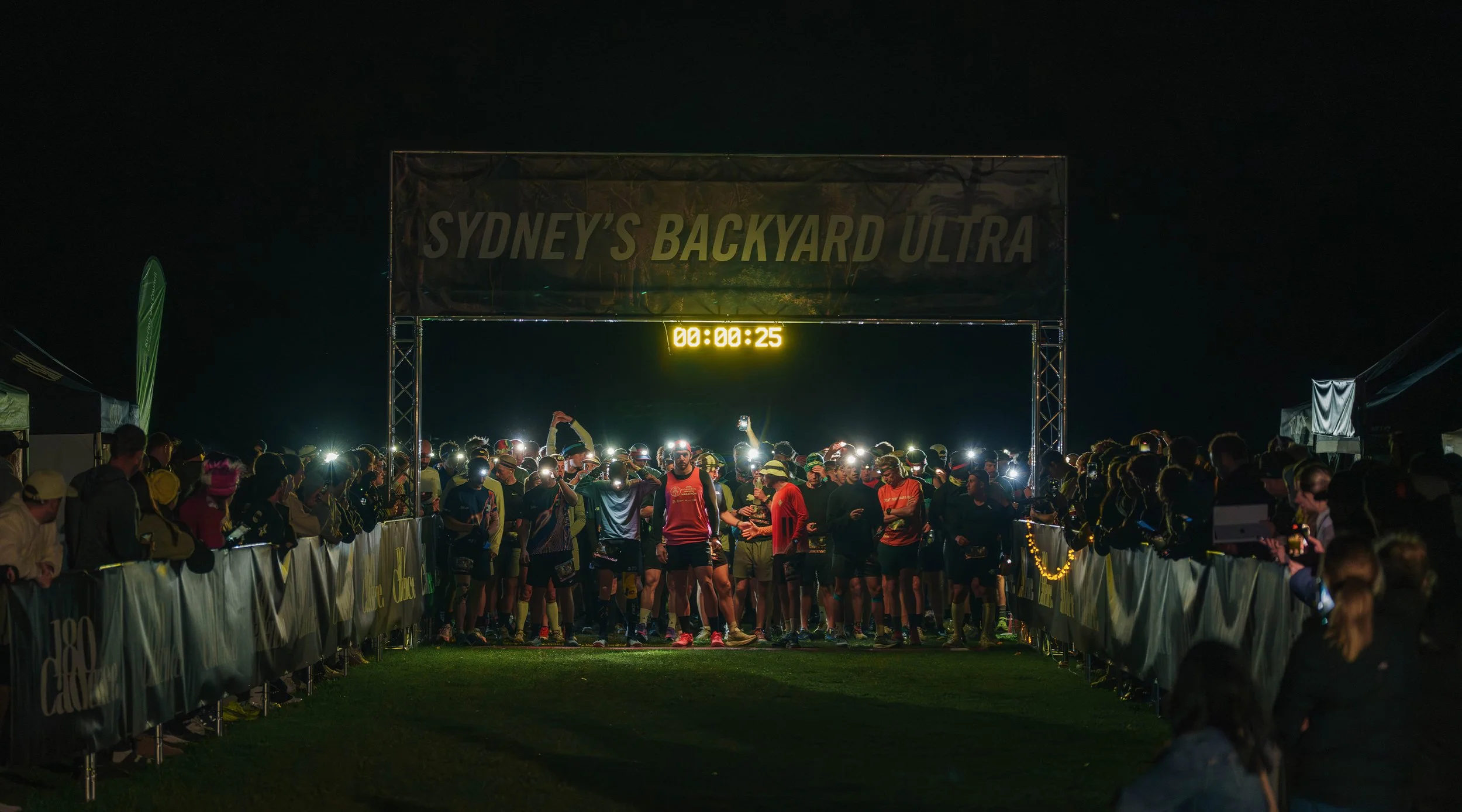
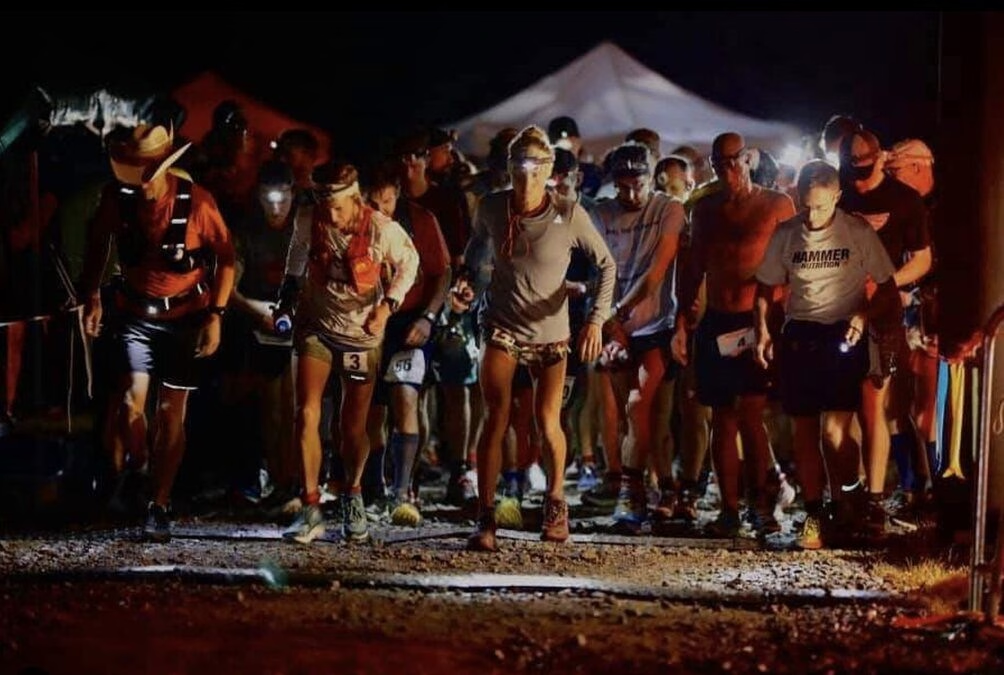
A backyard ultra is a last-one-standing running race. Runners start a 6.7 km loop, called a yard, every hour on the hour, and must finish it inside the hour to start the next. The race continues until one runner is left, who must complete one more yard alone to win. Everyone else is recorded as a DNF. 24 yards is exactly 100 miles (161 km). The world record is 119 yards (798 km), by Australia’s Phil Gore in 2025.
WTF is a backyard ultra?
The format, per the official Big’s Backyard Ultra rules, is almost insultingly simple. Runners complete a 6.7056 km loop — a “yard” — and every yard starts exactly one hour after the last one. You have to finish inside that hour. Whatever’s left over is your recovery time, and you’d better spend it well, because you need to be back in the starting corral, on your feet, when the bell goes again. Warnings sound at three, two and one minute out. There are no late starts.
Fail to complete a yard, or fail to front up for the next one, and you’re eliminated. There’s no predetermined finishing distance and no predetermined finishing time — the race simply continues until one person remains. That person then has to complete one more yard, alone, to be declared the winner. Everybody else, officially, records a DNF — including whoever ran second-longest. If the last person standing can’t finish that final yard either, there’s no winner at all.
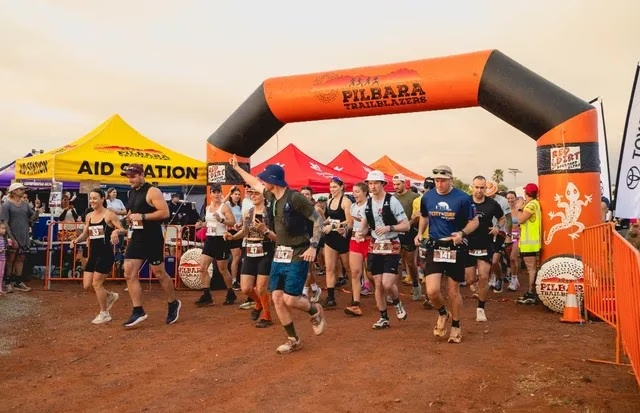
Why 6.7 Kilometres?
The maths behind a backyard ultra
It’s a nice bit of mathematical sadism. One yard is 6.7056 km, or 4.1667 miles. Complete 24 yards and you hit exactly 100 miles, about 161 km.
It’s a nice bit of mathematical sadism. 6.7056 km is exactly 4.1667 miles, which means 24 yards adds up to precisely 100 miles — about 161 km. Every distance milestone in the sport falls out of that one number:
It started in a Tennessee backyard
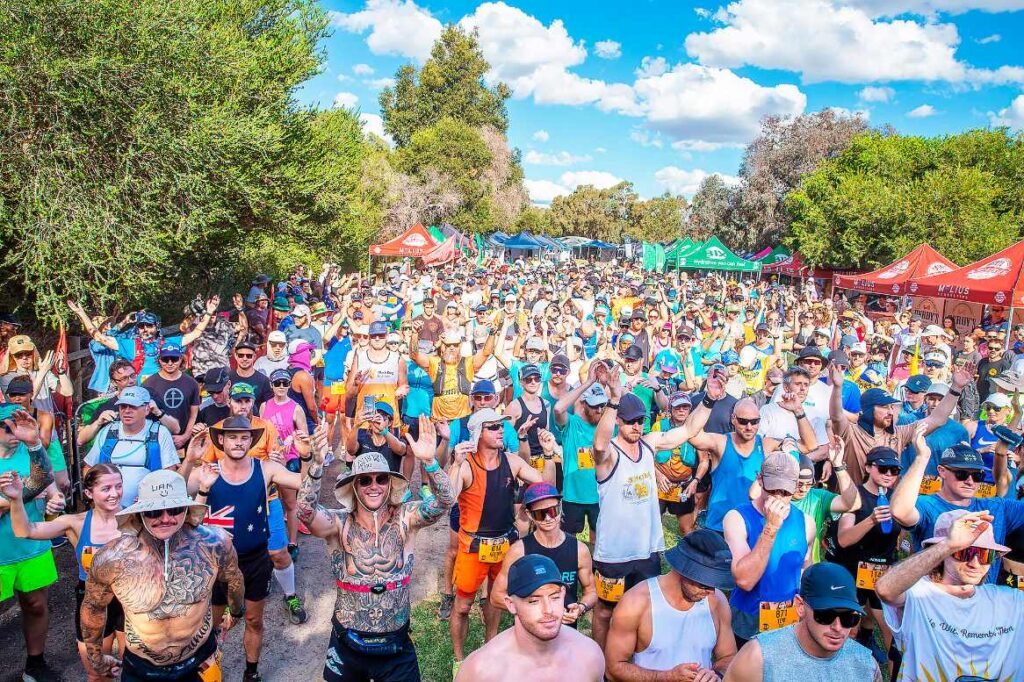
The format was dreamed up by Gary “Lazarus Lake” Cantrell — the same mind behind the Barkley Marathons, ultrarunning’s other famous exercise in deliberate misery. The original event was staged on his own property near Bell Buckle, Tennessee, in 2011, and named after his dog, Big. There’s no elaborate scoring system, no age handicaps, no complicated rulebook. You either make the next bell or you don’t.
Then the rest of the world went mad for it
What began as one bloke’s backyard has become a genuine global sport. As of September 2026, the tracking database Yardlore lists more than 79,000 athletes, over 2,350 recorded events and upwards of 1,050 individual backyard race series worldwide — and that’s before the smaller, informal club races that never make it into any database. In August 2026 alone there were 59 events across 29 countries, with 3,503 starters. Japan has its own national series, Last Samurai Standing; our Japanese-language guide is バックヤードウルトラとは?.
It also runs its own international competition. At the 2024 World Team Championship, held simultaneously across 63 countries on six continents, Belgium took the team title. The 2026 edition started on 17 October, with Australia’s invitation-only team of 15 racing at Integral Energy Park, Kembla Grange, NSW, head-to-head with the rest of the planet in real time from the same starting gun. Follow it in our World Team Championships live updates.
Australia became really, really good at this
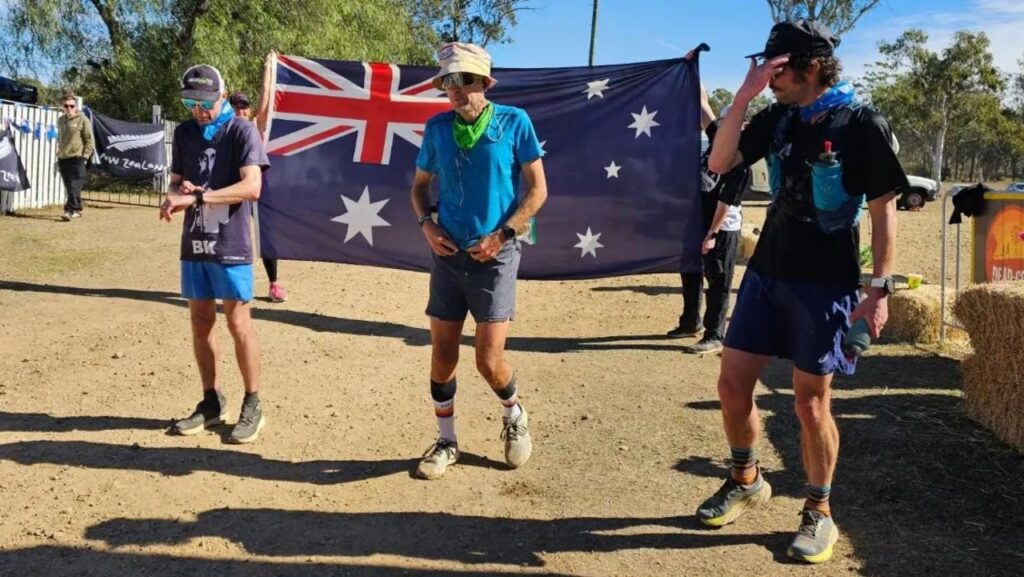
Australia isn’t just turning up to backyard ultras — it’s producing some of the best in the world, and the name to know is Phil Gore.
In June 2025, at the Dead Cow Gully Backyard Ultra in Queensland, Gore completed 119 yards — about 798 km, or 119 continuous hourly starts, the best part of five days — to set the world record, which still stands. Four months later he travelled to Big’s Backyard Ultra in Bell Buckle, Tennessee, and won the individual World Championship outright, completing 114 yards (roughly 764 km) before Belgium’s Ivo Steyaert became the last of his rivals to drop out, during yard 113. American Harvey Lewis rounded out the podium in third, having also passed the 111-yard mark.
You may see Russia’s Dmitry Klimov listed with 123 yards, run at the Biotropika Ultra Trail on 20 June 2026. It doesn’t count: two weeks later the format’s founder, Lazarus Lake, voided that event’s results after footage reportedly showed non-competitors on the course alongside runners, Marathon Handbook reported. Gore’s 119 is still the world record, and he holds the world title too. Later in 2026 he went looking for his limit in Project 168.
What makes Gore genuinely interesting, though, isn’t just the numbers — it’s how he got there. Backyard strategy has traditionally leaned toward running as slowly as the hour allows, to save the legs. iRunFar’s pace analysis of his world championship win found his average lap was around six minutes faster than the rest of the top four — and over 111 hours, that compounded into roughly twelve extra hours of banked rest, sleep and food compared to the field. His final lap, at 37 minutes and three seconds, was one of his fastest of the entire race — a fairly clear sign he had more in the tank than anyone left to test it against.
Which raises the actual strategic question at the heart of this sport: is it better to run slowly and conserve energy, or run faster and buy yourself sleep? Nobody’s settled it. Gore’s approach suggests the second option has real merit — provided your body can absorb the extra pounding without breaking down first.
How a 70-year-old could beat a 35-year-old
Let’s be clear: age doesn’t stop mattering. But the backyard format is specifically built to reduce how much outright speed matters, and that’s a different thing.
You need roughly an 8:57/km average pace to cover a yard inside an hour. That’s it. That’s the entire speed requirement. Once you’re comfortably capable of that — and plenty of unremarkable club runners are — running dramatically faster stops paying off the way it does in a normal race. Yes, a faster runner banks more rest time. But running harder than necessary also costs glycogen, muscle damage, thermal load, foot damage and cardiovascular strain you’ll be billed for at hour 30, not hour three.
A 35-year-old who runs 5 km in 20 minutes clearly has more raw speed than a 70-year-old who runs it in 30. But neither of them is being asked to run particularly fast. They’re both being asked the same question, over and over: can you still get out of the chair and cover another 6.7 km after 20, 30 or 40 hours of this? That’s a durability, pacing, fuelling and stubbornness question — and speed has surprisingly little say in the answer.
There’s real evidence behind this. A widely cited analysis of 24-hour ultramarathon results found peak male performance sits around the early 40s — considerably later than in shorter-distance running — and a more recent secular analysis of time-limited ultra events confirms the trend has held. Endurance doesn’t fall off a cliff in your 40s and 50s the way sprint speed does. It erodes slowly enough that a well-prepared older athlete can still be genuinely dangerous.
The clearest proof is German runner Hubert Karl, who at 68 in 2026 completed 45 yards — about 301.5 km, more than seven marathons back to back — at the Last Soul Ultra in Bornheim. Yardlore’s own 70+ world best currently sits at 24 yards (around 161 km), set by Romania’s Stan Turcu in 2021. Australia has its own entry in that conversation: at the 2026 Red Dirt Backyard Ultra in Western Australia, Dean Brown reportedly set the Australian M70+ record with 20 yards, roughly 134 km.
Eventually, running is the easy part
A backyard ultra isn’t run, finish, recover. It’s run, sit, eat, change, toilet, maybe sleep, panic, stand up, bell, run — on repeat, for as long as you can stand it. If you’re running 45-minute yards, you’ve got 15 minutes before the next one. Take out toilet time and “rest” can mean lying down for seven minutes, still chewing.
That’s why crews matter enormously at the elite end. Runners have to learn to eat fast, lie down immediately, wake up on command, treat blisters between starts, swap shoes and socks without wasting minutes, time their caffeine and — critically — not burn their rest window chatting to their crew about how they’re feeling. The chair, eventually, starts looking considerably more dangerous than the course.
There’s also a strange psychological wrinkle. A marathon runner at 35 km knows exactly how much is left: 7.2 km, however grim it feels. A backyard runner at hour 35 knows nothing — there might be one yard left in the field, or another three days. That removes the normal trick of rationing effort against a known finish line: every hour asks the same unadorned question — are you willing to do this once more? Probably why it’s good spectator sport too. Every hour is another mini start line, another chance for someone not to show up.
And then there’s the sport’s best joke: technically, there is only one finisher. The runner-up could cover 700 km and still be recorded as a DNF, sitting next to someone who simply ran 6.7 km further. Everyone loses except the last person left — and even they only “win” by outlasting everyone else, not by beating anybody in a straight race.
The world record is nearly five days
Worth sitting with that for a second. The world record, Phil Gore’s 119 yards at Dead Cow Gully in 2025, is about 798 km run in continuous one-hour instalments: 119 hours, just under five days, with no finish line in sight for any of it until the very end. Nobody in the field knew when it would stop until it did. The full history is in our backyard ultra world record guide.
Could you actually do one?
You don’t need to be able to run 100 km when you stand on the start line. You don’t even need to be fast — if you can jog a park 5 km comfortably, per our absolute beginner’s guide to running, you can already cover a yard inside the hour with room to spare. What you actually need is the discipline to keep front-loading recovery over showing off on the course — proper fuelling, ruthless use of every spare minute, and the willingness to actually rest instead of just standing around talking about it.
Multi-day backyard racing is genuinely punishing on the body — extreme sleep deprivation, dehydration, hyponatraemia, heat and cold exposure, gastrointestinal chaos and real musculoskeletal damage are all on the table the longer it runs. Nobody sensible signs up for their first one planning to chase 24 yards. But the format’s real trick is that it doesn’t ask you to. The official race might run for five days; your race can end whenever you decide it has. Six yards is a real, legitimate, printable result. So is ten. So is a hundred kilometres, even while the last person standing keeps going without you.
You don’t need to run 100 km when you stand on the start line. You need to run 6.7. Then, one hour later, make one decision. Do it again.
Backyard ultra FAQ
What is a backyard ultra?
A last-one-standing running race. Runners start a 6.7 km loop every hour and must finish it inside the hour. The race goes on until one runner is left.
How far is a yard in a backyard ultra?
6.7056 km, or 4.167 miles. Twenty-four yards is exactly 100 miles, about 161 km.
How long does a backyard ultra last?
There’s no set finish. Small races can end within a day, while the longest have gone for nearly five days.
How do you win a backyard ultra?
Be the last runner left, then complete one more yard on your own. Everyone else, including second place, is recorded as a DNF.
What is the backyard ultra world record?
119 yards, about 798 km, by Phil Gore of Australia at Dead Cow Gully in June 2025. See our world record guide.
Where can I run a backyard ultra in Australia?
There are races in every state. See our list of Australian backyard ultras below.
Australian Backyard Ultras: 2026–27
The significant backyard and last-one-standing races currently scheduled from late October 2026 onwards. Dates can change, so check with organisers before booking travel. For every race with confirmed dates, see our full Australian backyard ultra calendar.
Queensland
Smurf’s Backyard Ultra
Trail loops through Smithfield Mountain Bike Park, plus a six-lap Mini Backyard for the less sleep-deprived.
Cobb & Co Backyard Ultra
A classic 6.7 km hourly format based at the historic Nine Mile Camping Grounds.
The Furnace Backyard Ultra
The normal backyard rules, with the added pleasure of inland Queensland in February.
New Moon Ultra
A backyard-style event with 6.7 km hourly trail loops and fixed 12- and 24-hour options.
New South Wales
Victoria
Aussie Alpine Backyarder
A 6.71 km loop at altitude with more than 200 metres of climbing each yard. New Year’s Eve could be worse. Probably.
Maribyrnong Valley Park Backyard Ultra
A genuine last-one-standing race with no fixed finishing distance.
Melbourne Frontyard Ultra
A city version of the backyard format using a 6.71 km loop through Melbourne parkland.
Harry’s Longest Mile
Currently listed on the Australian last-one-standing calendar for July 2027.
Western Australia
Herdy’s Frontyard Ultra
One of Australia’s biggest backyard-format events, despite the frontyard name.
South Australia
No Time To Die Frontyard Ultra
6.71 km every hour, on the hour, until one runner remains.
Tasmania
Greenvale Backyard Ultra
A traditional 6.706 km backyard loop every hour until only one runner remains.