
Netflix’s four-part TYSON landed on 13 October, and it’s sent a lot of people back to the same question: how did a 178cm kid from Brownsville become the youngest heavyweight champion in history, at 20, built like a fridge with legs? The short answer is volume. In his prime, Mike Tyson ran before dawn, sparred twice a day and did thousands of bodyweight reps, spread through the day, under Cus D’Amato and then Kevin Rooney. He fought at about 99–100kg.
The famous numbers (2,000 sit-ups, 500 dips, the neck bridges) get repeated everywhere, often with different totals. Here’s what’s consistent across the accounts, what he actually weighed, what he ate then and now, and a version of the day a normal bloke can survive.
- Born: 30 June 1966, Brooklyn, New York (he’s 60)
- Height and reach: 178cm (5ft 10in), 180cm reach
- Prime fight weight: about 99–100kg (218–221lb), 1986–1990
- Pro record: 50 wins (44 by KO), 7 losses, 2 no contests
- Youngest heavyweight champion: 20 years, 4 months, stopping Trevor Berbick on 22 November 1986
- Trainers: Cus D’Amato (died November 1985), then Kevin Rooney until late 1988
- Watch: TYSON (four episodes, Netflix, from 13 October 2026)
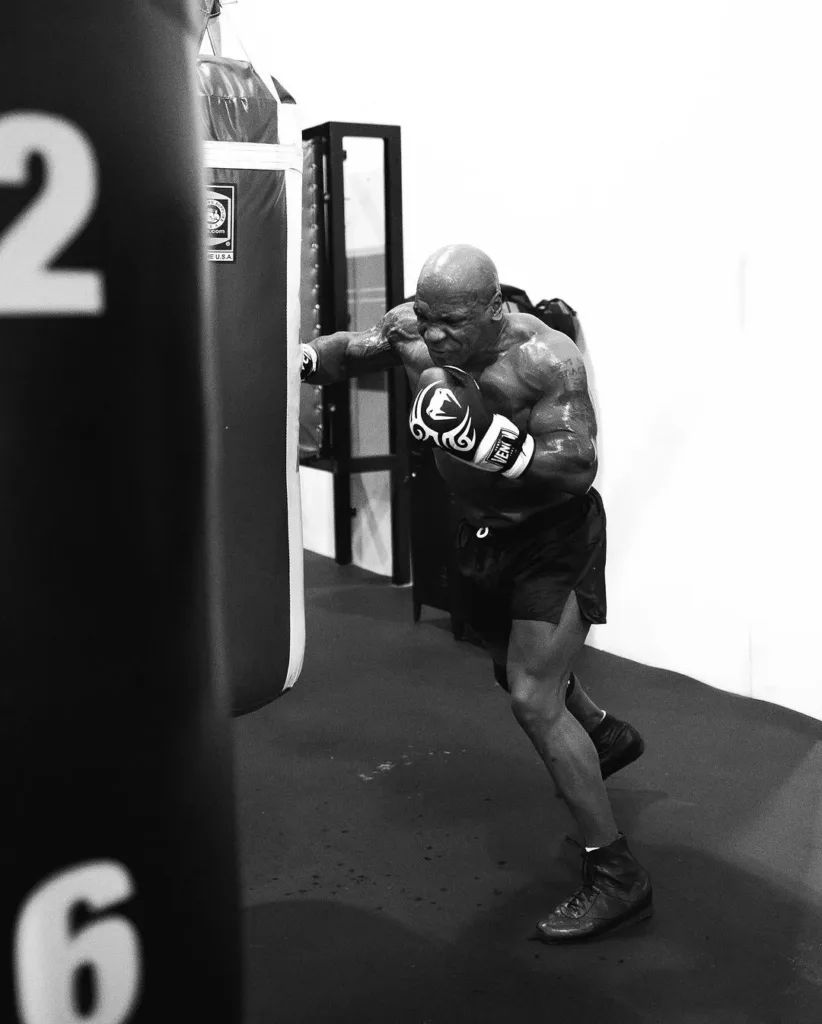
Mike Tyson’s workout routine in his prime
Nobody published Tyson’s training log. What exists is a day pieced together from his books (Iron Ambition and Undisputed Truth), interviews and people who were in the Catskill gym. The details shift from source to source, but the shape of the day is consistent, and it went roughly like this:
| When | What |
|---|---|
| 4am | Run, usually given as 3–5 miles (5–8km) |
| Morning | Breakfast, back to bed, then sparring (often 10 or more rounds) |
| Afternoon | More rounds: bags, slip bag, pads, speed bag, skipping, sparring |
| Between sessions | Calisthenics in sets: sit-ups, push-ups, dips, shrugs, neck bridges |
| Evening | Shadow boxing, exercise bike, then watching fight film |
Tyson has explained the 4am start in interviews: it wasn’t that 4am is magic, it was knowing the other bloke wasn’t doing it. The edge was psychological as much as physical.
The calisthenics numbers: what’s consistent and what isn’t
Search “Mike Tyson workout” and you’ll find 2,000 sit-ups, 500 push-ups, 500 dips, 500 barbell shrugs and somewhere between 10 and 30 minutes of neck bridges, every day. Some versions bump the sit-ups to 2,500 or add 2,000 squats.
- Sit-ups: 2,000 a day is the figure that turns up most often, including in interview accounts of his day.
- Push-ups, dips, shrugs: about 500 each a day is the common figure. Shrug weights are given as anything from 30kg to 75kg, so treat those as guesses.
- Squats: Iron Ambition has 400 push-ups and 400 squats before school after a 4-mile run. In prison he did his famous playing-card squat routine (from Undisputed Truth). Daily totals of 2,000 squats show up, but not consistently.
- Neck: wrestler’s bridges, front and back, for minutes at a time.
Crucially, none of it was done in one hit. The reps were split into sets and spread across a day built around 10 or more rounds of boxing. Our read: the totals are believable for a full-time teenage fighter with nothing else to do, and they’re a terrible idea as a cold-start program for anyone else.
Did Mike Tyson lift weights?
Not much, by the accounts of the D’Amato years. The work was running, boxing and bodyweight volume, with the barbell mostly used for shrugs. The neck and traps people remember came from bridges and shrugs repeated daily for years, not from a bodybuilding split. If you want to train the same qualities, the boxing basics are in our guide to boxing punches and combinations.
How much did Mike Tyson weigh in his prime?
Between about 99kg and 100kg for his biggest fights, short and dense for a heavyweight. In 2001 ESPN put his average prime weight at about 217lb (98kg). Here’s what he weighed in for the fights that matter:
| Fight | Weight | Result |
|---|---|---|
| Trevor Berbick, 22 Nov 1986 | 100.4kg (221¼lb) | Won, TKO round 2: youngest heavyweight champ |
| Michael Spinks, 27 Jun 1988 | 99.0kg (218¼lb) | Won, KO in 91 seconds |
| Buster Douglas, 11 Feb 1990 | 100.0kg (220½lb) | Lost, KO round 10 (Tokyo) |
| Brian Nielsen, 13 Oct 2001 | 108.4kg (239lb) | Won, RTD round 6 |
| Jake Paul, 15 Nov 2024 | 103.6kg (228.4lb) | Lost, unanimous decision |
At 58 he weighed in heavier for Jake Paul than he did at his peak, but lighter than a lot of people expected. The Paul fight drew a peak of 65 million concurrent streams on Netflix, which is a big part of why Netflix wanted his story.
Mike Tyson’s diet, then and now
In his prime: nothing fancy. The commonly reported version is oats for breakfast, then steak or chicken with pasta, eaten to fuel two or three sessions a day. No macro tracking, no supplement stack. A full-time fighter training like that needs a lot of food; our macro calculator will show you why.
Vegan from about 2010: after years of weight swings and addiction, Tyson told ESPN Radio in 2010 he’d gone vegan and lost a huge amount of weight. He said 130lb (59kg); a Las Vegas reporter at the time questioned the number, and later interviews have used 100–140lb. Either way, it was a big change.
For the Jake Paul fight: he went back to meat, but only on training days. He told Newsmax’s Greta Van Susteren that after a fight he wouldn’t eat meat any more because he liked how he felt without it, as Men’s Health Australia and Business Insider reported. He also blamed “bad food” for the ulcer flare-up that pushed the fight back from July to November 2024, and said he’d cut out processed food.
A Tyson day for the rest of us
This is our scaled version, not Tyson’s. Same structure (run, rounds, bodyweight volume spread through the day, neck), about a tenth of the volume. Do it three days a week and add 10% a week if you’re recovering well.
- Morning: 3km easy run. Early if you can; that part’s free.
- Rounds: 6 x 3-minute rounds of shadow boxing or bag work, 1 minute rest. Jab, cross, hook, and move your head.
- Through the day, in sets of 20–25: 200 sit-ups, 50 push-ups, 50 bench dips, 50 dumbbell shrugs.
- Neck: 3 x 30 seconds of gentle neck work (chin tucks and isometric holds against your hand). Skip wrestler’s bridges until you’ve built up to them, and skip neck loading altogether if you have any neck problems.
If 50 push-ups in sets is a struggle, start with our calisthenics for beginners plan, then step up to the military calisthenics workout. For the conditioning side, fit to fight covers boxing fitness in more depth.
TYSON on Netflix: what it covers
TYSON is four episodes of about an hour each, directed by Floyd Russ (Untold: Malice at the Palace), with Bill Simmons and Jim Gray among the executive producers. It uses archive footage and new interviews with Tyson to go from Brownsville and the D’Amato years to the titles, prison, the money, the drugs and the comeback (What’s on Netflix, Hypebeast). His one-man comedy show, Mike Tyson: Return of the Mike, follows on Netflix on 3 November.
Mike Tyson workout FAQ
How many sit-ups did Mike Tyson do a day?
2,000 is the most quoted figure, split into sets through the day. Some accounts say up to 2,500.
How much did Mike Tyson weigh in his prime?
About 99–100kg (218–221lb). He was 99kg (218¼lb) for Michael Spinks in 1988 and 100kg (220½lb) for Buster Douglas in 1990.
How tall is Mike Tyson?
178cm (5ft 10in), with a 180cm reach, which is short for a heavyweight. Some tales of the tape listed him at 5ft 11in.
How did Mike Tyson train his neck?
Wrestler’s bridges, front and back, plus heavy barbell shrugs, done every day for years.
Is Mike Tyson still vegan?
Mostly. He was vegan from about 2010, ate meat on training days for the Jake Paul fight, and said he’d stop once the fight was done.