
On Tuesday afternoon, riders weighing about 55 kg each will crouch over horses nine times their weight, at close to 60 km/h, in a tight pack, for 3,200 metres, with their hearts at or above the maximum they hit in a lab test. Then most of them will ride again in the next race. Jockeys are usually the smallest people at the track and among the toughest athletes in Australian sport. Here is what they weigh, why, and what it takes to do the job.
- What jockeys weigh: elite Australian jockeys average about 56.5 kg and 164 cm (Farley et al., 2024).
- The Melbourne Cup: the lowest weight a horse can carry is 51 kg in 2026; the top weight is 59 kg. That includes the saddle and gear, so the rider is lighter still.
- Most Victorian races: a minimum of 54 kg since August 2025.
- The work: heart rates at or above lab maximum, with the legs and core absorbing every stride of a 450 to 500 kg animal.
- The risk: about one flat ride in every 240 in Australia ended in a fall in a national study.
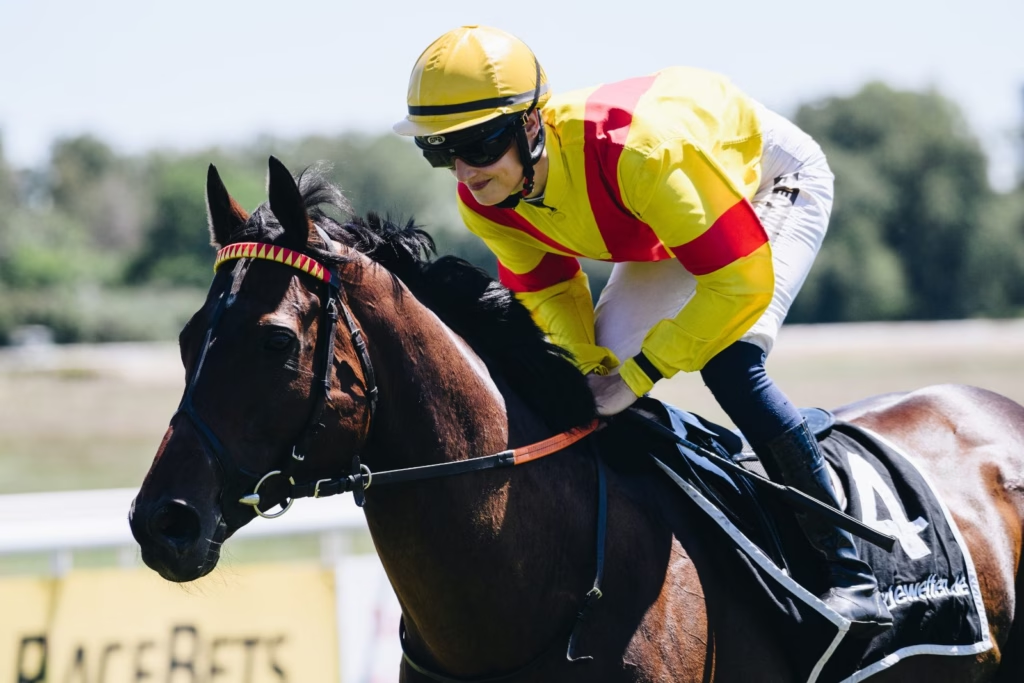
Nine times their weight, at 60 km/h
A Thoroughbred racehorse weighs around 450 to 500 kg: one study of 851 Japanese three-year-olds averaged 474 kg (Journal of Equine Science, 2017). Flat races are run at an average of about 59 to 62 km/h (race data from Japan), and the Melbourne Cup record works out at about 59 km/h for more than three minutes (see how fast a racehorse can run). The jockey has no steering wheel and no brakes, only hands, legs, balance and nerve, while a dozen or more horses fight for the same few metres of rail.
The fitness: what race riding does to the body
The heart
In real races, jockeys’ heart rates reach or pass the maximum they hit in a lab test. One study recorded a peak of 189 beats a minute in competition, 103 per cent of the riders’ lab peak (Cullen et al., 2015). A New Zealand study found jockeys rode races at about 94 per cent of their maximum heart rate, against about 81 per cent in trials (Legg et al., 2022).
The engine
In a simulated 1,400 m race, jockeys worked at about 75 per cent of their peak oxygen uptake, roughly 9.4 times their resting energy use (Cullen et al.). Blood lactate builds fast: in real races, peak heart rate and lactate were the same whether the race was short or long (Kiely et al., 2020). A sprint race is flat out from the gates.
The crouch
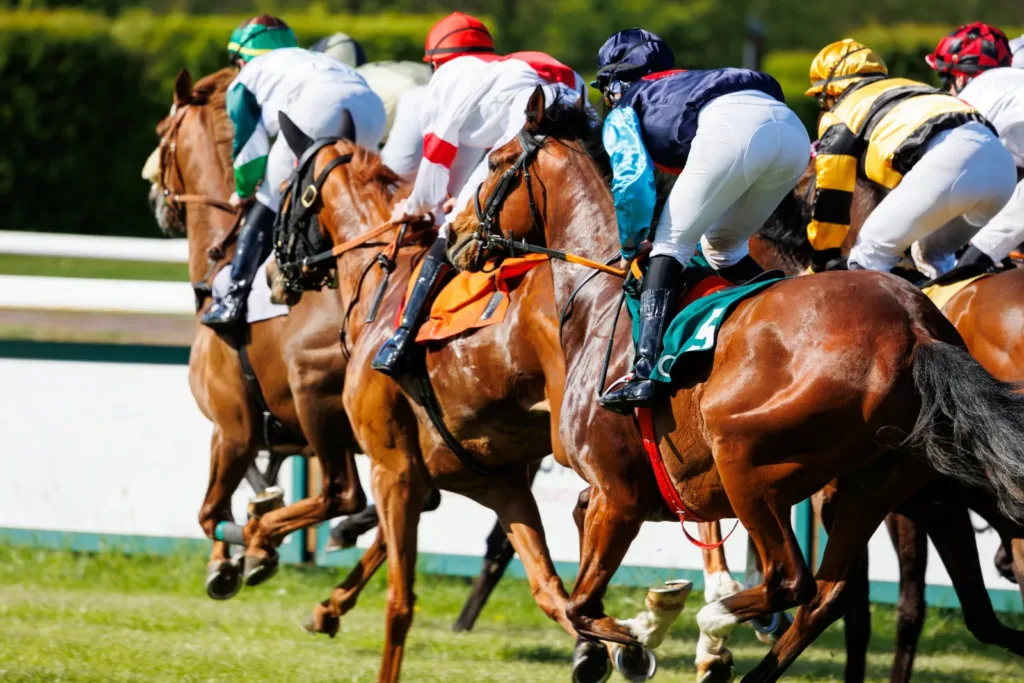
Race riding is done in a low crouch, standing in short stirrups with the body over the horse’s neck. The legs work like suspension, soaking up the horse’s motion, while the core holds the upper body still so the rider’s weight does not throw the horse off balance. Riders use a lower crouch in races than in trackwork, with more work from the hamstrings (Legg et al.). Hold that for three minutes at 60 km/h and then try to ride a finish.
The danger
Between 2002 and 2006 there were 3,360 falls in 748,367 race rides in Australia. On the flat, that is about one fall in every 240 rides; over jumps, about one in 19. Five jockeys died in that time, all in flat races (Hitchens et al., Medical Journal of Australia, 2009). The same paper cites a US study that found jockeys’ risk of death at work was higher than that of pilots, loggers, roofers and boxers.
In Victoria, flat racing from 2004 to 2019 averaged about 3 falls and 1.8 jockey injuries for every 1,000 starts. Falls became less common over that time; injuries did not (Victorian racing study). Riders must wear an approved safety vest in races, trials and trackwork, and a helmet must be replaced after five years of use, after any severe impact, or if the rider is concussed (Australian Rules of Racing).
How much do jockeys weigh? The rules
Every horse in a race is given a weight to carry, and the jockey must weigh in at that weight with their gear. Under the Australian Rules of Racing, the weight includes clothing, the saddle, any lead bag used to make up the difference, and gear attached to the saddle, including the breastplate since May 2025. The helmet, goggles and gloves are not weighed, and 1 kg is taken off the scale reading to allow for the compulsory safety vest.
| Race | Lowest weight a horse can carry |
|---|---|
| Melbourne and Caulfield Cups (Victoria) | 51 kg |
| Other Group 1 handicaps (Victoria) | 52 kg |
| Group 2 handicaps (Victoria) | 53 kg |
| Group 3 down to Benchmark 52 (Victoria) | 54 kg |
| Night and non-TAB meetings (Victoria) | 55 kg |
Racing Victoria lifted the Cups minimum from 50 to 51 kg in 2025, after a record eight Melbourne Cup runners carried 50 kg in 2024 and riders struggled to make the weight (Racing Victoria; 2025 handicap changes). For 2026, the top weight is 59 kg, given to Half Yours, last year’s Caulfield and Melbourne Cups winner, and the minimum is 51 kg (SEN).
Apprentices get a weight allowance to help them win rides: 3 kg until they have ridden 20 winners, 2 kg until 50 and 1.5 kg until 80, though not in Group or Listed races. History has heavier days: Phar Lap won the 1930 Cup carrying about 62.5 kg, and Carbine’s 10 stone 5 pounds (about 66 kg) in 1890 is still the heaviest winning weight.
Making the weight, and what it costs
Staying light enough to ride, year round, is the hardest part of the job for many jockeys. In a survey of 116 Victorian jockeys, 43 per cent said keeping their weight down was difficult or very difficult, three in four routinely skipped meals, and 81 per cent restricted food in the 24 hours before racing (Moore et al., 2002). That survey is more than 20 years old, but the pattern still shows up in newer research.
Studies of jockeys in the UK, Ireland and Hong Kong describe saunas, sweat suits, fluid restriction and very low energy intakes, linked to poor bone health and low mood (Wilson et al., 2014). A 2021 review reported that about half of jockeys tested were severely dehydrated on race day, and that 53 per cent of Irish flat jockeys had low bone density, with 12 per cent in the osteoporosis range (Ryan and Brodine, 2021). Diuretics are banned for riders in Australia, at any level (Australian Rules of Racing). Raising minimum weights, as Victoria did in 2025, is the main fix racing has made.
How jockeys train
Racing Victoria runs its apprentice program as a high-performance athlete program, with fitness, riding and medical testing, and access to a sports psychologist, nutritionist, physio and strength and conditioning coach (Racing Victoria). The day starts in the dark with trackwork: in a New Zealand study, apprentices rode about six horses each morning over two and a half hours (Legg et al.). On a race day, a busy jockey may ride several races and trials in a couple of hours.
Try the jockey crouch
A home test of what the crouch asks of your legs and core. Stand with your feet hip-width apart, sit back into a quarter-to-half squat, hinge forward until your chest is over your knees and hold your hands out in front as if holding reins. Keep your back flat and your head up.
- Level 1: hold for 60 seconds.
- Level 2: hold for 3 minutes 16 seconds, the Melbourne Cup record time.
- Level 3: do Level 2, rest for 30 seconds, then do it again. A jockey rides several races a day.
Stop if your knees hurt. It will not make you a jockey, but you will watch Tuesday’s finish differently. For the horse’s side of the race, read are you as fit as a racehorse?
FAQ
How much do jockeys weigh?
A study of 46 elite Australian jockeys found an average of 56.5 kg and 1.64 m. To ride in the Melbourne Cup at 51 kg, including the saddle and gear, a rider has to be lighter still.
What is the minimum weight in the Melbourne Cup?
51 kg in 2026, including the saddle and gear. It was raised from 50 kg in 2025. The 2026 top weight is 59 kg.
Does the jockey’s weight include the saddle?
Yes. The weight includes clothing, the saddle, any lead used to make up the weight and gear attached to the saddle. The helmet, goggles and gloves are not weighed, and 1 kg is allowed for the safety vest.
Are jump jockeys heavier than flat jockeys?
Yes. UK data put flat jockeys at about 56 kg and 167 cm, and jump jockeys at about 65 kg and 175 cm (Ryan and Brodine, 2021).
How fit are jockeys?
Very. Their heart rates in races reach or pass their lab maximum, and race riding is done in a held crouch that works the legs and core hard, at close to 60 km/h.