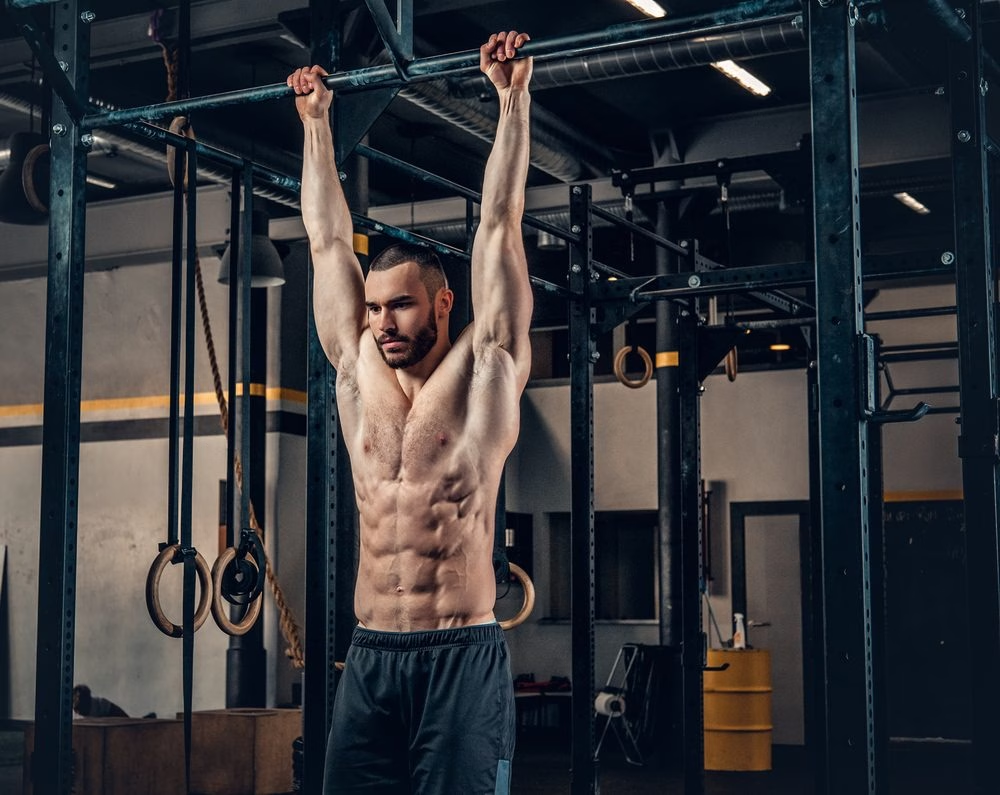
On Physical 100: Italy, judo champion Manuel Lombardo hung from a bar above a pool for close to an hour. The show’s opening test was a plank rather than a hang, and CrossFit athlete Elisa Fuliano held it for more than an hour and 27 minutes. The Guinness World Record for a dead hang is 80 minutes 41 seconds, set by Kenta Adachi of Japan in 2022.
Most of us would be pleased with a minute. So how long should you actually be able to hang from a bar, what does it say about your fitness, and how do you get better at it? Here’s what the research says, what it doesn’t, and a six-week plan to add time to yours.
There are no official, research-based norms. These are practical coaching benchmarks for a healthy adult, not a medical standard:
- Under 30 seconds: a starting point. Very common if you don’t train grip or pulling.
- 30–60 seconds: a solid, useful grip.
- 60–90 seconds: strong.
- 2 minutes: the target longevity doctor Peter Attia popularised for men at 40 (90 seconds for women). It’s an ambitious goal, not a pass mark.
Your bodyweight matters: a heavier man is holding more load, so compare yourself with your own last test, not with someone else.
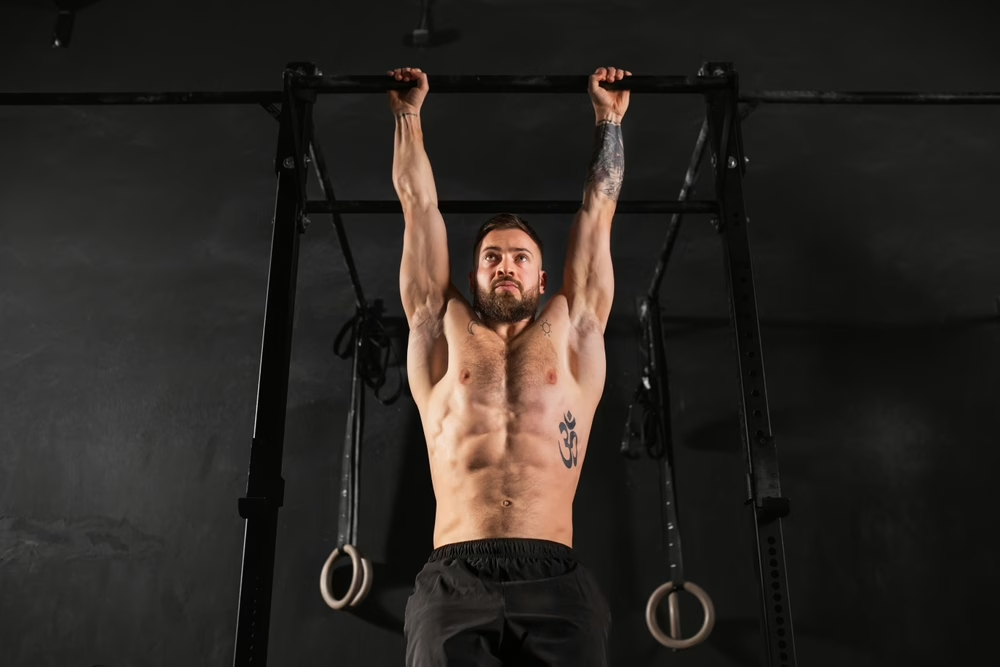
What a dead hang is (and what it tests)
A dead hang is exactly what it sounds like: grab a pull-up bar overhead, lift your feet off the floor, and hang with straight arms for as long as you can. No swinging and no pulling up. You’re done when your grip gives out.
That makes it a test of grip endurance: how long your forearm and finger muscles can keep producing force before they fatigue. It’s related to, but not the same as, grip strength, which is how hard you can squeeze once and which researchers measure with a hand dynamometer. It also asks something of your shoulders, lats and trunk, and a fair amount of your willingness to sit in discomfort.

What the research actually says
This is where most dead hang content gets ahead of the evidence, so here’s the honest version:
- There are no peer-reviewed population norms for dead hang time. Studies measure grip in different ways (bar thickness, chalk, how strict the hang is), and nobody has published a large, standardised dataset of how long adults can hang by age. Any “you should hang X seconds at age Y” chart is a coaching estimate.
- Grip strength itself is well researched. The PURE study, published in The Lancet in 2015, followed 139,691 people across 17 countries. Lower grip strength was associated with higher risk of death from any cause and from heart disease, and it predicted those outcomes better than blood pressure did. (Leong et al., The Lancet, 2015.) A large recent review of 60 studies also linked stronger grip with a lower risk of cognitive decline; we covered it in the 10-second grip test.
- That’s association, not proof. Grip is a window onto how strong and active you are overall. Hanging from a bar won’t add years to your life on its own; being the kind of person who can hang for a long time probably reflects habits that do.
- The military uses a harder version. The US Marine Corps’ old flexed-arm hang (chin held above the bar) needed 15 seconds to pass and 70 seconds for maximum points. It’s a different test from a dead hang, but it shows how quickly hanging time gets hard.
Are dead hangs good for your shoulders?
You’ll often read that hanging “decompresses” the shoulder and fixes impingement. That claim comes mostly from orthopaedic surgeon John Kirsch, who reported excellent results with a daily hanging programme for his shoulder-pain patients and argued that hanging stretches the structures over the rotator cuff. It’s an interesting idea, but his work hasn’t been replicated in controlled trials, so treat it as a promising theory, not established treatment.
What’s reasonable to say: for a healthy shoulder, controlled hanging is a useful way to build grip and load the shoulder through its full overhead range. If your shoulder hurts, catches or feels unstable overhead, see a physio before you start hanging, and use a feet-supported hang in the meantime.
How to do a dead hang properly
- Use a bar you can reach from a box or bench, so you step into the hang rather than jumping and jarring your shoulders.
- Grip overhand, hands about shoulder-width apart, with your thumbs wrapped around the bar. Chalk helps if your hands sweat.
- Choose passive or active. In a passive hang your shoulders rise towards your ears and you hang off the joint. In an active hang you pull your shoulders slightly down and back, away from your ears, without bending your elbows. Beginners and anyone with sensitive shoulders should use the active version. It’s the safer default for long holds.
- Keep still. Legs together, slightly in front of you, and no swinging.
- Breathe normally. Holding your breath shortens the hang and spikes your blood pressure.
- Step down with control. Don’t let go and drop from a height.
How to test your dead hang
Test once a week at most, at the start of a session when you’re fresh. Use the same bar every time, because thickness makes a big difference. Hang with a full grip until your hands open, time it with a stopwatch, and write it down. That number is your baseline, and it’s the only comparison that really matters.
A six-week plan to hang longer
Grip responds quickly to direct training. The plan below borrows from climbing research: a 2022 trial with 54 experienced climbers found that near-maximal hangs built finger strength, while repeated shorter hangs at around 60–80% effort improved endurance, and 80% did both (Devise et al., 2022). For hang time, you want both.
Do it three times a week, on non-consecutive days, at the start or end of a workout. Rest 90 seconds between sets.
| Weeks | Main work | Notes |
|---|---|---|
| 1–2 | 4 sets, each lasting about half your test time | If you can’t hang 20 seconds, do feet-supported hangs: toes on a box, taking some weight off |
| 3–4 | 3 sets of 7/3 repeaters: hang 7 seconds, rest 3 seconds, six times. Then one hang to about 80% of your best | Repeaters build endurance without grinding you to failure every set |
| 5–6 | 2 sets of repeaters, 2 sets of 60–80% hangs, plus one towel hang (drape a towel over the bar and hold both ends) | Towels and thick bars make your grip work harder, so your normal hang feels easier |
| End of week 6 | Retest | Same bar, fresh, full grip |
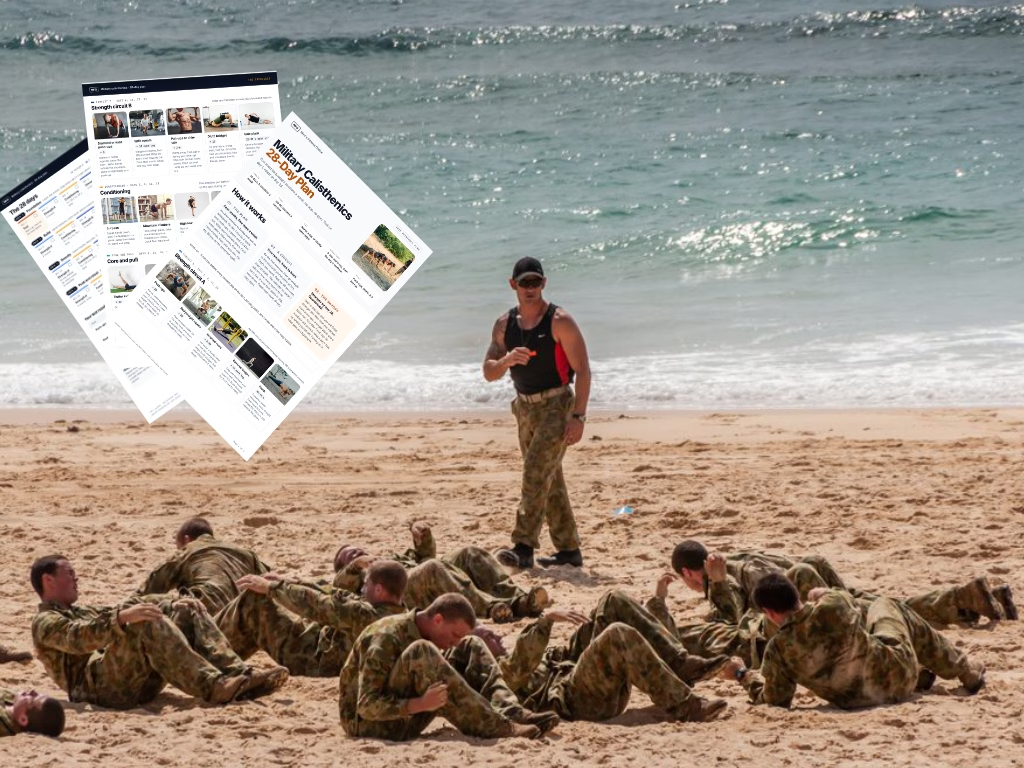
Add farmer’s carries once a week: heavy dumbbells or kettlebells, walked for 30–40 metres, three or four times. They load the grip the way daily life does, and they’re one of the HYROX stations for a reason. If you can’t do a pull-up yet, our calisthenics plan for beginners builds the pulling strength that makes hanging easier, and our free 28-day military calisthenics plan builds hangs into a full-body routine.
Common mistakes
- Hanging to failure every day. Tendons adapt more slowly than muscle. Three sessions a week is plenty.
- Jumping into the hang. Dropping onto straight arms jolts the shoulder. Step in from a box.
- Swinging to stay up. It turns the test into a different exercise and makes your times meaningless.
- Ignoring shoulder pain. A burning grip is expected; sharp or catching pain in the shoulder isn’t. Stop, and get it checked.
- Always using straps. If you deadlift and row with wrist straps every session, your grip never gets the stimulus it needs.
Hanging on Physical 100
Hanging tests turn up again and again on Netflix’s Physical 100, because a hang strips everything back to grip, shoulders and willpower:
- Italy’s opening test was a plank, not a hang: all 100 contestants held a plank on a suspended grid of bars above a pool, hands gripping one bar and feet on another, while dodging laser beams. CrossFit athlete Elisa Fuliano lasted more than an hour and 27 minutes.
- Italy’s Grid of Heroes in episode 7 was a true hang, with 14 left. Judo champion Manuel Lombardo lasted close to an hour, Sebastian Rodwell about 53 minutes, and Olympic wrestling champion Andrea Minguzzi, one of the heaviest men left, about 28. See the Physical 100: Italy cast and the Italy winner, or every Italy challenge explained.
- Mexico’s Puerta al inframundo had three athletes hanging from a bar four metres above water while the bar slowly tilted. Our guide to every Physical 100: Mexico challenge explains how each one works and how to train for it.
Notice who does well: lighter, strong, patient athletes, not the biggest men in the room. That’s the dead hang in a sentence.
Dead hang FAQ
How long should you be able to dead hang?
There’s no research-based norm. As practical benchmarks for a healthy adult: under 30 seconds is a starting point, 30–60 seconds is solid, 60–90 seconds is strong, and two minutes is an ambitious target. Track your own time, not someone else’s.
Is a one-minute dead hang good?
Yes. A controlled 60-second hang shows good grip endurance and shoulder control for most adults.
Are dead hangs good for your shoulders?
For a healthy shoulder, controlled active hangs are a good way to load it overhead. Claims that hanging cures shoulder impingement come from one surgeon’s unreplicated work. If your shoulder hurts, see a physio first.
How often should you do dead hangs?
Two or three times a week is enough to improve. Your tendons need recovery time, so avoid hanging to failure every day.
Do dead hangs build muscle?
They mainly build grip and forearm endurance, with some work for the shoulders and back. For bigger lats and arms you still need pulling exercises such as pull-ups and rows.
What is the dead hang world record?
Guinness World Records lists 80 minutes 41 seconds, by Kenta Adachi of Japan in 2022.