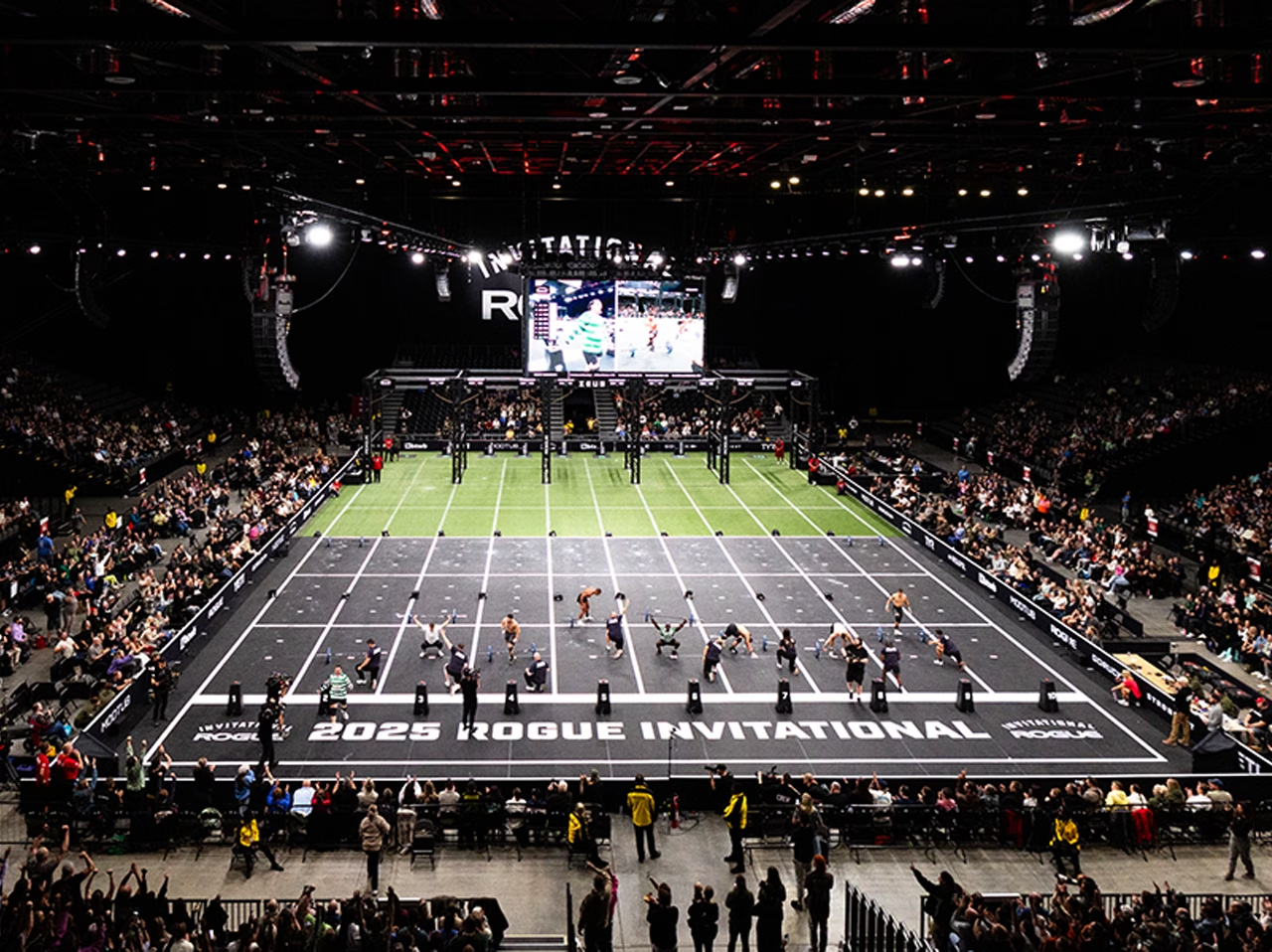


CrossFit was a liberation, a new kind of training and a welcome and departure from the leg warmers, pump classes and/or gritty bodybuilding culture of the 1990s and 2000s. It boomed for many reasons, and needs another story. But CrossFit eventually lost its way in spectacular fashion, while similar training paradigms such as F45 had their own problems.
Then came HYROX: same energy pathway demand, different packaging. It tapped into the same appetite for community, competition and identity, but stripped away much of CrossFit’s complexity and cultishness it offered an alternative to unpleasantness and unpredictability of obstacle-course races.
Introduced in Hamburg in 2017, HYROX offered something simpler and more measurable: eight one-kilometre runs, each followed by a standardised gym station.
Introduced in Hamburg in 2017, its first event attracted 650 competitors. In the 2025–26 season, more than 1.4 million people competed across more than 100 events, watched by another 1.5 million spectators. What began as eight one-kilometre runs alternating with eight gym stations has become a global fitness business, a spectator sport and a serious investment opportunity.

In September 2026, HYROX’s founders, backed by a consortium led by US private-equity firm L Catterton, bought back the majority stake previously held by Infront Sports & Media. The deal’s financial terms were not disclosed, but reports put HYROX’s valuation at roughly €600 million.
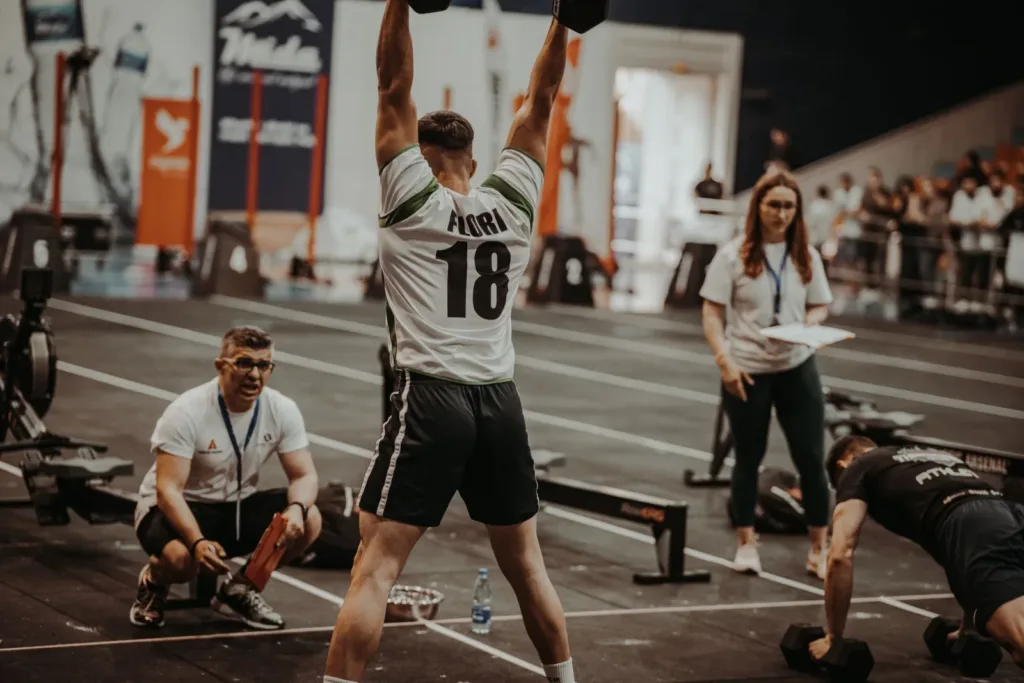
That is the market XENOM is entering: not an empty field waiting for a new fitness competition, but a rapidly expanding category in which the leading brand has already attracted private-equity money and a valuation approaching three-quarters of a billion Australian dollars. according to Reuters and the Financial Times. That growth is visible locally too: HYROX Perth alone is forecast to grow four-fold to 11,000 competitors in 2026.

Founded by Keith Barlow, a former HYROX insider and CrossFit athlete, XENOM has raised US$15 million in seed funding to build what it calls the “Decathlon of Fitness”. Its backers include WndrCo, the investment firm associated with former Disney Studios chairman Jeffrey Katzenberg, while Rogue Fitness is the official equipment partner. XENOM also has a CrossFit Partner Event Series licence.
The commercial logic is obvious. HYROX has proved that fitness can be packaged into a standardised event, sold around the world and turned into a repeatable test that ordinary people can understand. XENOM is targeting the part of the market HYROX leaves largely untouched: the strength, skill and technical demands of CrossFit.


Where HYROX offers eight runs and eight familiar workout stations, XENOM wants a broader, harder and more technically ambitious contest. It is trying to turn the fragmented world of functional fitness into a global sport with fixed events, standard equipment, international rankings and one number that supposedly tells you how good an athlete really is.
That number is the point.
XENOM consists of 10 events held across two days. Athletes begin with a one-repetition maximum snatch. Before the weekend is over, they will have climbed ropes, sprinted on an Echo Bike, cycled a barbell, skied and run, pulled heavy weight and accumulated muscle-ups, burpees and handstand push-ups.
Every performance earns points towards an Elite Performance Index, or EPI. The promise is that an athlete in London, Miami or wherever XENOM goes next can be measured against every other competitor in the world.
That makes XENOM more than a new fitness competition. It is a direct attempt to challenge HYROX’s growing dominance while giving CrossFit athletes their own standardised global stage.
The more interesting question is whether XENOM has created a genuine measure of total fitness, or simply designed a sport that rewards people who are already good at XENOM.

The 10 events and what they test
The official event pages currently show the following program. The “main demand” and “caveat” columns are editorial analysis, not claims that each event isolates one physical quality.
| Event | Format | Main demand | Important caveat |
|---|---|---|---|
| 1. 1RM snatch | Maximum load in nine minutes | Power, strength and technique | The snatch is highly skill-dependent |
| 2. Wall walk and rope-climb ladder | Ascending rounds for eight minutes | Upper-body pulling, trunk strength and gymnastics | Rewards specific movement practice |
| 3. Echo Bike sprint | Maximum calories in 60 seconds | Anaerobic power | A minute of output is not general endurance |
| 4. Barbell cycling | Deadlifts, front squats, shoulder-to-overhead and thrusters in five minutes | Strength endurance and efficiency | Technique and pacing affect the result |
| 5. Echo Ski plus run | 2 km ski and 3 km run, 40-minute cap | Aerobic capacity and pacing | Still a relatively short hybrid effort |
| 6. Toes-to-bar, dumbbell snatches and muscle-ups | Three rounds, then maximum ring muscle-ups within six minutes | Gymnastics skill and fatigue resistance | A very high technical barrier |
| 7. Rhino Pull | Five-repetition maximum in three minutes | Heavy pulling strength | Equipment-specific |
| 8. Burpees, ski and bike | 12-minute AMRAP-style test | Repeated high-output conditioning | Rewards tolerance for short, severe efforts |
| 9. Heavy clean ladder | Ascending loads, then maximum cleans in eight minutes | Strength, power and fatigue tolerance | Olympic-lifting proficiency matters |
| 10. HSPU, chest-to-bar and lunges | Repeated rounds within 12 minutes | Gymnastics, pulling and loaded leg endurance | Advanced upper-body skills remain decisive |
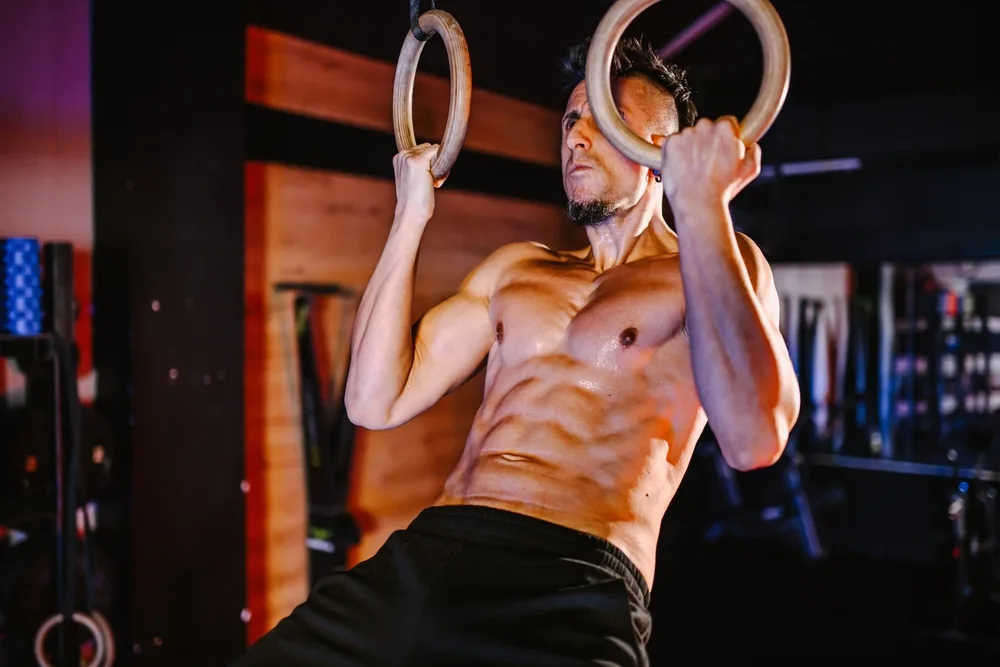
The list is broad. A pure strength athlete will be exposed by the run and machine work. An endurance specialist cannot hide from the heavy clean ladder. A powerful athlete who lacks gymnastics skill will leak points on two separate events.
But broad is not the same as complete. Long-duration endurance, swimming, agility, lateral movement, balance and mobility as an independent quality are absent or lightly represented. There is no conventional maximal squat or deadlift. Nothing tests change of direction, throwing, contact skill or performance over several hours.
Every sport leaves things out. The omission is not a scandal; it is the act that creates the sport. It does mean the winner is best described as the best performer under XENOM’s definition, not the owner of a scientifically settled title to total human fitness.
How the Elite Performance Index works
XENOM does not rank athletes by simply adding their places. It converts each raw performance into points using a progressive formula:
Points = A × (P − B)C
For the time-based fifth event, the subtraction is reversed: A × (B − P)C.
In plain English, the constants A, B and C determine where scoring begins and how quickly points rise as a performance improves. XENOM says this is the same formula that has powered the Olympic decathlon since 1984. The careful wording is that it uses the same mathematical form. The constants must necessarily be adapted because a snatch in kilograms, bike calories, repetitions and a finish time are not the decathlon’s running, jumping and throwing marks.
Each event offers up to 1,000 points, and the 10 event scores are added to make the EPI. The public London leaderboard makes that concrete. Elite winner Siria Meha’s displayed event scores were 770, 858, 726, 706, 839, 953, 759, 984, 698 and 723. Together they produce her listed EPI of 8,016.
That is more informative than “first” on its own. If Meha returned and scored 8,100 against a stronger field, her place could fall while her absolute score improved. A fixed score can also show where an athlete gained or lost points.
Yet the arithmetic cannot decide whether the underlying trade-offs are fair. That depends on how A, B and C were selected for every event. Why should five more bike calories compensate for a particular loss on the run? Should an extraordinary score erase a serious weakness elsewhere? How much does normal day-to-day variation move an EPI?
XENOM publishes scoring tables through its calculator and explains its three-step tiebreak: most event wins, then the highest single event score, then a shared placing. Its public material reviewed for this article does not establish independent scientific validation of the EPI as a universal fitness measure. Consistent scoring can make a test reliable without proving that the test captures everything its label suggests.

XENOM vs HYROX vs CrossFit
XENOM will inevitably be compared with HYROX and CrossFit — a match-up MFO has already put head-to-head — but the three ask different questions.
| XENOM | HYROX | CrossFit | |
|---|---|---|---|
| Format | 10 fixed events over two days | Eight 1 km runs, each followed by a fixed workout station | Training methodology and competition ecosystem using varied workouts |
| Main demands | Strength, Olympic lifting, gymnastics and conditioning | Running, pacing and strength endurance | Broad capacity across changing tasks |
| Scoring | Event points added into an EPI | Elapsed race time | Competition-specific points or placements |
| Technical barrier | High in RX and Elite | Generally lower; less gymnastics and Olympic lifting | Varies, with scaling central to training |
| Repeatability | Same 10-test ambition | Same global race format | Variation is part of the method |
HYROX is the easiest to explain: run 1 km, complete a station, and repeat that sequence eight times. The stations include SkiErg, sled push and pull, burpee broad jumps, rowing, farmers carries, sandbag lunges and wall balls. Open, Pro, Doubles and Relay formats change how athletes take on the work, but running remains the spine of the race. MFO has broken down all eight stations in order for anyone weighing up which format to train for.
That makes HYROX more accessible technically, not easy physically. It asks how quickly an athlete can cover a standard course while managing predictable strength-endurance work.
CrossFit, meanwhile, defines its training around constantly varied functional movements performed at relative intensity. Its competition events change. Uncertainty is part of the test: athletes are rewarded for adapting broadly rather than mastering one permanent decathlon.
XENOM sits between them. Like HYROX, it wants standardisation and direct comparison. Like competitive CrossFit, it uses complex lifts, gymnastics and a wider spread of short conditioning tasks. Its main innovation is not a new exercise. It is freezing one functional-fitness vocabulary into a permanent scoring system.

Who is XENOM really built for?
The likely winner is not simply the strongest or the fastest athlete. It is someone with enough Olympic-lifting technique to score well twice, enough gymnastics experience to survive muscle-ups and handstand push-ups, enough power for a one-minute bike sprint, and enough aerobic capacity to recover and perform across two days.
That profile sounds familiar because it closely resembles a high-level CrossFit or functional-fitness athlete. An elite rower, marathon runner, climber, powerlifter, swimmer, wrestler or footballer might possess exceptional fitness for his sport and still score poorly because he has not practised XENOM’s movement language.
For a fit man in his 40s or 50s, the Compete division may offer a route in. The official description promises reduced loading and complexity, while RX is aimed at experienced athletes and Elite at the highest level. Before entering, however, a recreational athlete should inspect every current movement standard rather than assume that a scaled label removes the need for technical preparation. The public event pages show individual and pairs options, but the material reviewed here does not clearly advertise masters age divisions.
Australian readers will recognise the ambition. AusFitness Expo Sydney is running its own all-in-one test this year, the Deadly Dozen — a different set of disciplines chasing the same idea: one number that claims to sum up how fit someone really is.