

Only got a pair of dumbbells and 20 minutes? The renegade row works your back and your abs in one move: you row from a plank, and your core has to fight to stop your body twisting. It’s harder than it looks, and most people go too heavy and twist their way through it. Here’s how to do it properly, what weight to use, easier and harder versions, and a 20-minute workout to put it in.
- Set-up: high plank with your hands on two dumbbells, feet wider than hip-width
- The move: row one dumbbell to your ribs without letting your hips twist, lower it, then row the other
- Works: upper back and lats, the abs and obliques that stop you rotating, plus shoulders and chest holding the plank
- Weight: light: 5–10 kg dumbbells for most men to start; it’s limited by your plank, not your back
- Beginners: 3 sets of 6–8 each side, two or three times a week
- Hips twisting?: widen your feet, go lighter, or row from your knees
How to do a renegade row
- Set up. Place two hexagonal dumbbells shoulder-width apart and grip them, wrists straight. Walk your feet back into a high plank, feet a little wider than hip-width for a stable base.
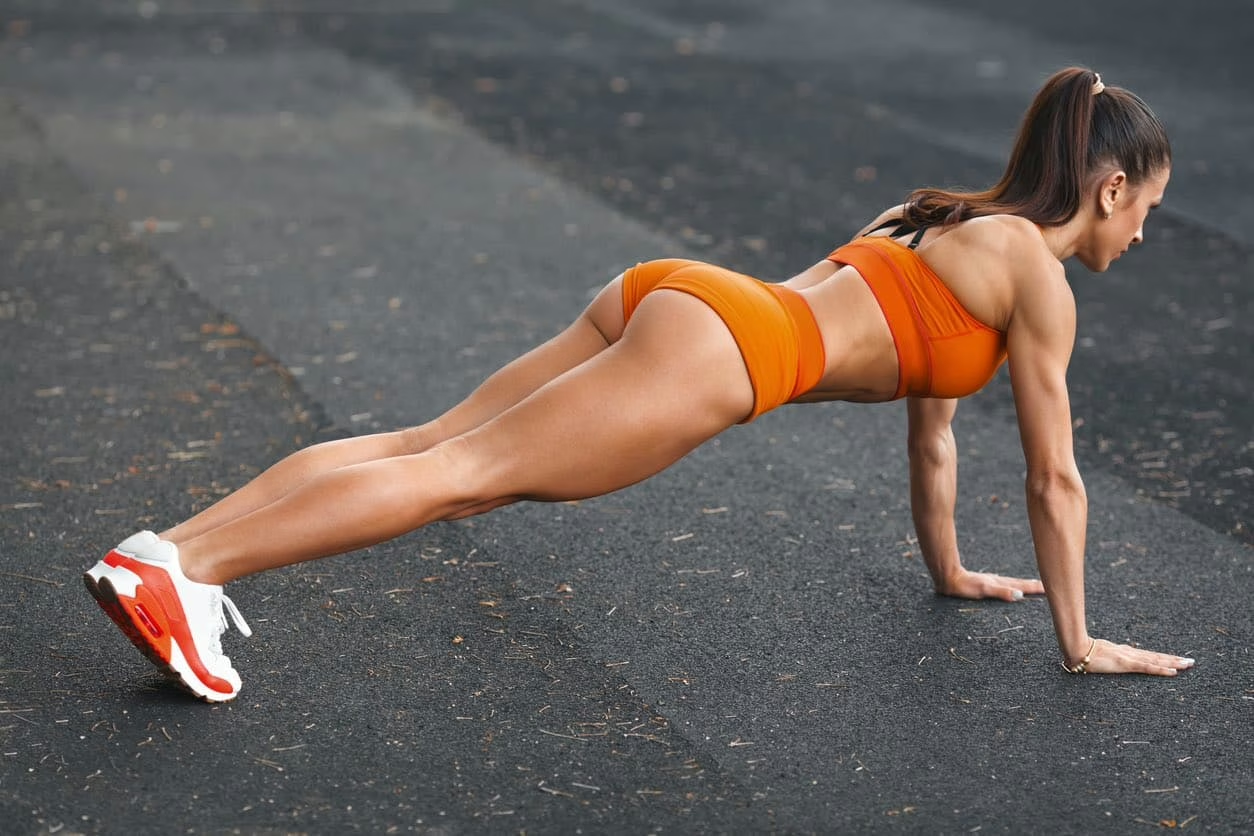
- Brace. Squeeze your glutes, tighten your stomach and make a straight line from your head to your heels.
- Row. Shift a little weight onto your left hand and foot, then pull the right dumbbell up towards your lower ribs, elbow close to your body. Your hips stay level and square to the floor.
- Lower it under control back to the floor, don’t drop it, then repeat on the other side. One row each side is one rep.
Breathe out as you row. Push the planted dumbbell into the floor as hard as you pull the other one up: that push is what keeps you from tipping over. Use hexagonal dumbbells, which don’t roll; round ones can roll out from under your hand.
Common renegade row mistakes

- Twisting to lift the weight. If your hips rotate open as you row, your torso is doing the lifting. Go lighter and widen your feet. The aim is to resist rotation, not use it.
- Going too heavy. Your plank limits this move long before your back does. Use a weight you could row easily from a bench.
- Hips sagging or piking. Keep the straight line from head to heels the whole set.
- Feet together. A narrow base makes it much harder to stay square. Start wide and bring your feet in as you get stronger.
- Rushing. Pause briefly at the top of each row and lower slowly.
What muscles does the renegade row work?
- Upper back and lats: the rowing arm’s latissimus dorsi, rhomboids and middle trapezius, plus the rear shoulder and biceps.
- Abs and obliques: holding the plank works your abs, and resisting the twist when one hand leaves the floor works your obliques.
- Shoulders and chest: the planted arm holds you up on a straight elbow, much like the top of a push-up.
- Glutes and legs: squeezing them keeps your hips level.
We couldn’t find a study that has measured the renegade row itself, so treat any claim that it’s the best back or core exercise with caution. What’s clear is what it asks of you: a row with a much lighter weight than you’d use on a bench, plus a demanding plank. Think of it as a core and conditioning exercise with some back work, not your main back builder. For that, a heavier single-arm row or a lat pulldown is better.
Easier and harder versions
| Version | Sets and reps | How |
|---|---|---|
| 1. Plank shoulder tap | 3 x 8 each side | No weights: lift one hand to tap the other shoulder, hips still |
| 2. Kneeling renegade row | 3 x 8 each side | Same row from your knees, hips in line |
| 3. Renegade row, wide feet | 3 x 6–8 each side | The standard version |
| 4. Renegade row, narrow feet | 3 x 6–8 each side | Less stable, more anti-rotation work |
| 5. Renegade row with push-up | 3 x 5 | A push-up, then a row each side, is one rep |
The push-up version adds chest and triceps work and makes it a full-body conditioning move. If your push-ups need work first, our push-up guide covers form and progressions.
Sets and reps for beginners
Start with 3 sets of 6–8 rows each side with light dumbbells, two or three times a week, with a day between sessions. That matches the American College of Sports Medicine’s advice of 2–3 days a week for novices (ACSM, 2009), and Australia’s guidelines ask adults to do muscle-strengthening work on at least two days a week (Department of Health).
A 20-minute dumbbell workout

Do the exercises as a circuit: one set of each, back to back, then rest 90 seconds and repeat three or four times. You need a pair of dumbbells.
| Exercise | Reps |
|---|---|
| 1. Goblet squat | 10 |
| 2. Renegade row | 6 each side |
| 3. Dumbbell Romanian deadlift | 10 |
| 4. Push-up | 8–12 |
| 5. Reverse lunge | 8 each leg |
For the lower-body moves, see our guides to the sumo squat and kettlebell training. For more core work, try our 20-minute ab workout.
Renegade row FAQ
What weight should I use for renegade rows?
Lighter than you think. Start with 5–10 kg dumbbells. If your hips twist or you can’t lower the weight under control, it’s too heavy.
Are renegade rows good for abs?
Yes, mainly as an anti-rotation exercise: your abs and obliques work to stop your trunk twisting when one hand leaves the floor. That’s the same job they do when you carry something heavy in one hand or brace for a tackle.
Can I do renegade rows without dumbbells?
You can use kettlebells, which are more stable on the floor, or do plank shoulder taps to train the same anti-rotation without any weight.
Renegade row or bent-over row?
For building your back, the bent-over row, because you can lift far more. For core strength and conditioning in one move, the renegade row. They work well in the same program.
Sources: American College of Sports Medicine position stand (2009), Medicine & Science in Sports & Exercise; Australia’s physical activity and exercise guidelines for adults. Checked 29 October 2026.