The push-up is the most useful exercise you can do without equipment. It trains your chest, shoulders, triceps and core at once, you can do it anywhere, and it scales from your first rep on a kitchen bench to one-arm push-ups. The catch is that most people do it badly: hips sagging, elbows flared, half the range. Get the basic rep right first, then use the variations below to make it easier, harder or more specific.
- Hands: just wider than your shoulders, under your chest, fingers spread
- Body: one straight line from head to heels; brace your stomach and squeeze your glutes
- Elbows: tucked in towards your sides, not flared out to a T
- Depth: chest to a fist’s height off the floor, then press all the way back up
- How much you lift: about 64% of your body weight in a standard push-up
- Too hard? Put your hands on a bench. Too easy? Put your feet on one
How to do a push-up
- Set your hands. Place them on the floor slightly wider than your shoulders, level with your chest, fingers spread and pointing forward. Grip the floor as if you’re trying to screw your hands into it.
- Make a plank. Step your feet back so your body is a straight line from head to heels. Brace your stomach as if someone’s about to punch it, and squeeze your glutes. That’s what stops your hips sagging.
- Lower. Bend your elbows and lower your whole body as one piece, elbows tucked in towards your sides rather than flared out. Keep your neck long: look at the floor just ahead of your hands.
- Go deep. Stop when your chest is about a fist’s height from the floor.
- Press. Think about pushing the floor away from you rather than lifting yourself up, and drive back to straight arms. That’s one rep.

Common push-up mistakes
- Sagging hips. The most common fault. If your hips drop, your lower back takes the strain and your core switches off. Brace harder, squeeze your glutes, or raise your hands until you can hold the line.
- Hips in the air. The opposite cheat: it shortens the range and takes work off your chest.
- Elbows flared to 90 degrees. Hands too far forward and elbows out in a T puts the front of your shoulder in a poor position. Bring your hands back under your chest and tuck your elbows in.
- Half reps. Stopping a few centimetres down feels productive but trains a fraction of the movement. Fewer full reps beat more half ones.
- Head dropping. Chin poking towards the floor makes the rep look deeper than it is. Lead with your chest, not your face.
How much of your body weight is a push-up?
More than most people guess. Researchers measured the force through the hands in six versions of the push-up: a standard rep loads about 64% of your body mass, so an 80 kg man is pressing about 51 kg. Raising your feet makes it heavier; raising your hands or dropping to your knees makes it lighter. That gives you a ready-made ladder, from easiest to hardest:
| Push-up version | Body mass lifted |
|---|---|
| Hands on a 61 cm box | 41% |
| From your knees | 49% |
| Hands on a 30 cm box | 55% |
| Standard push-up | 64% |
| Feet on a 30 cm box | 70% |
| Feet on a 61 cm box | 74% |
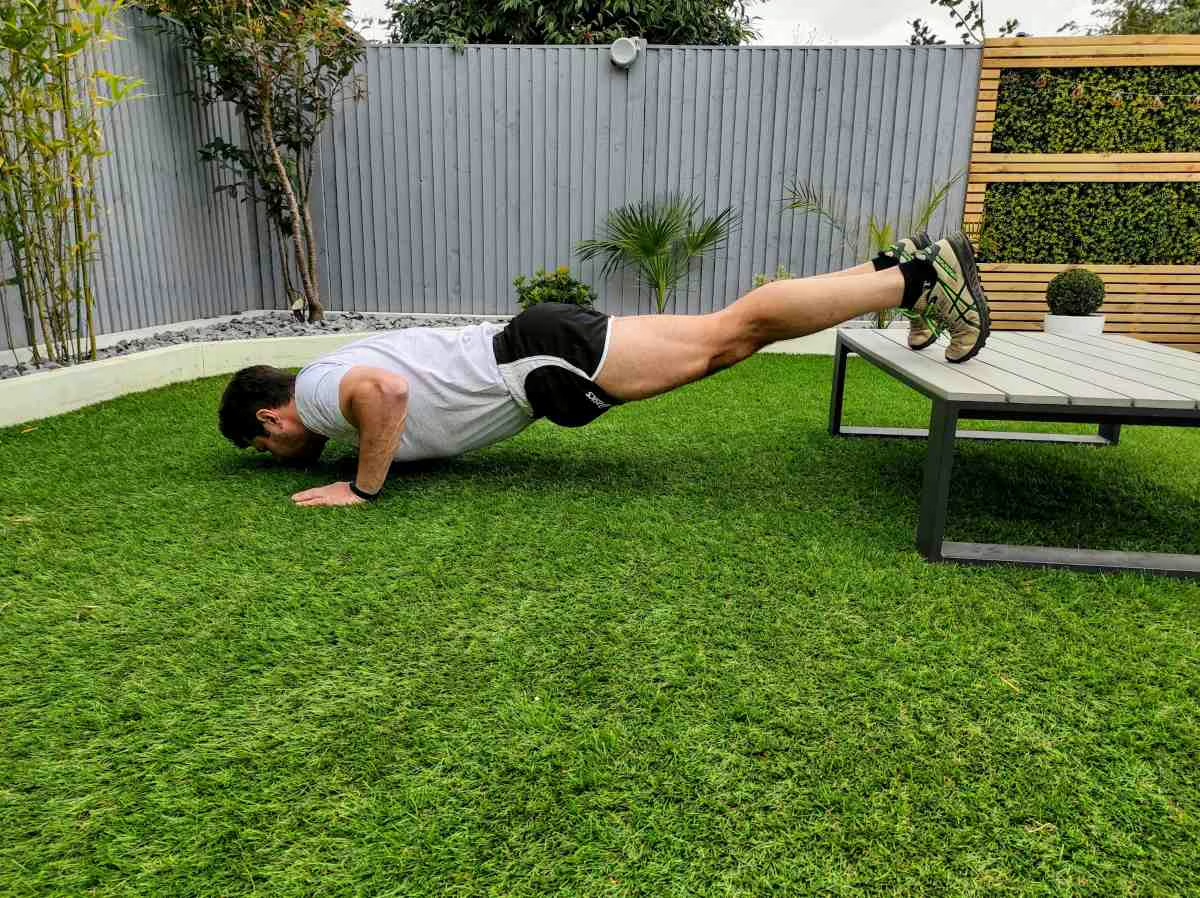
Push-up progression: from your first rep to one arm
Pick the first step where you can do 8 to 12 good reps. When you can do three sets of 12 with clean form, move up a step.
- Wall push-up: hands on a wall, feet a step back. For complete beginners or coming back from injury.
- Incline push-up, high: hands on a kitchen bench or a 60 cm box (about 41% of your body weight).
- Incline push-up, low: hands on a step or 30 cm box (about 55%). Many coaches prefer this to knee push-ups because you still hold the full-body plank.
- Full push-up (about 64%).
- Feet-elevated push-up: feet on a step, then a bench (70–74%).
- Harder variations: 1.5 reps, slow eccentrics, single-leg, then archer and one-arm work.
Want a structure to follow? Our free 28-day military calisthenics plan builds push-ups, squats and core work into four weeks with no equipment.
12 push-up variations, by what they train
These are the types of push-up worth knowing. Each one changes the angle, the base or the speed, which changes where the work goes.
For your chest
1. Wide-grip push-up
Works: chest and front shoulders.
Set your hands a few centimetres wider than normal. It’s a classic chest variation, but don’t go so wide that your elbows flare out to a T. One honest note: the research on hand width is mixed. One study found a narrow hand position worked the chest and triceps harder than a wide one (Cogley and colleagues, 2005), while others have found the opposite (reviewed by Intziegianni and colleagues, 2026). Use wide grip for variety, not because it’s the “chest” push-up.

2. Decline (feet-elevated) push-up
Works: upper chest, shoulders and core.
Put your feet on a step, box or bench and do a normal push-up. The higher your feet, the more weight you lift: about 70% of body mass with your feet on a 30 cm box.

3. 1.5 push-up
Works: chest and triceps, with more time under tension.
Lower to the bottom, press halfway up, lower again, then press all the way up. That’s one rep. The extra half rep keeps your muscles working at the hardest part of the movement.
4. Eccentric (slow) push-up
Works: chest strength, and the best way to get your first full push-up.
Take four or five seconds to lower, then press up normally, or drop to your knees to come back up if you can’t press yet. The slow lowering phase builds strength you can’t yet show on the way up.
For your triceps
5. Close-grip push-up
Works: triceps, plus inner chest.
Bring your hands in until they’re under your chest, a hand’s width or less apart, and keep your elbows brushing your ribs. Touching thumbs and index fingers in a diamond shape makes it harder still.

6. Medicine ball push-up
Works: triceps, chest and shoulder stability.
Put both hands on a medicine ball under your chest. The ball moves, so your shoulders and core have to work to keep it still. Start with a ball that’s heavy and firm.

For power
7. Clap push-up
Works: explosive chest and arm power.
Lower under control, then press up hard enough for your hands to leave the floor, clap, and land with soft elbows straight into the next rep. Keep the sets short (3 to 6 reps) and stop when the height drops.

8. One-arm push-up
Works: chest, triceps and serious core strength.
Set your feet wide, put one hand under your chest and the other behind your back, and lower with your elbow tucked. Most people need months to get one. Build towards it with hands on a bench, lowering the height as you get stronger.

For your core
9. Single-leg push-up
Works: core and anti-rotation strength.
Lift one foot a few centimetres off the floor and hold it there for the whole set. Swap legs on the next set. It’s a small change that makes your trunk work much harder.

10. T push-up
Works: chest, shoulders and rotational core strength.
Do a push-up, then rotate onto one hand and the sides of your feet, reaching the other arm straight up so your body makes a T. Come back down and repeat on the other side. Hold light dumbbells to make it harder.

11. Spider-Man push-up
Works: obliques, hip flexors and chest.
As you lower, bring one knee out to the side and up towards the elbow on the same side. Return it as you press up, and alternate sides each rep.

12. Atomic push-up
Works: chest and core, with your heart rate up.
Put your feet in the straps of a suspension trainer. Do a push-up, then pull both knees in to your chest, then straighten and repeat. It’s a good finisher at the end of a session.

A push-up workout
Do it two or three times a week, with a rest day in between. Rest 60 to 90 seconds between sets, and stop each set one or two reps before your form goes.
| Level | Exercises | Sets x reps |
|---|---|---|
| Beginner | Incline push-up · eccentric push-up · plank | 3 x 8–12 · 3 x 5 · 3 x 30 sec |
| Intermediate | Push-up · close-grip · single-leg · Spider-Man | 3 x 10–15 · 3 x 8–10 · 2 x 8 each · 2 x 6 each |
| Advanced | Clap push-up · decline 1.5s · T push-up · atomic | 4 x 5 · 3 x 8 · 3 x 6 each · 2 x 10 |
Push-ups are only half the picture: balance them with pulling work. Our pull-up and push-up workout pairs the two across four days a week.
Push-up FAQ
How many push-ups should you be able to do?
It depends on your age, and we’ve set out the numbers in how many push-ups you should be able to do at every age. There’s a health angle too: in a ten-year study of 1,104 US firefighters, men who could do more than 40 push-ups had a 96% lower rate of heart disease events than those who managed fewer than 10 (Yang and colleagues, 2019; Harvard Gazette). That’s a link, not proof that push-ups protect your heart, and the men were firefighters, but it’s a useful benchmark.
Do push-ups build muscle?
Yes, if they’re hard enough. In an eight-week Japanese study, men doing push-ups loaded to match 40% of their bench press max gained chest muscle and strength comparable to a bench press group (Kikuchi and Nakazato, 2017). A Spanish study found push-ups made heavy with elastic bands gave strength gains similar to the bench press over five weeks (Calatayud and colleagues, 2015). Once you can do more than about 20, make them harder rather than doing more: raise your feet, add a band or a weighted vest, or move to a harder variation.
Are knee push-ups worth doing?
Yes, as a step. They load about 49% of your body weight against 64% for a full push-up. Hands-on-a-bench push-ups are often a better option because you hold the whole-body plank you need for the full version.
Which push-up is best for your chest?
Feet-elevated push-ups, because they put the most weight through your hands, and 1.5 reps or slow eccentrics for more time under tension. Hand width matters less than people think: studies disagree on which hand position works the chest hardest, so pick the one that feels strongest on your shoulders.
Should you do push-ups every day?
You can do some most days if they’re easy for you, as people do during The Push-Up Challenge. For strength and size, two or three hard sessions a week with rest days between will get you further.
Are push-ups in military fitness tests?
Yes, in most of them, usually alongside a run and a core test. Our beep test guide covers the ADF and police running targets, and the military calisthenics plan trains the rest.
Sources: Wurm, Ebben and colleagues (2011), Journal of Strength and Conditioning Research, also reported by ISBS proceedings and Breaking Muscle; Cogley and colleagues (2005), Journal of Strength and Conditioning Research; Intziegianni and colleagues (2026), Muscles; Kikuchi and Nakazato (2017), Journal of Exercise Science and Fitness; Calatayud and colleagues (2015), Journal of Strength and Conditioning Research; Yang and colleagues (2019), JAMA Network Open. Checked 28 October 2026.