
A new study published in JAMA Network Open followed more than 5,400 women aged 63 to 99 and found something confronting: muscular strength strongly predicted longevity. Yes, the study focused on women. But the implications absolutely apply to men.
Women with higher grip strength and better lower-body power had roughly a one-third lower risk of premature death over eight years — even after researchers adjusted for aerobic fitness, daily activity, inflammation, age, smoking and general health.
Grip Strength Predicts Mortality
And then there’s this: a 2024 Nature study, for instance, of almost 10,000 men and women found that weak grip strength equated to an increased risk of early death. Similarly, a 2016 review of past research concluded that muscular weakness reliably predicted upcoming concerns with “cognition, mobility, functional status and mortality.” It’s also the science behind old-man strength — why some older guys stay surprisingly strong.
Large international datasets, including UK Biobank and the PURE study, have shown grip strength predicts mortality in both sexes. In some analyses, weak grip strength predicted death more strongly than high blood pressure. That should get your attention.
In Australia, cardiovascular disease remains the leading cause of death, accounting for roughly one in four deaths nationally, according to the Australian Bureau of Statistics and the Heart Foundation. Strength training directly improves many of the risk factors involved: insulin sensitivity, blood pressure, inflammation, body composition and bone density.
Men begin losing muscle mass from their mid-30s. Strength declines even faster than muscle size — a process known as dynapenia. Testosterone gradually drops. Fast-twitch fibres shrink. Neuromuscular efficiency fades. Ageing is not just about wrinkles. It’s about losing biological reserve. This is exactly why building muscle, losing fat and avoiding injury requires structured resistance training, not just more cardio.
And strength appears to be one of the clearest external markers of how much reserve you have left.
Importantly, the women in the study were not elite athletes. The strongest group averaged about 24 kilograms of grip strength and completed five sit-to-stands in around 11 seconds. That’s solid but achievable.
This wasn’t CrossFit. It was competence.
That competence can be built in less theatrical places too: Milton H. has completed 500 Pure Barre classes at 92, a useful reminder that consistent training matters before the exercise looks impressive.
The study cannot prove that strength causes longer life — it’s observational. Stronger people may have had better nutrition or healthcare. But when observational data aligns with decades of mechanistic research showing resistance training improves metabolic health, mitochondrial function and inflammatory markers, the signal becomes hard to dismiss.
Cardio keeps you fit. Strength keeps you resilient. For men, who often prioritise aerobic training or aesthetics over long-term structural capacity, the message is simple: If you want to live long, lift. Not for ego. But for insurance.
Strength after 50 is not limited to slowing decline. Brazilian Almir Rogério da Silva reportedly lost 80kg after 51, became a competitive bodybuilder and later posted a 220kg gym deadlift. The story of Vovô Bodybuilder is an extreme example, but it demonstrates how much physical capacity can still be developed in midlife.
Test Your Strength at Home (Longevity Check)
These are not performance metrics. They are resilience markers.
1. Grip Strength
Best measured with a hand dynamometer (available at many gyms or online).
General reference ranges for men:
- 40–49 years: ~45–50 kg
- 50–59 years: ~40–45 kg
- 60+: ~35–40 kg
If you don’t have a dynamometer, try this:
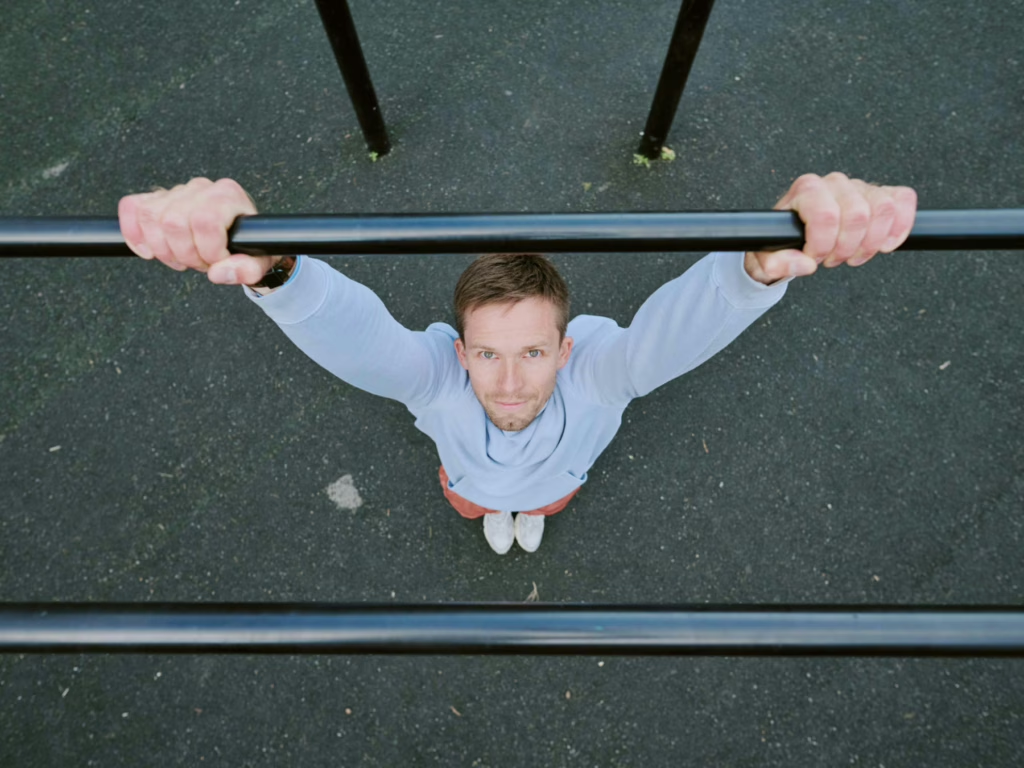
- Dead hang from a pull-up bar
- Under 40: aim for 60 seconds
- 40–50: aim for 30–45 seconds
- 60+: aim for at least 10–20 seconds
2. 5x Sit-to-Stand Test
Sit on a chair, arms crossed over chest.
Stand up and sit down five times as fast as possible.
Benchmarks:
- Under 12 seconds = good functional lower-body power
- Over 15 seconds = potential weakness marker
3. Relative Strength Check
Can you:
- Perform 10 controlled push-ups?
- Carry two heavy grocery bags without strain?
- Climb stairs without using the rail?
If not, strength deserves attention. Worth pairing with our BMI Calculator for Men Who Lift for a fuller read on where you stand. If it’s your grip specifically that’s fading, a 380,000-person study also links it to cognitive decline — worth testing yours.