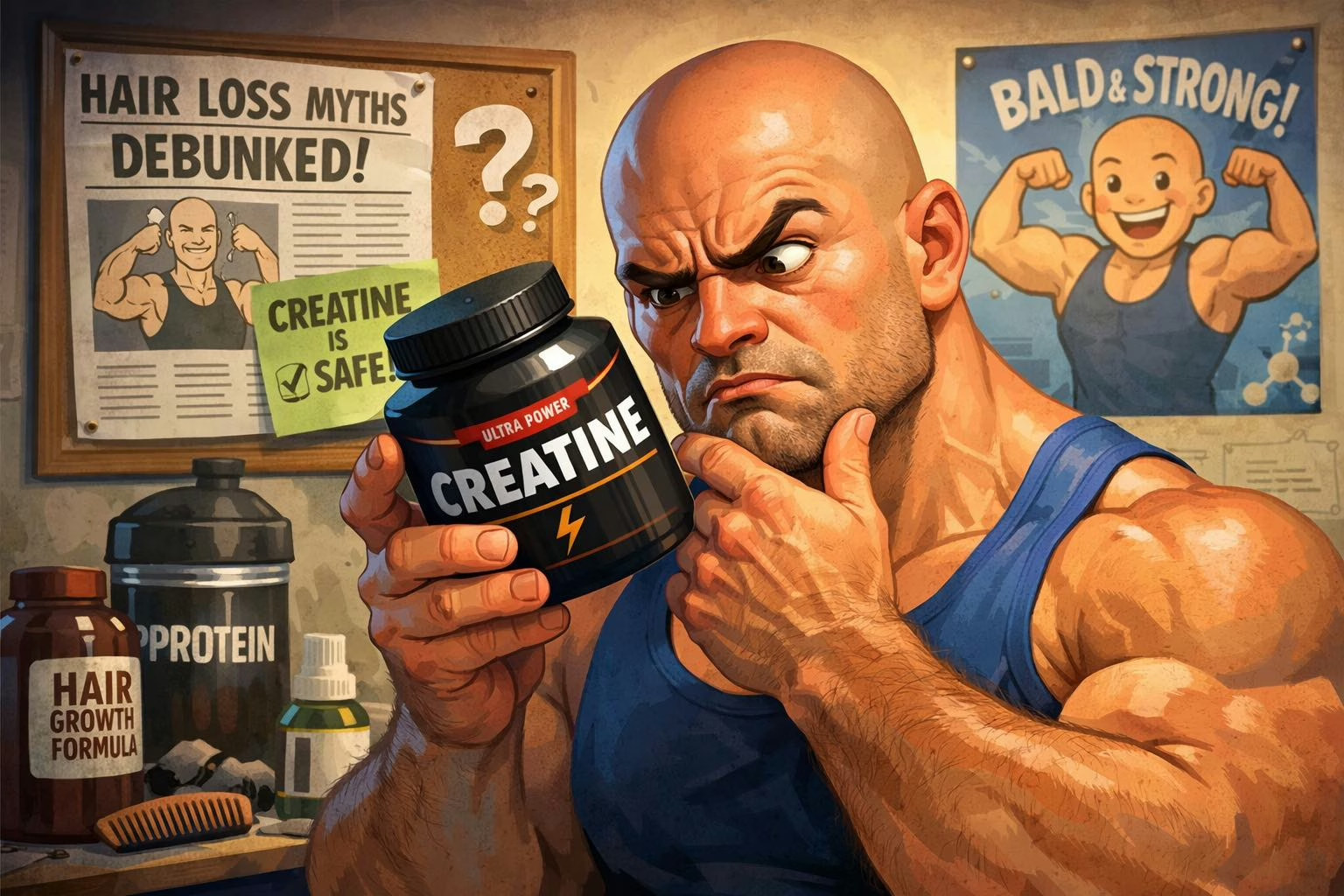
Short answer: no. There’s no good evidence that creatine causes hair loss. The whole rumour traces back to one small 2009 study of rugby players that measured a hormone, not hair. In 2025, the first trial to actually check men’s scalps found no difference in hair between creatine and placebo after 12 weeks.
Creatine has had a resurgence. What was once a staple of 90s bodybuilding has become one of the most widely used supplements across gyms, sport and, increasingly, general health conversations. People are taking it for muscle, for the brain, for sleep and for ageing, on the back of decades of research. And with that has come the old rumour, back with fresh legs: creatine makes you bald. Don’t take it if you’re already thinning. A mate stopped using it because he reckoned his hairline was shifting.
Here’s where the claim came from, what the newer trial found, what DHT really does to your hair, and what to do if you’re already thinning.
- Does creatine cause hair loss? No study has shown it does.
- Where the fear started: a 2009 South African study of college rugby players. DHT rose 56% after a week of high-dose loading. Hair was never measured.
- The newer evidence: a 2025 randomised controlled trial gave men 5 g a day for 12 weeks. No change in DHT, and no change in hair count, density or thickness versus placebo.
- Testosterone: most studies find creatine doesn’t change it.
- What drives male pattern baldness: mainly your genes and how sensitive your hair follicles are to androgens.
- Dose: 3–5 g of creatine monohydrate a day. Loading is optional.
Where the claim comes from: the 2009 rugby study
The entire creatine-hair loss theory traces back to a single study published in 2009 in the Clinical Journal of Sport Medicine. Researchers in South Africa gave 20 college rugby players three weeks of creatine and three weeks of a glucose placebo, in random order with a six-week break in between (16 finished).
The creatine phase started with a week of loading at 25 g a day, then two weeks at 5 g a day. Testosterone didn’t change. But DHT (dihydrotestosterone, the hormone linked to male pattern baldness) rose 56% after the loading week and was still 40% above baseline at the end.
That’s the study. One study, with no hair measurements at all. And the details matter:
- The DHT levels stayed normal. Even after the rise, every reading on both creatine and placebo sat within the normal range for healthy men, as both a 2021 ISSN review and the 2025 trial authors point out.
- The creatine phase started low. Baseline DHT was about 23% lower in the creatine condition than in placebo, and placebo DHT drifted down slightly over the study. That gap helped make the change “statistically significant”.
- It used a big loading dose. 25 g a day is five times the usual daily dose.
- It was never repeated. No later study has reproduced the DHT jump.
To be fair to the researchers, they didn’t claim creatine causes baldness. They said the androgen change was worth investigating further. The internet did the rest.
The 2025 trial that actually looked at hair
Sixteen years later, someone finally checked scalps. A randomised, double-blind, placebo-controlled trial published in April 2025 in the Journal of the International Society of Sports Nutrition asked the question in its title: does creatine cause hair loss?
Researchers in Iran recruited 45 resistance-trained men aged 18 to 40. Half took 5 g of creatine monohydrate a day, the other half took 5 g of maltodextrin, for 12 weeks. Thirty-eight finished. The team measured total testosterone, free testosterone and DHT in the blood, and used trichogram scalp imaging to track hair count, hair density, follicle numbers, the share of hairs in the growth phase, and total hair thickness.
The result: no difference between the groups on any of it. DHT didn’t change, the DHT-to-testosterone ratio didn’t change, and none of the hair measures moved. Total testosterone rose and free testosterone fell over the 12 weeks in both groups, with no difference between them, so that wasn’t the creatine either. The authors call it “strong evidence against the claim that creatine contributes to hair loss”.
Our read: it’s the best evidence we have, but it isn’t the last word. It’s one trial of 38 men over three months. It didn’t record family history of baldness, and it excluded men already treating hair loss. None of that sinks it. It just means the claim that creatine causes hair loss now has a proper trial against it, and still nothing in its favour.
The evidence at a glance
| Study | What it found |
|---|---|
| van der Merwe et al., 2009 (20 rugby players, 16 finished; crossover, 3 weeks, 25 g/day loading then 5 g/day) | DHT up 56% after loading, 40% at three weeks, still within normal range. Testosterone unchanged. Hair not measured. |
| 12 other studies on testosterone (3–25 g/day, 6 days to 12 weeks; summarised by the ISSN in 2021) | Ten found no change. Two found small, short-lived rises. None that measured free testosterone found an increase. |
| Lak et al., 2025 (38 trained men, 12 weeks, 5 g/day vs placebo) | No difference in DHT, DHT-to-testosterone ratio, hair count, density or thickness. |
| Studies showing creatine causes hair loss | None. |
What DHT actually does to your hair
DHT is a more potent form of testosterone. Your body makes it when an enzyme called 5-alpha reductase converts testosterone. In susceptible hair follicles, DHT binds to androgen receptors and shrinks the follicle over time, so the hairs grow back thinner and shorter until they stop.
The key word is susceptible. Male pattern baldness is an inherited condition: the follicles of men who go bald are more sensitive to androgens (healthdirect; MedlinePlus). Having a close relative with pattern hair loss is a risk factor, and it gets more common with age.
So even if creatine nudged DHT up, which only the 2009 study found, the real question is whether a small rise that stays in the normal range speeds up hair loss in men who are already prone to it. The 2025 trial is the only one to measure hair at all, and it found nothing, though it didn’t single out men already prone to balding.
What the rest of the research says about testosterone
If creatine were pushing up androgens, you’d expect it to show up in testosterone studies. It mostly doesn’t. The International Society of Sports Nutrition’s 2021 review of common creatine myths counted 12 other studies that measured testosterone during creatine use. Ten found no change. Two found small increases after six or seven days that the reviewers called physiologically insignificant. Five also measured free testosterone, the pool your body uses to make DHT, and none found a rise.
Their conclusion: the evidence “does not indicate that creatine supplementation increases total testosterone, free testosterone, DHT or causes hair loss/baldness”. If you’re chasing testosterone, creatine isn’t the lever anyway. These are the things that actually move it.
The honest answer if you’re already thinning
If you’ve got a full head of hair and no family history of baldness, there’s no credible evidence creatine will change that.
If you’re already losing your hair, or your dad and grandfather were both bald by 40, the picture is less complete. Not because the evidence says creatine makes it worse (it doesn’t), but because nobody has run a long trial in men who are already balding. A few practical points:
- Skip the loading phase. The biggest DHT jump in 2009 came after a week at 25 g a day. Loading isn’t required: 3 g a day fills your muscles more slowly, over about four weeks, and gets you to the same place (ISSN position stand, 2017). Our read: if DHT worries you, there’s no downside to a steady 3–5 g a day.
- Don’t panic about hairs in the shower. Losing around 50 to 100 hairs a day is normal (American Academy of Dermatology).
- See your GP if you’re worried. healthdirect recommends seeing a doctor if your hair loss bothers you, you’re losing more than usual or your hairline is receding. There are medical treatments for male pattern baldness.
The honest answer: the evidence doesn’t support avoiding creatine over hair loss, and the one trial that measured hair directly came up empty.
What creatine actually does
Since we’re here: creatine is one of the most researched supplements there is. It raises phosphocreatine stores in your muscles, which helps regenerate ATP faster during hard, short efforts. That means more reps, more power and, over time, more muscle.
The standard dose is 3–5 g of creatine monohydrate a day. You don’t need to load and you don’t need to cycle it. Plain monohydrate is the form with the research behind it, and the cheapest; here’s why the fancier HCl version isn’t worth the extra money. It’s also one of the few supplements that made Dr Mike Israetel’s shortlist of five.
If you’ve been avoiding it because of a rumour that started with one small study in South Africa more than 15 years ago, you’ve probably been leaving gains on the table for no good reason. One study found a DHT rise that stayed in the normal range. It’s never been repeated. The one trial that measured hair found nothing. If you’re worried about your hairline, your genes are doing far more work than your pre-workout stack.
Take the creatine.
FAQs
Does creatine cause hair loss?
There’s no evidence it does. One 2009 study found a rise in DHT, a hormone linked to male pattern baldness, but it didn’t measure hair and has never been repeated. A 2025 randomised trial that measured hair directly found no difference between creatine and placebo after 12 weeks.
Does creatine increase DHT?
Only one study has found that. In 2009, DHT rose 56% in rugby players after a week of loading at 25 g a day, and stayed within the normal range. The 2025 trial, using 5 g a day for 12 weeks, found no change in DHT or in the DHT-to-testosterone ratio.
Will my hair grow back if I stop taking creatine?
Creatine hasn’t been shown to cause hair loss, so stopping it isn’t a known fix. If you’re thinning, the likeliest cause is male pattern baldness, which is inherited. See your GP about what’s causing it and what can be done.
Should I avoid creatine if I’m already losing my hair?
The research doesn’t say you should. No long trial has tested creatine in men who are already balding, so if you’re concerned, skip the loading phase, stick to 3–5 g a day and talk to your GP or a dermatologist.
Does creatine raise testosterone?
Generally no. Of 12 studies reviewed by the International Society of Sports Nutrition in 2021, ten found no change and two found small, short-lived rises. Studies that measured free testosterone found no increase.
What is the recommended dose of creatine?
3–5 g of creatine monohydrate a day. Loading at about 20 g a day for five to seven days fills your muscles faster, but it’s optional: a daily 3 g gets you there in about four weeks. There’s no need to cycle it.