

Calisthenics is bodyweight training — push-ups, pull-ups, dips, squats and the harder skills that build on them — done with little or no equipment. That’s the plain definition. In everyday use, though, the word has narrowed: search “calisthenics” today and most people mean the street-workout scene built around park bars and playgrounds, chasing skills like the muscle-up, the front lever and the human flag, not just staying in shape.
Technically, it’s almost any form of bodyweight training – but recently it’s come to mean the “sport” of urban calisthenics: a street workout consisting of moves done on pull-up bars or playground equipment, focusing on advanced variations that include bar spins and muscle-ups.
New to bodyweight training? Start with our beginner calisthenics plan before working up to the strength program below.
What’s it good for?
“Calisthenics is a great training method to build strength and gain strength and master control of your body,” says Darren Onyekwe, a calisthenics specialist who also teaches known systems such as Bodyweight D. “More important: by learning to build tension throughout your body, you’ll be in better control when it’s time to lift. And, of course, it’s great Instagram-fodder.”
What are its limitations?
If you’re trying to pack on loads of muscle mass, calisthenics isn’t the most efficient option,” says Onyekwe. “Combined with a sensible diet, it’ll create a lean, defined body like a gymnast’s.” Weight added into workouts helps, Onyekwe says. You’ll also need to think creatively to train legs. Pistol squats are an option, as is lunging with an improvised balance.

Calisthenics vs weights: which builds more muscle?
Straight answer: weight training, for most men, packs on raw muscle mass faster. Onyekwe’s own view above is honest about that — calisthenics is exceptional for relative strength, body control and a lean, gymnast-style physique, not maximum size. That’s not calisthenics failing at the job; it’s a different job. If the goal is the biggest possible frame, progressive overload with external weight wins. If the goal is being strong for your bodyweight, moving well, and building a physique that looks capable rather than simply big, calisthenics is arguably the harder, more honest test. Plenty of men do both — a lifting base with calisthenics skill work layered on top, which is exactly where a combined move pull-up and push-up program earns its keep.
The Workout: Build Bodyweight Strength
“This workout is focused on strength, so the reps are kept low and there’s a decent amount of rest between sets,” says Onyekwe. “Focus on quality movement.” Do it twice a week, supersetting the moves marked A and B, resting for as long as you need to get through the reps.
The Workout: Build Bodyweight Strength
Sets: 3 Time: 20–30 sec Rest: 1–3 min
Do it on bars or the edge of a sofa/chair. If that’s too hard, try the bent-leg version—tuck your legs.
Sets: 5 Reps: 5 Rest: 1–3 min
Aim to pull your elbows down, not raise your body. Use a full range—go to the bar on each rep.
Sets: 5 Reps: 5 Rest: 1–3 min
Lower until your upper arms are parallel to the floor, pause, and push back up.
Sets: 5 Reps: 10
Keep your hands under your shoulders, tuck your elbows to your sides, and bring your chest to the floor. Push up and squeeze your abs and glutes.
Sets: 5 Reps: 10 Rest: 1–3 min
Lie under a bar or Smith machine with your feet flat and body straight. Pull up until your chest touches the bar, pause and lower.
Sets: 5 Time: 60 sec Rest: 1–2 min
From the hollow hold, roll onto your front and lift arms and legs off the floor. Steel-style. It’ll build near-bulletproof abs.
Sets: 5 Reps: 20
With your feet shoulder width apart, squat down so your thighs are parallel to the floor. Drive back up through your heels.
Sets: 5 Reps: 12 Rest: 1–2 min
Lie on the floor with your feet closest to your glutes. Drive your hips up in the air, pause and lower.
Instant Expertise
Know your scapula
“Your shoulder blades act as stabilisers in your positions: protraction, retraction, depression,” says Onyekwe. “Few people even understand the advanced skills of cueing work depending on which position they’re using.” The scapulohumeral rhythm is vital for good form. “Brace and keep your elbows straight and shoulders back. Move your shoulder blades together to set up, and keep your shoulders away from your ears.”
Unleash L
Make the L-sit your new favourite abs move. “This static position strengthens your shoulder blades,” says Onyekwe. “But you’ll also build abs most people will never touch. If you need work on it, do L-holds with one foot on the floor.”
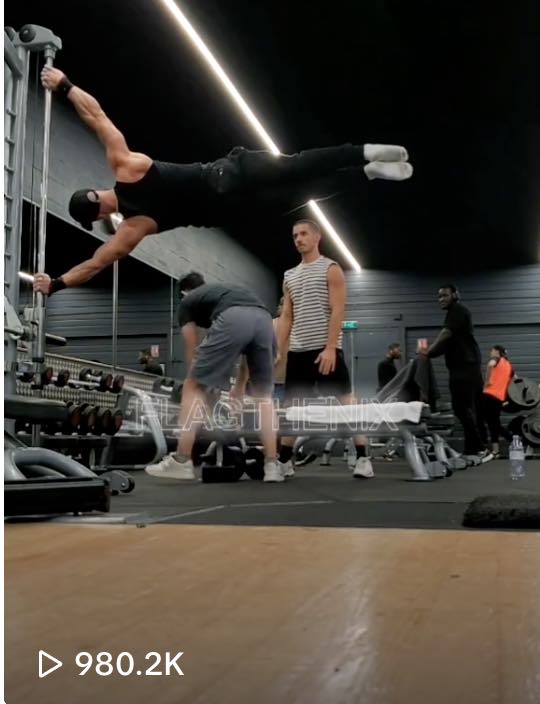
Fly the flag
The human flag is one of calisthenics’ best-seen drills – and Instagrammed. “It’s a semi-opposed skill, meaning it requires you to push with one arm and pull with the other,” says Onyekwe.
You’ve made it when…
…Calisthenics isn’t about volume, it’s about how you move. “Most people look at the top-level and they’re more interested in the quantity,” says Onyekwe. “A lot of people are attracted by the highlight-reel moves, but it’s usually the simple moves – pushups, dips, pullups, squats and hanging knee raises. I respect anyone who’s strong, and has control throughout the range of movement.”
Pull-ups are one of the cornerstone calisthenics moves. See how many pull-ups you should be able to do at your age to check where you stand.