

You’ve done your squats or deadlifts and you’ve got ten minutes left. A CrossFit finisher turns those ten minutes into a short, hard burst of conditioning, so you leave the gym fitter as well as stronger without adding a whole extra session.
Below: what a finisher is, how to use one without wrecking your lifting, and 10 CrossFit finishers of five to eight minutes each, with a scaled option for every one.
Finishers originally programmed by strength coach Alyssa Ages.
- What it is: a short burst of conditioning tacked onto the end of a strength session.
- How long: five to 10 minutes. Every finisher below runs five to eight.
- Formats: AMRAP (as many rounds as possible), EMOM (every minute on the minute) or a few rounds for time.
- When: after your main lifts, never before them.
- How often: our read: two or three sessions a week is plenty.
- Will it hurt your gains? A big 2022 review found cardio alongside lifting didn’t hold back muscle size or maximal strength. Explosive power took a small hit, mainly when both were done in the same session.
Want full WODs instead? These are bolt-ons, not stand-alone workouts. For Fran, Murph, Cindy and the rest, go to 20 brutal CrossFit workouts.
What is a CrossFit finisher?
A finisher is a short, high-intensity piece done at the end of a session, once the main work is finished. In CrossFit speak it’s a mini metcon (metabolic conditioning): a few movements, done fast, with little or no rest.
It’s not the workout. A WOD is the main workout of the day, anything from a few minutes (Fran) to an hour or more (Murph). A finisher is the full stop at the end of your lifting, short enough that you can go hard from the first rep.

How to use a finisher
Do it last. Warm up, do your mobility, then your main lifts (squats, deadlifts, presses). The finisher comes after. Your heavy sets deserve fresh legs and a clear head.
Keep it short. Five to eight minutes. If you could keep going for 20 minutes, you’re going too easy. If your form falls apart after two minutes, the weight is too heavy.
Two or three times a week. Our read: that’s enough to build your engine without leaving you flat for your next lifting session. Skip it on days when you’re chasing a heavy single or doing jumps and Olympic lifts.
There’s research behind that last point. A 2022 review in Sports Medicine pooled 43 studies and found that adding aerobic training to strength training didn’t compromise muscle growth or maximal strength. Explosive strength was the exception: it improved a little less, especially when both kinds of training were done in the same session rather than at least three hours apart (abstract). The studies mostly used running and cycling, not CrossFit-style circuits, so it isn’t a direct test of finishers. Our read: a short one is unlikely to cost you muscle.
Scale it. Every finisher below has an easier version. Use a lighter bell, cut the reps, or swap the hard move. The point is to keep moving for the full time.
Score it. Write down your rounds or your time. Repeat the same finisher in four weeks and see if you’ve beaten it.
One more thing. A finisher won’t uncover your abs on its own. Our read: that comes down to diet and sleep, as our piece on how to get a six pack explains.
Pick your finisher
| Finisher | Best for |
|---|---|
| 1. Carry, swing, sit-up (6-min AMRAP) | Grip and core |
| 2. Sled, box jump, plank (5-min AMRAP) | Leg drive |
| 3. Deadlift, wall ball, hollow rock (3 rounds for time, 8-min cap) | Legs and core |
| 4. Snatch, push-up, toes-to-bar (6-min AMRAP) | Upper body |
| 5. Rope, burpee, get-up (8-min AMRAP) | Lungs and coordination |
| 6. Clean and press, dips, plank (6-min EMOM) | Shoulders and arms |
| 7. Thruster, slam, V-up (5-min AMRAP) | Full-body burn |
| 8. High pull, row, sit-up (3 rounds for time, 8-min cap) | Engine |
| 9. Manmaker, jump lunge, twist (6-min AMRAP) | Total body |
| 10. Lunge, goblet squat, toes-to-bar (6-min AMRAP) | Legs |
The 10 CrossFit finishers
1. Grip strength and core (6-minute AMRAP)
Farmer carry (15 metres)
Kettlebell swings (10)
Weighted sit-ups (15)
Use farmer handles if your gym has them. If not, grab two dumbbells or kettlebells of the same weight, heavy enough to make the carry hard. Brace your core and keep your shoulders back. Scale it: lighter bells and unweighted sit-ups.
2. Explosive force and core (5-minute AMRAP)
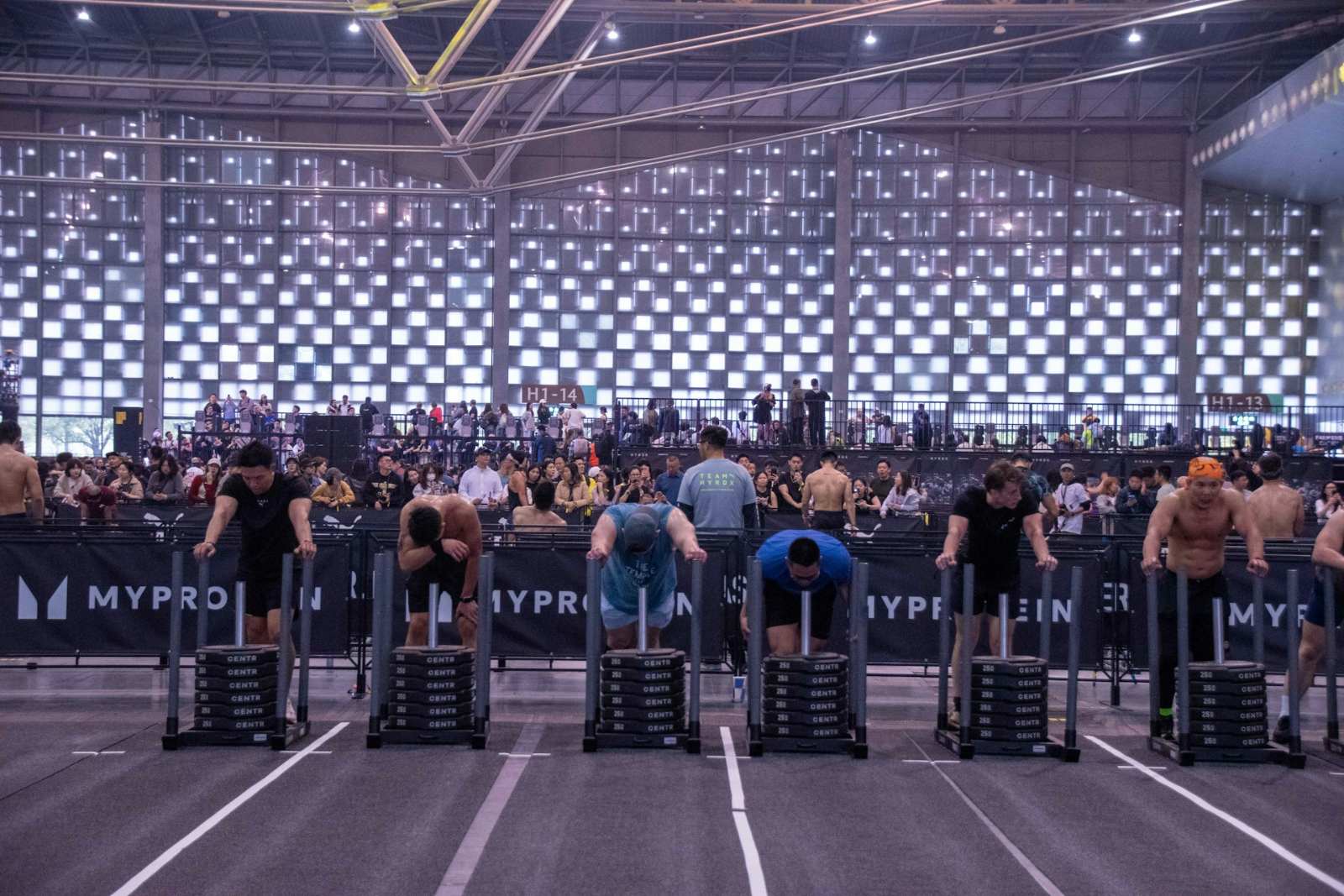
Sled or prowler push (20 metres)
Box jumps (10)
Plank shoulder touches (20)
Load the sled heavy enough to make it hard but light enough that you can still move fast. On the shoulder touches, keep your hips as still as you can. Scale it: step-ups instead of box jumps. No sled? Do a 20-second sprint on the bike or rower.
3. Legs and core (3 rounds for time, 8-minute cap)
Deadlifts (8)
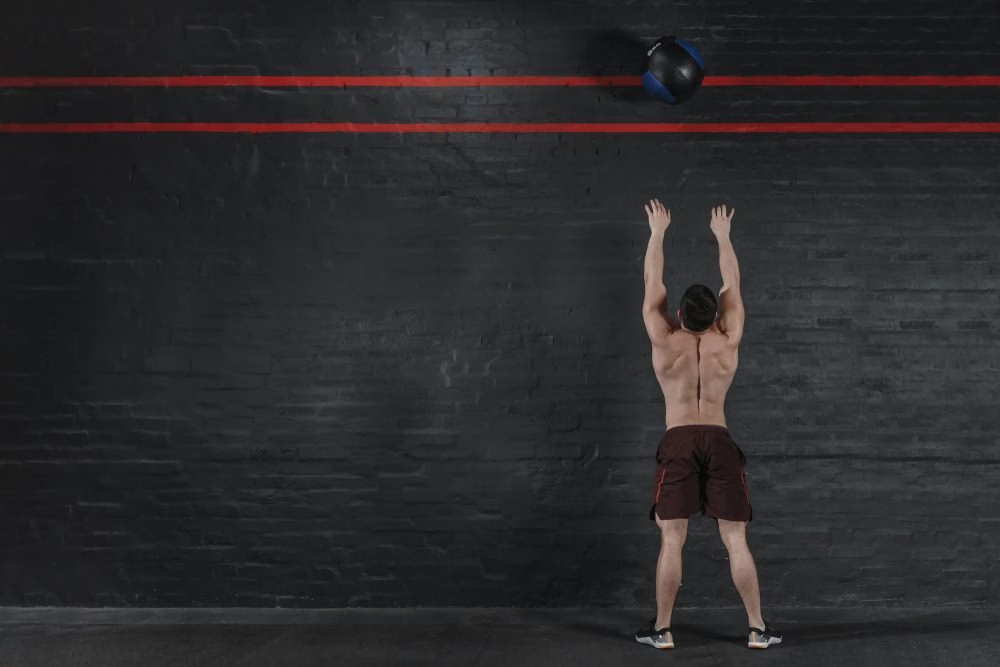
Wall balls (12)
Hollow rocks (15)
You’ve probably already lifted heavy, so pick a deadlift weight you can move with a flat back while you’re breathing hard. For the hollow rock, lift your shoulders and legs off the floor, arms straight by your ears, and rock using only your core. Nothing touches the ground. Scale it: a hollow hold with bent knees instead of rocking.
4. Chest, back and core (6-minute AMRAP)
Dumbbell snatches (8 per side)
Push-ups (10)
Toes-to-bar (10)
Can’t get your toes to the bar yet? Draw your knees up towards your elbows instead. Scale it: knee raises and push-ups on a bench.
5. Jump rope cardio burner (8-minute AMRAP)
Double-unders (20 to 50)
Burpees (10)
Turkish get-ups (5 per side)
Double-unders take time to learn, so don’t get frustrated. If you’ve got them, go for 50 unbroken. If not, aim for 20 total by doing two singles, then one double. Keep the get-ups slow and controlled with a light bell: this is the part where your heart rate comes down a little. Scale it: 60 single skips.
6. Arms and abs (6-minute EMOM)
Odd minutes: kettlebell clean and press (5 per side)
Even minutes: dips (10), then a weighted plank for the rest of the minute
Do the dips on parallel bars or rings, or on a bench if that’s all you have. For the plank, start with a 5kg plate on your back and work up to 10kg or more. New to the format? Our EMOM workout guide explains how it works. Scale it: bench dips and a plank without the plate.
7. Legs and core (5-minute AMRAP)
Dumbbell thrusters (10)
Med ball slams (10)
V-ups (20)
For the slams, lift the ball overhead, then bend your knees and follow it down as you slam it. Pick it up the moment it lands. Scale it: lighter dumbbells and tuck-ups instead of V-ups.

8. Total-body explosive training (3 rounds for time, 8-minute cap)
Kettlebell sumo deadlift high pulls (12)
Row (250 metres)
Weighted sit-ups (10)
For the high pull, take a wide stance, drive your feet into the floor and squeeze your glutes as you pull the bell up to chin height, elbows high. We’ve cut the row from 500 to 250 metres so three rounds stay inside about eight minutes. Scale it: two rounds.
9. Total-body cardio circuit (6-minute AMRAP)
Manmakers (5)
Jumping lunges (20)
Russian twists with a kettlebell (20)
For each manmaker, put two dumbbells on the floor, shoulder-width apart. Grip them, step or jump back to a plank, do a push-up, then a renegade row on each side. Bring your feet back in and finish with a squat clean into a thruster. Scale it: drop the push-up, and swap jumping lunges for walking lunges.
10. Legs and back (6-minute AMRAP)
Racked alternating reverse lunges (20)
Goblet squats (10)
Toes-to-bar (10)
Hold two kettlebells of the same weight at shoulder height, keep your chest up and step back into a lunge, alternating legs for 20 reps in total. Scale it: one kettlebell held in the goblet position for both the lunges and the squats.
Want more? Our HIIT workouts and 20-minute ab workout work as stand-alone sessions, and the 20 brutal CrossFit workouts are there when you want the full thing.
FAQ
What is a finisher in CrossFit?
A short, hard piece of conditioning done at the end of a session, after the main strength or skill work. Think of it as a mini WOD of five to 10 minutes.
How long should a finisher be?
Five to 10 minutes. Our read: if it’s going past 10 minutes, it’s a workout, not a finisher, and it’s eating into your recovery.
Should I do a finisher every session?
No. Our read: two or three a week is plenty. Leave them out on heavy or explosive days, and if you’re already doing full WODs, you probably don’t need them at all.
Will a finisher kill my gains?
Unlikely. A 2022 review of 43 studies found that adding aerobic training to strength training didn’t hold back muscle size or maximal strength. Explosive strength gains were slightly smaller, especially when both were done in the same session.
What’s the difference between a finisher and a WOD?
Length and job. A WOD is the main workout of the day, anything from a few minutes (Fran) to an hour or more (Murph). A finisher is a short add-on after your lifting. For full WODs, see our 20 brutal CrossFit workouts.
Are finishers good for beginners?
Yes, scaled. Pick the simpler finishers (1 or 7), use light weights and stick to five minutes. Good form matters more than speed when you’re tired.