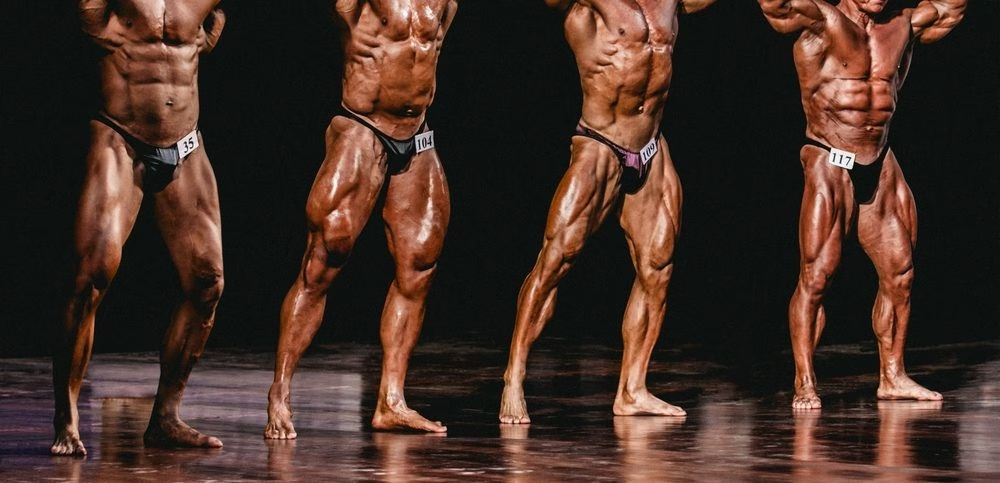
Imagine spending months training, dieting and getting lean enough to make a chicken breast feel like a treat. You steer clear of steroids, SARMs, peptides and everything else on the banned list. You do it properly. You’re natty, one-hundred percent.
Then, before you are even allowed on stage, you sit down for a lie-detector test. You’re understandably nervous, jittery. After all, you’re about to go on stage dressed in little more than a coin purse. And you fail the test.
Here’s the uncomfortable part: polygraphs are not infallible.
So in theory, you could do everything right, arrive on the Gold Coast in the best shape of your life, and still have your competition end before you ever hit a Front Lat Spread.
At WNBF Australia’s Gold Coast event at Glow Church on 19 September 2026, the polygraph isn’t theatre. It is one part of the entry process.
The Tests
In the days before the show, every competitor sits for a polygraph examination. It costs $150, takes about half an hour once the paperwork’s done, and exists for one purpose: to check whether the athlete is telling the truth about being drug-free. Fail it, and the federation’s own policy is unambiguous: “he or she will not be allowed to compete. No exceptions.” Not a warning. Not a please-explain. You go home.

Can a lie detector really catch a steroid user?
Here’s where it gets uncomfortable for WNBF, and where the story gets more interesting than a straight write-up of the rules.
The polygraph doesn’t detect drugs. It detects physiological stress responses — heart rate, skin conductivity, breathing — while someone answers questions, on the theory that lying produces measurably more stress than telling the truth. The American Psychological Association’s summary of decades of research on the technique is blunt: “Most psychologists and other scientists agree that there is little basis for the validity of polygraph tests.” A 2003 US National Academy of Sciences report found the standard polygraph technique could identify lies correctly around 70% of the time — but couldn’t establish how often it wrongly flagged an honest answer as a lie, because the false-positive rate is essentially unknown. A 2019 review found the science hadn’t moved much since.

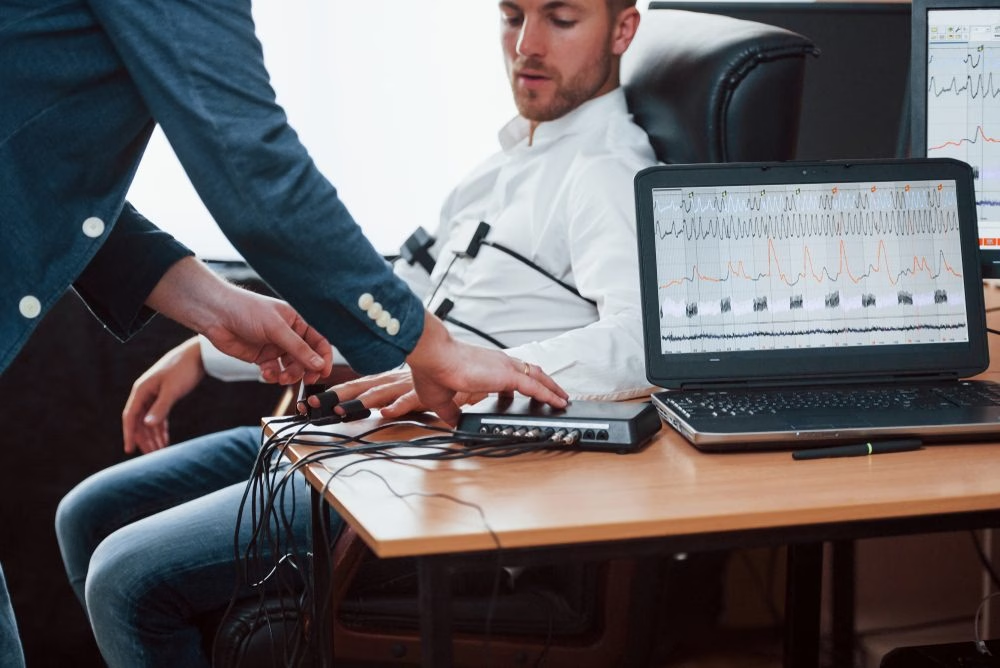
The core problem is that the machine can’t actually tell the difference between “I’m lying” and “I’m extremely nervous because a stranger is asking me questions about steroids while I’m dehydrated, spray-tanned and forty minutes from walking on stage.” Both look the same on the printout.
None of which makes the polygraph pointless. It’s a real deterrent, a real cost, and a real filter — some competitors are presumably not walking in the door because they know it’s there. It’s just not the forensic-grade lie-proof machine the phrase “lie detector” implies. Combined with the urinalysis testing for winners, WNBF is really running two different, imperfect checks and hoping the gaps don’t overlap. That’s a defensible strategy. It’s not the same as certainty.
The polygraph and the urine test are both aimed at the same failure mode: a federation whose entire product is the promise of “these physiques are real” has an obvious incentive to actually check.
Older, tested, and not going anywhere
The classes that make this story land closer to home: WNBF Australia runs a Masters division for athletes 40 and over, and a Grand Masters division for 50 and over — both subject to the same testing regime as everyone else, and both eligible to become “pro qualifying” (triggering the winner’s urine test) once five or more athletes register. A 55-year-old stepping on stage at Glow Church this month isn’t getting a gentler version of natural bodybuilding’s proof problem. He’s getting the identical polygraph, the identical stakes, and good company: Phil Earley didn’t start bodybuilding until 57, and was still winning Masters titles at 60.
So is the winner on the Gold Coast definitely natural?
Probably, by any reasonable standard. WNBF’s screening is more extensive than most amateur physique shows attempt, and a federation whose entire brand depends on the claim has real incentive to keep it credible. But “more rigorous than most” isn’t the same as “scientifically certain,” and a polygraph specifically is a weaker instrument than its reputation suggests. The honest answer is the one natural bodybuilding has always quietly run on: probably, mostly, as far as anyone can currently prove — which turns out to be the same uneasy compromise every drug-tested sport eventually lands on.
FAQ
Does WNBF Australia test everyone, or just winners? Everyone competing takes the pre-event polygraph. Only pro-qualifying class winners face the additional urinalysis test, immediately after competing.
Is a polygraph result admissible proof of steroid use? No. It measures stress responses, not drug metabolites, and the American Psychological Association considers the underlying science weak for exactly that reason.
Do WNBF’s Masters and Grand Masters classes get tested too? Yes — the same polygraph applies to every competitor regardless of age, and Masters/Grand Masters classes become subject to winner urinalysis once five or more athletes register.