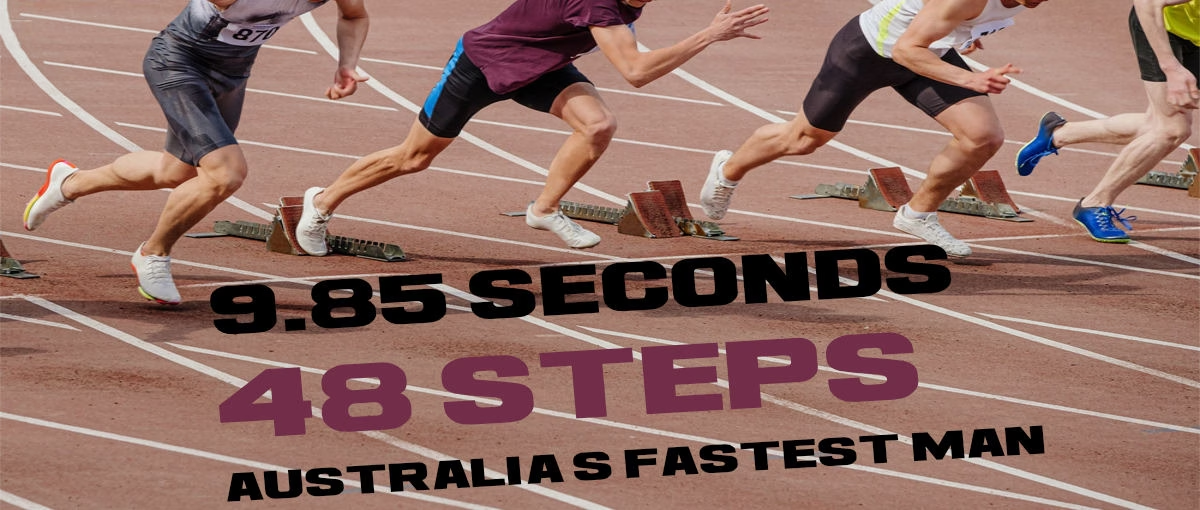
Lachlan Kennedy’s Australian-record sprint was remarkable for more than the time on the clock. An informal analysis suggests he covered 100 metres using an unusually rapid 48 steps, revealing a sprinting style built around extreme leg turnover.

Lachlan Kennedy ran 9.85 seconds to win silver in the men’s 100m at the 2026 Commonwealth Games in Glasgow. The performance broke Patrick Johnson’s 23-year-old Australian record of 9.93 seconds and delivered Australia its first Commonwealth Games medal in the event for 64 years.
Cameroon’s Emmanuel Eseme won the final in a Commonwealth Games record of 9.83 seconds, just two-hundredths ahead of Kennedy. Nigeria’s Kayinsola Ajayi took bronze in 9.90.
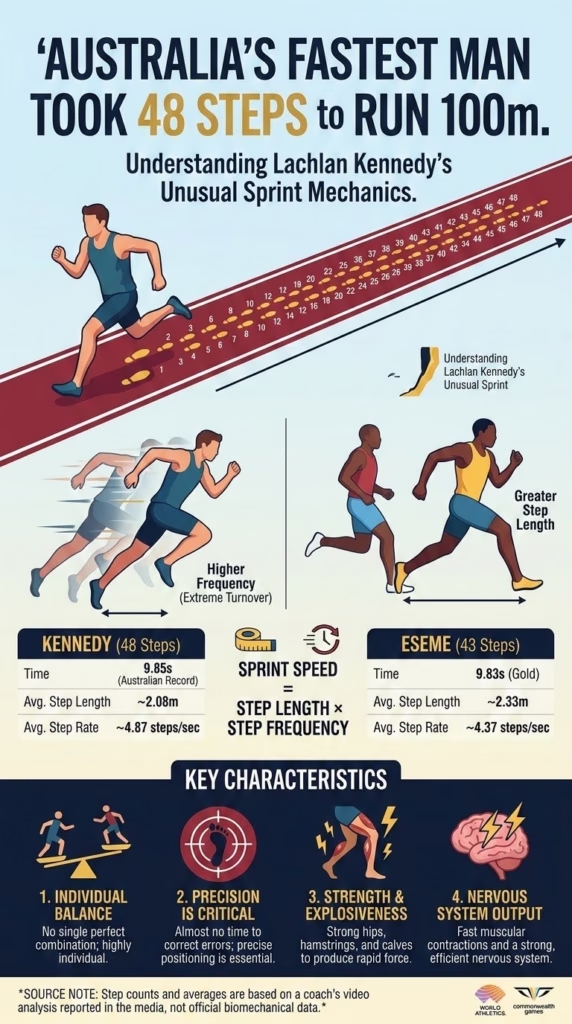
The result is confirmed in the official World Athletics records and Commonwealth Games results. But a closer look at Kennedy’s mechanics has produced an equally interesting number: 48 steps.
The number that makes Kennedy unusual
Athletics coach Robert Graham conducted an informal video analysis of the final, subsequently reported by news.com.au.
According to Graham’s count:
- Kennedy took approximately 48 steps.
- His average step length was about 2.08 metres.
- His average step rate was approximately 4.87 steps per second.
- Eseme took approximately 43 steps.
- Eseme averaged about 2.33 metres per step and 4.37 steps per second.
Graham described Kennedy’s turnover as “off the charts” and operating in “red-line territory”. That does not mean Kennedy’s technique is wrong. It means he appears to reach elite speed using a different balance of step frequency and step length from many of his rivals.
Sprint speed is not one thing
Running speed is created by two basic variables:

Step length × step frequency = speed.
Some elite sprinters cover more ground with every step. Others compensate with exceptionally rapid turnover. The fastest athletes combine both qualities, but not in identical proportions.
A study of 52 races involving elite male 100m sprinters found substantial differences in how individual athletes relied on step length and frequency. The researchers concluded that this balance was highly individual.
Kennedy appears to sit unusually far towards the frequency end of that spectrum.
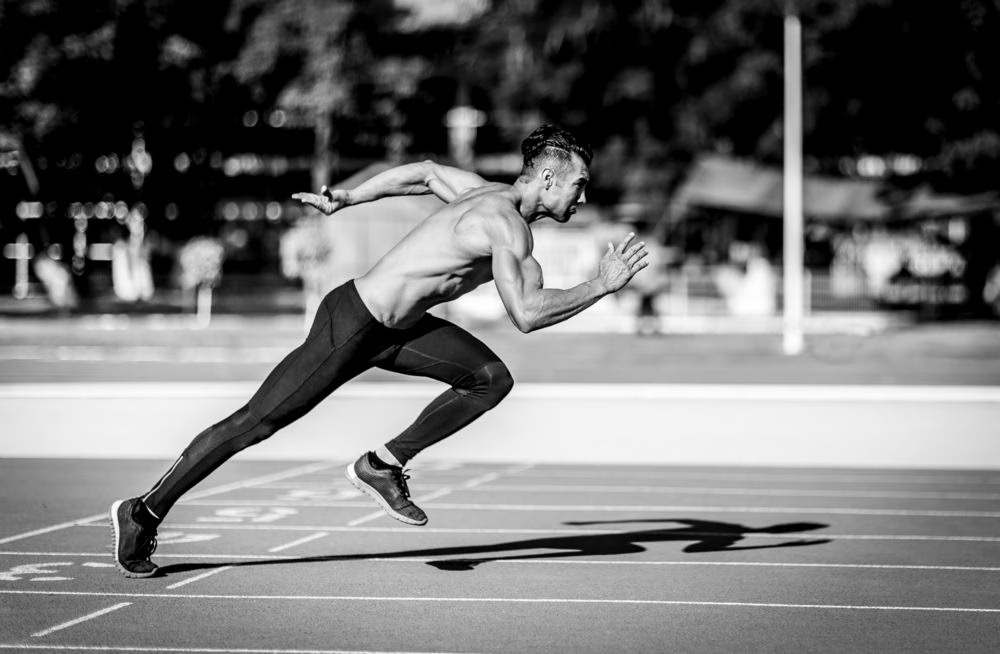
His feet must repeatedly strike the ground, produce force and leave again in a fraction of a second. There is almost no time available to correct a poor position or grind through a slow muscular contraction.
Why Kennedy cannot simply take longer steps
The obvious response is to look at Kennedy’s 48 steps, compare them with Eseme’s 43 and conclude that Kennedy would be faster if he lengthened his stride. Sprint mechanics are not that simple.
Forcing a longer step can cause the foot to land too far in front of the body. That can increase braking, interrupt rhythm and reduce the very turnover that makes an athlete fast.
Kennedy and his coach, Andrew Iselin, may find small improvements in projection, force application or step length as his technique develops. However, those changes must work with his natural strengths.
The goal is not to copy another sprinter’s step count. It is to find the combination that allows the individual athlete to travel fastest.
What extreme turnover requires
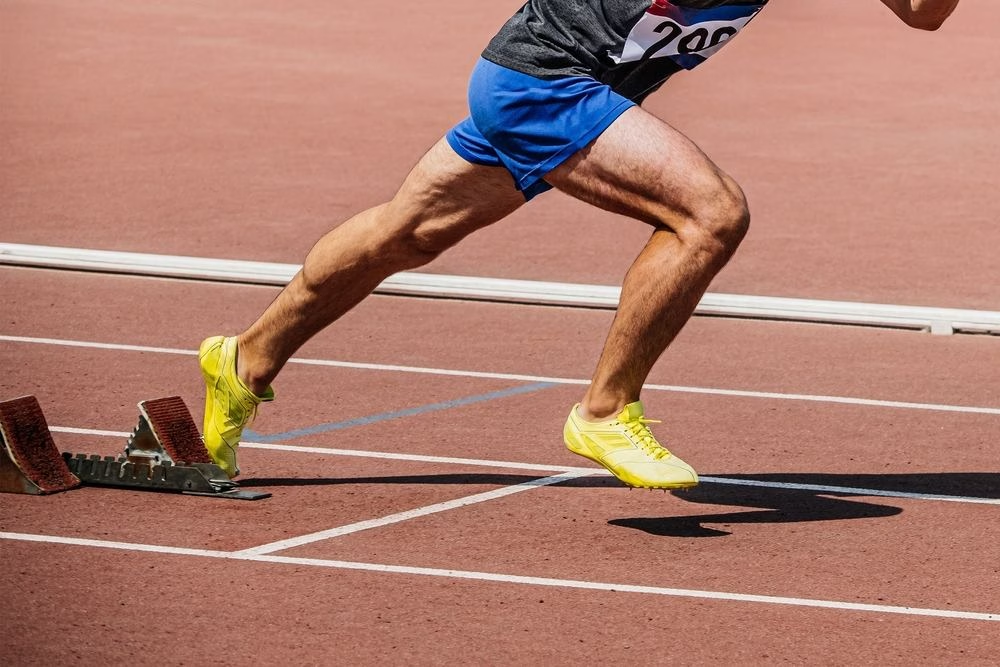
Moving the legs quickly is only part of the equation. Kennedy must also apply meaningful force during extremely short ground contacts.
Research involving male sprinters performing 60m sprints found that a greater ability to develop propulsive force rapidly was associated with better acceleration performance. The faster runner does not merely move his feet more quickly. He produces useful force in the very small window available before each foot leaves the track.
You can read the force-development study here.
That combination requires:
- explosive strength;
- precise foot placement;
- strong hips, hamstrings and calves;
- stiffness through the ankle on contact;
- rapid nervous-system output; and
- the ability to remain relaxed while moving at maximum speed.
Tension can slow turnover. Elite sprinting therefore involves the strange ability to produce enormous force without looking as though every muscle is being consciously squeezed.
Kennedy’s rise has been rapid
Kennedy did not grow up as a specialist sprinter. According to his Australian Athletics profile, he played rugby union for about a decade and did not enter his first athletics race until 2020.
Within two years, he represented Australia at the World Under-20 Championships. He later made his Olympic debut in the 4x100m relay in Paris and won silver over 60m at the World Indoor Championships.
Kennedy first broke 10 seconds with a 9.98 run in Nairobi in May 2025. His progress was interrupted by a stress fracture in his lower back, which forced him to miss the world championships later that year.
He returned in 2026, ran 9.96 twice at the Australian Championships and then reduced the national record to 9.85 in Glasgow.
After the individual silver medal, Kennedy also ran the opening leg as Australia won its first Commonwealth Games men’s 4x100m relay title since 1974.
What ordinary men can learn from it
Nobody training for general fitness should attempt to imitate Kennedy’s 4.87-step-per-second turnover.
The practical lesson is that speed is a skill, not merely a test of effort. It improves through short, high-quality repetitions performed while fresh.
A sensible speed session to try
Warm-up: Spend 8–10 minutes walking, jogging and moving through a comfortable range of motion.
Build-ups: Complete three 20m accelerations, increasing from roughly 60 to 80 per cent effort.
Main work: Run four to six repetitions of 20–30m at approximately 85–90 per cent effort.
Recovery: Walk back and rest for two to three minutes between efforts.
Stop when: Your speed drops, your movement becomes forced or you feel pain rather than normal muscular effort.
Start with one session per week. Men returning to sprinting after a long break should increase speed and volume gradually.
Grinding through sprints when fatigued usually turns speed work into conditioning. If the goal is to become faster, each repetition needs enough recovery for you to run with control and good mechanics.
You do not need Kennedy’s step frequency to benefit from sprint training. You need repeatable acceleration, adequate recovery and a body prepared for the forces involved.
Kennedy’s 48-step race matters because it shows there is more than one way to run extremely fast. His mechanics are unusual, but the stopwatch is definitive: 9.85 seconds, an Australian record and a new benchmark for the country’s sprinters. At 22, he may not have found his final combination yet. If you want to see how your own speed compares, here’s how fast you should be able to run a 400m lap for your age.
Editorial sources
- Official World Athletics athlete record
- Official Commonwealth Games results
- World Athletics event report
- Australian Athletics athlete profile
- Informal 48-step analysis reported by news.com.au
- Research: individual step-frequency and step-length reliance
- Research: force development during sprint acceleration