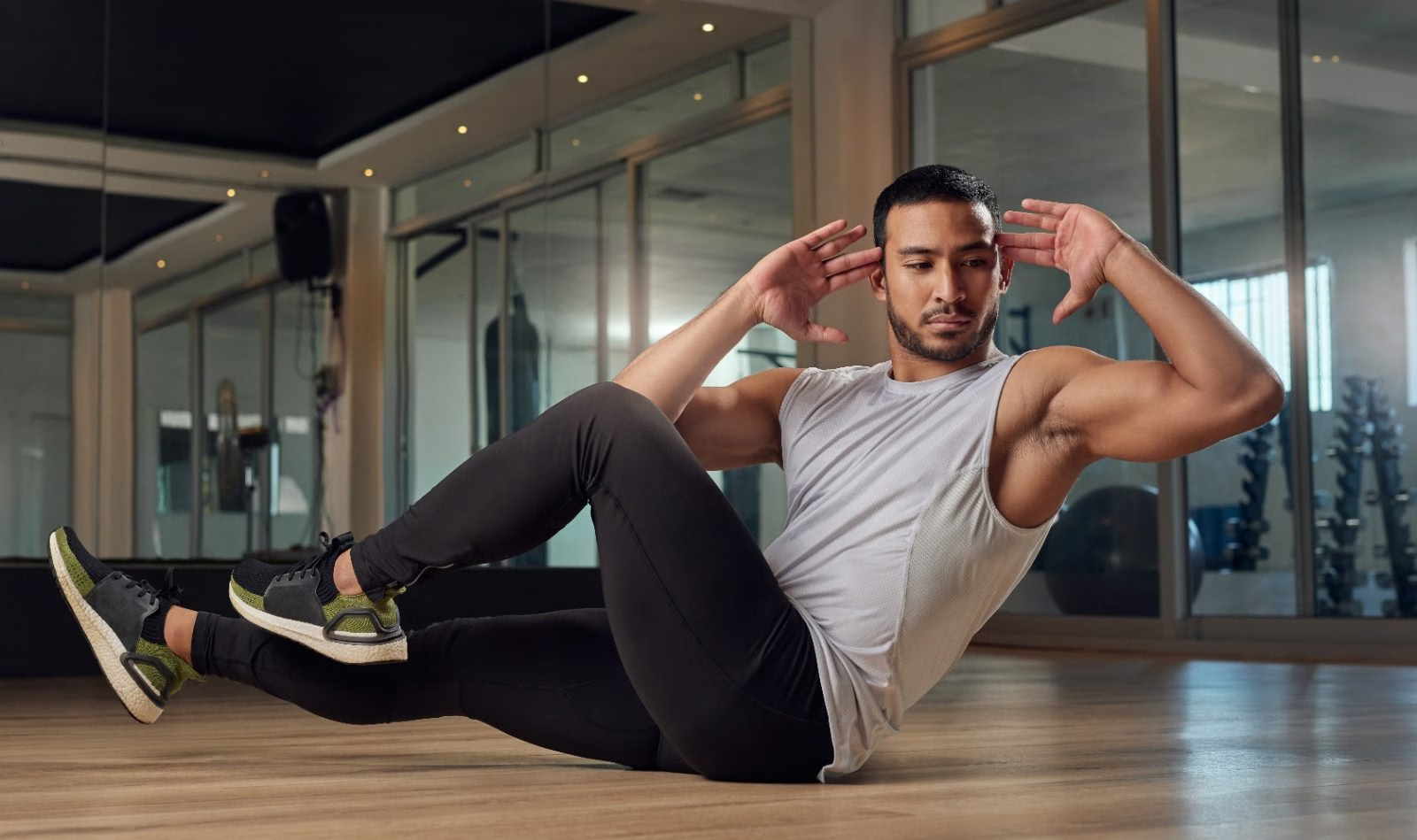

The bicycle crunch is one of the few ab exercises that came out on top in a head-to-head test, and one of the most often done badly. Done slowly, with your lower back pinned and your ribs turning towards the opposite knee, it trains both the six-pack muscle and the obliques along the sides of your waist, with no kit at all. Done fast, with your hands yanking on your head, it mostly trains your neck. Here’s how to do it properly, what it works, and where it fits in a weekly plan.
- Set-up: on your back, lower back pressed to the floor, fingertips lightly behind your ears, knees up over your hips
- The move: lift your shoulders, then bring one elbow towards the opposite knee as the other leg straightens out; switch sides
- Works: the six-pack muscle (rectus abdominis) and the obliques on the sides of your waist
- Beginners: 3 sets of 10 each side, slowly, two or three times a week
- Biggest mistake: going fast and yanking on your neck. Slow down and turn your ribs, not just your elbow
- Lower back lifting? Straighten your legs less, aiming them higher towards the ceiling
How to do bicycle crunches
- Lie on your back on a mat. Press your lower back into the floor and keep it there for every rep.
- Hands light. Rest your fingertips behind your ears with your elbows wide. They’re there to keep your arms out of the way, not to pull your head up.
- Lift your legs so your knees are over your hips and bent to about 90 degrees, shins parallel to the floor.
- Curl up. Lift your head and shoulder blades off the floor by tightening your abs, and keep them up for the whole set.
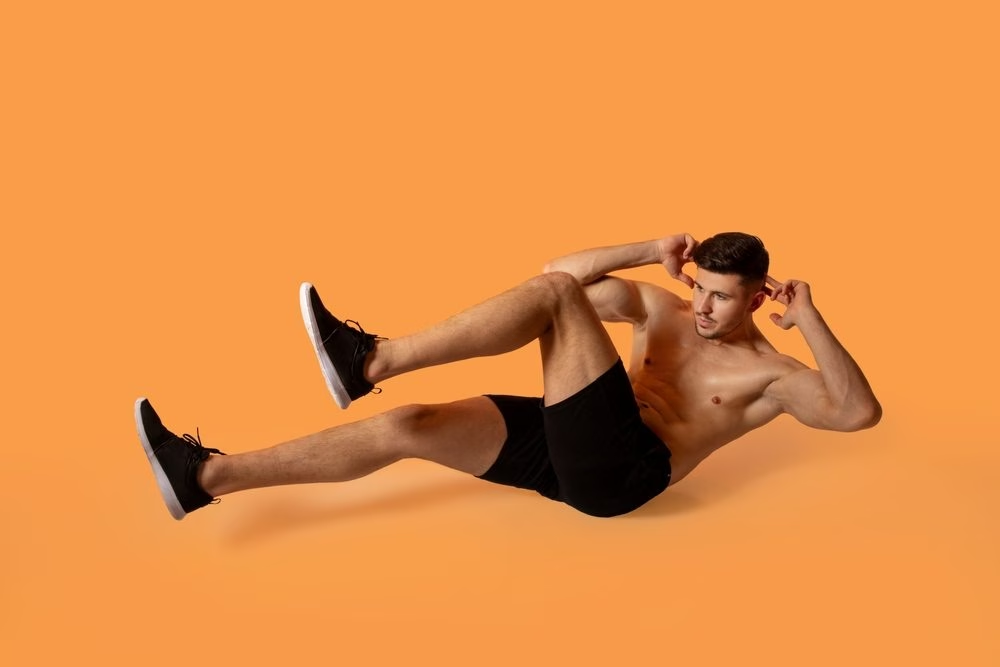
- Twist and extend. Turn your ribcage so your right shoulder moves towards your left knee as you pull that knee in, and straighten your right leg out in front of you at the same time.
- Switch sides in a slow pedalling motion: left shoulder to right knee, left leg straight. That’s two reps, one each side.
Breathe out as you twist and in as you change sides. The elbow doesn’t have to touch the knee. What matters is that your shoulder and ribs rotate across your body, rather than your elbow flapping forward while your torso stays flat.
Common bicycle crunch mistakes
- Going too fast. Rapid pedalling turns it into a momentum exercise. Count two seconds per side, and pause briefly when your shoulder reaches the knee.
- Pulling on your neck. If your hands are laced and tugging your head forward, your neck takes the strain. Fingertips only, elbows wide, and keep a gap the size of a fist between your chin and chest.
- Only moving your elbow. If your shoulder blades stay on the floor and only your elbow swings across, your obliques barely work. Lead with your shoulder.
- Lower back arching off the floor. This happens when you straighten your legs too low. Aim the straight leg higher, at about 45 degrees or more, until you can keep your back down.
- Dropping your head between reps. Keep your shoulders up for the whole set. The constant tension is part of what makes the move hard.
What muscles do bicycle crunches work?
- Rectus abdominis: the six-pack muscle down the front, which curls your trunk forward.
- External and internal obliques: on the sides of your waist. They rotate your trunk, which is the twist in every rep.
- Hip flexors: the muscles at the front of your hips that pull each knee in.
- Transverse abdominis: the deep layer that braces your trunk and helps hold your lower back against the floor.
The best-known test is an American Council on Exercise study run at San Diego State University’s biomechanics lab. Researchers fitted about 30 adults with electrodes and measured muscle activity across 13 common ab exercises. The bicycle crunch ranked first for the rectus abdominis and second for the obliques, behind the captain’s chair. The traditional crunch came 11th on both lists (ACE, 2001; HealthDay).
Keep that in perspective. It was a small study more than 20 years old, sponsored by ACE. A later test of 16 ab exercises at the University of Wisconsin-La Crosse, in 14 adults, found none of them, the bicycle crunch included, worked the rectus abdominis significantly harder than a regular crunch (Stenger, 2013). Our read: the bicycle crunch is a very good bodyweight ab exercise, especially for the obliques. It isn’t magic, and it works best as one part of a routine that also trains your trunk to resist movement.
Will bicycle crunches give you a six-pack?
Not on their own. They’ll build and strengthen your abs, but whether you can see them depends on how much fat sits on top. You can’t burn fat from your stomach by working your stomach: in a six-week trial, 24 sedentary adults who did seven ab exercises five days a week got better ab endurance but lost no more belly fat than a group that did nothing (Vispute and colleagues, 2011). Visible abs come from overall fat loss, which means your diet and total training. Our guide to getting a six-pack covers that side.
Bicycle crunch progressions and easier versions
If you can’t keep your lower back down, start at step 1. Move up when every set at the top of the rep range feels controlled, with no neck strain.
| Exercise | Sets and reps | Why |
|---|---|---|
| 1. Dead bug | 3 x 8–10 each side | Learn to keep your lower back down while your legs move |
| 2. Bicycle crunch, legs high | 3 x 8–10 each side | Straighten each leg towards the ceiling, not the floor |
| 3. Bicycle crunch | 3 x 10–15 each side | The standard version, slow and controlled |
| 4. Slow-tempo bicycle crunch | 3 x 8 each side | Three seconds to switch sides, one-second hold at each knee |
| 5. Hanging knee raise with a twist | 3 x 6–8 each side | Rotation from a hang, once you can hang 30 seconds |
The dead bug is the best stepping stone: you lie in the same position and move your opposite arm and leg, but your head stays down, so you learn to control your lower back first. Once the standard bicycle crunch is easy, slowing it down does more than adding reps. If you can hang from a bar, hanging knee raises with a twist load the same rotation much harder; our dead hang guide will help with the grip.
Sets and reps for beginners
Start with 3 sets of 10 slow reps each side, two or three times a week, with at least a day between sessions. That’s the standard advice for any muscle group: the American College of Sports Medicine recommends 2–3 days a week for novices (ACSM, 2009), and Australia’s guidelines ask adults to do muscle-strengthening work on at least two days a week (Department of Health). Add reps each week up to about 20 a side, then slow the tempo rather than adding more.
A 15-minute ab workout with bicycle crunches
Do the five moves back to back, then rest 60–90 seconds and repeat. Three rounds take about 15 minutes. You only need a mat.
| Exercise | Reps or time |
|---|---|
| 1. Dead bug | 10 each side |
| 2. Bicycle crunch | 12 each side |
| 3. Side plank | 20–30 sec each side |
| 4. Reverse crunch | 12 |
| 5. Front plank | 30–45 sec |
It pairs flexing (the bicycle and reverse crunch) with holding still (the dead bug and planks), which is how your trunk works when you lift, run or carry something. For a longer session with harder moves, use our 20-minute ab workout for men. When you’re ready for an advanced challenge, try the dragon flag. Have a Swiss ball? Our Swiss ball exercises add rollouts and jackknifes.
Bicycle crunches FAQ
Are bicycle crunches better than regular crunches?
For the obliques, probably: the twist puts them to work, and the ACE study ranked the bicycle well ahead of the crunch for both muscle groups. For the six-pack muscle alone, a later study found no significant difference. If you only have time for one, the bicycle crunch covers more.
How many bicycle crunches should I do a day?
You don’t need to do them every day. Three sets of 10–20 slow reps each side, two or three times a week, is plenty for most men. If you can do 50 fast reps without feeling it, slow down before you add more.
Why do bicycle crunches hurt my neck?
Usually because you’re pulling your head with your hands, or tucking your chin hard into your chest. Use your fingertips only, keep your elbows wide and look up at the ceiling at an angle. If your neck still aches, do dead bugs until your abs can hold your shoulders up on their own.
Why do I feel bicycle crunches in my lower back?
Your lower back is lifting off the floor as you straighten your legs. Aim each straight leg higher, towards the ceiling, and press your back into the mat. If you have back pain, see a physio or GP before you train through it.
Bicycle crunches or Russian twists?
Both train rotation. The bicycle crunch keeps your lower back supported on the floor, which makes it the easier one to do well. Russian twists, sitting up and rotating side to side, are harder to control once you add a weight. Start with the bicycle.
Sources: American Council on Exercise press release (14 May 2001) and HealthDay’s report on the San Diego State University study; Stenger (2013), MS thesis, University of Wisconsin-La Crosse; Vispute, Smith, LeCheminant and Hurley (2011), Journal of Strength and Conditioning Research; American College of Sports Medicine position stand (2009), Medicine & Science in Sports & Exercise; Australia’s physical activity and exercise guidelines for adults. Checked 29 October 2026.