

From the Australian Men’s Fitness archive: this interview first ran in May 2012, when Christian Marchegiani was our cover man. It appears here as published, with a 2026 update at the end.
Appearing on the cover of Men’s Fitness with his shirt off – successful, happy and in great shape – is Excess Baggage coach Christian Marchegiani’s middle finger to all those who bullied him when he was young.
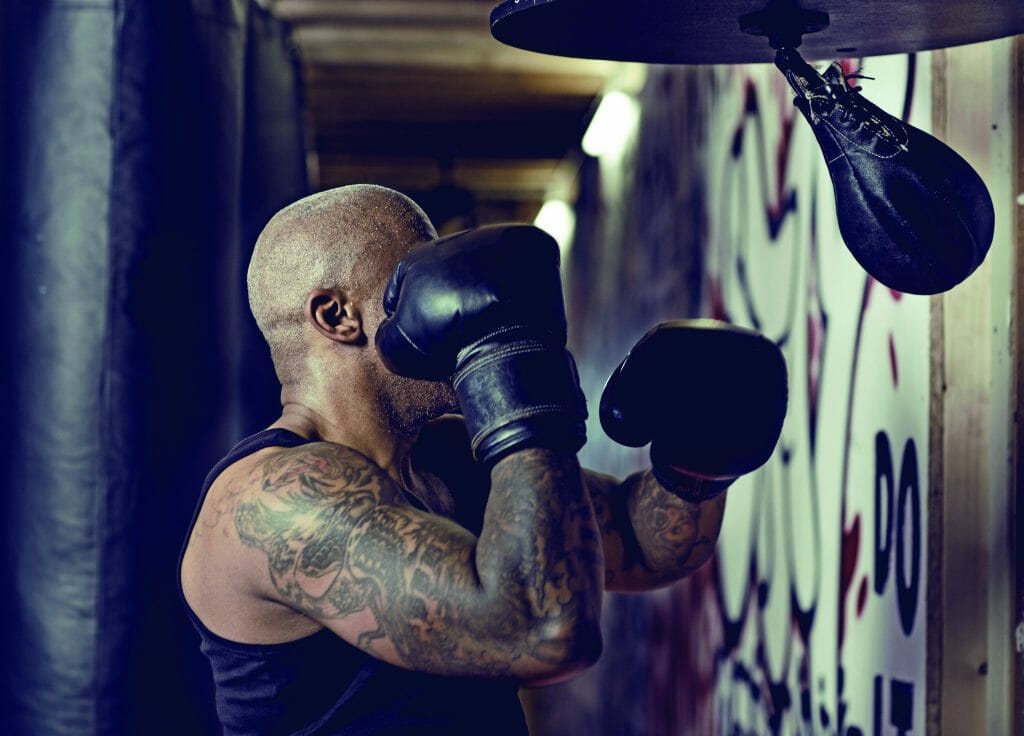
An unhappy, overweight teenager badly bullied at school in the Sydney suburb of Five Dock, Christian Marchegiani took a wrong turn at 18 and ended up in trouble with the law. When he faced court, the judge gave him two choices: go to jail or attend a boxing gym. Christian took the boxing option, and so began a life-changing journey.
He went on to lose 48 kilograms, complete a degree in Exercise Science at the Australian Catholic University in Sydney — and found THUMP Boxing, which would become an internationally recognised name in boxing-for-fitness training. Today, THUMP has four certification courses for instructors, employs hundreds of staff globally, and is licensed in thousands of gyms around Australia, NZ, Asia and the UK. In 2011, Christian, 34, was announced as the coach on Nine Network’s new celebrity weight-loss show, Excess Baggage, in which identities such as singer Christine Anu, AFL legend Robert “Dipper” DiPierdomenico, celebrity photographer Darryn Lyons and Beaconsfield mine survivor Brant Webb teamed with ordinary Aussies to lose weight and discover their healthier selves. MF sat down with Christian to find out more.
I was bullied every day…
School was probably the saddest part of my life. I felt as if I just didn’t belong and was picked on constantly. To the other kids at school, I was the fat wog. Also, I was a mummy’s boy and they knew it. Mum did what she could to protect me. She even gave up work two days a week to work in the school tuck shop, just to be closer to me. I used to look forward to those days, because I could hide at the back of the tuck shop. Another time, she got a job close to the school so that she could see me every day at the bus stop.
Once, when I was about 14 and on the bus, kids threw fruit at me, then grabbed my face, shoved it into a porn magazine and forced me to lick the page while they just laughed.
I can’t remember a day at school, especially high school, that I could say was a good day. Every day was a torment one way or another.
Other than leaving school, I couldn’t find a way out of it. Older people would advise, “Oh, you know what you should do? Find the biggest bully at school and beat him up — everyone will leave you alone then.”
I did think about fighting back — I even used to watch gang movies on DVD to see how they operated.
I shied away from sport…
Sport interested me, but I stayed away from it because I was so unfit. At my heaviest I was about 120 kilos. Once, we had to do a 12-minute run and I couldn’t keep up — everyone laughed because I came last.
I faced going to jail…
As I got older, I got bigger and a lot stronger, so when I was bullied I started fighting back. After a while I stopped getting picked on by the bullies, but I still had a lot of anger inside me. Now, I felt a need to protect myself and my new friends, who were my “gang”, if you like. If there was no fight happening we’d look for one — out in the street, in the car park, outside train stations.
When we were 17 or 18 and had started to get our driver’s licences, we’d go to the city or Kings Cross. Mates would say “So-and-so owes me money”, so we’d stand over that person and collect the debt. We’d go into clubs and just cause a fight.
During an all-in brawl over a turf dispute, a mate got stabbed, and others were hurt, because there were knives and baseball bats involved. Others escaped, but he and I were taken to hospital because I’d broken my thumbs from punching. While he was being treated in Emergency, the police arrived. I got scared, so I ran away, but they turned up at my house at 3 o’clock in the morning.
From there it went to court. The guy who stabbed my friend was charged, but that’s when the judge gave me a wake-up call: “You can go to jail, or you can join a boxing gym”.
It wasn’t quite the breakthrough moment — “Wow, I’ve been given a second chance” — after all, I was an 18-year-old with an “I don’t need to be told what to do” attitude, but I did ask myself, “Is this really the life I want?”
As I was walking out of court, a police officer who’d come to know me and taken a liking to me, said, “Son, you’ll be dead by the time you’re 21”. He was running the Police Boys Club at Burwood, near the train station, which had a boxing club. He invited me to come down, so I did. I went there and hung out a bit. It gave me something to do.
Boxing fixed my anger…
The judge had also ordered me to do community service, so I was painting, cleaning toilets, that sort of thing. And then I started hanging out with the boxers and trainers and started liking that — punching the bag. Even though I’d got up to 148 kilos, they could see I was strong.
Being able to punch something, I’d walk out of the gym exhausted. I didn’t have the energy to be angry or to want to fight; I just wanted to go home and relax, and that felt good.
I also started to lose weight, which gave me more confidence to meet girls, the way my friends all were now. That felt good too.
I enjoyed that for a couple of years. Then, when I was 21, I saw an ad in the paper for trainers at the YMCA in New York. I got a job teaching teenage boys and girls fitness and boxing for four months and when I came back to Sydney I thought, “Yep, I know what I want to do”. I went to the local gym and applied for a job. They had one shift available, on a Sunday afternoon.
It was the shift nobody wanted, but I took it and enrolled at uni in a degree in Exercise Science.
I thought that was it for me with boxing, that I would focus on getting my degree. However, all my assignments at uni were based around boxing and I found the other students, and the lecturers, were really intrigued by the sport.
There’s a mystique to boxing…
You don’t really ever see a modern boxing gym — they’re all old and dingy and smelly — but there are so many stories of struggle and survival that come out of boxing. Movies such as Rocky, Cinderella Man and Million Dollar Baby all tell those stories in a beautiful way. And, in a way, it’s my story too.
I started THUMP Boxing while at uni…
As a student, I needed extra money to help pay my tuition, so I found a room above a mechanic’s garage and started running boxing classes. And then it just grew and grew into THUMP Boxing. Initially, I wanted THUMP to be a place where everyone could belong.
I wanted it to be a place where the underdogs and those who don’t feel comfortable in a commercial gym could just come and be accepted. We had everyone — mums, dads, teenagers — people who had never been in a gym before were enjoying the experience of THUMP.
Our philosophy was simple. We didn’t have membership tags, we never had turnstiles — it was all based on an honesty system. You came to the counter and you let us know your name and that you were here and that was that. People really appreciated that. No one ever tried to sneak in. We treated people honestly and they behaved honestly.
After a while, trainers started to ask, “Can you train me to teach boxing classes?” Soon we found most of our time was being taken up running THUMP courses for trainers and we thought, “That’s what we need to get into”.
The original gym was in Five Dock. It was old, small and run down, and the owners didn’t want to spend money on it, so after eight years we shut it down. But given how many trainers we’d taught by then, THUMP was in people’s hearts and minds and could now be enjoyed at any gym in Australia.
When Excess Baggage came calling…
A casting agent rang me and said, “We’ve got this TV show coming up. We’ve auditioned hundreds of trainers, but we haven’t found the one we want. We’re looking for a trainer who’s more than a trainer”.
I went for the audition and they explained, “On the show, you’re going to be training 16 people”. I said, “What? One trainer? The Biggest Loser has four trainers for 16 people and you have just one? In that case, I won’t be the “trainer”, I’ll be the “coach”, because “coach” will encompass everything.”
I really wanted to meet Dipper…
On Excess Baggage there were two celebrities I especially wanted to meet. The first was Dipper [AFL star of the 1970s and ’80s Robert DiPierdomenico]. To me as a boy, Dipper was God — he was Italian, he’d made it in AFL and was so hard and strong.
The other was [maverick celebrity photographer] Darryn Lyons, “Mr Paparazzi”. I’d read his book, about how he’d gone to Bosnia three times during the Balkan conflict in the 1990s, working for one of the international news agencies. He had that mongrel attitude: the boy from Geelong who went and made it big, who believed that if you want something you’ve got to go and get it. I could identify with that.
All those on the show are quite deep people who had stories of struggle. Probably the most interesting was Gabby Millgate, the actress from Muriel’s Wedding. She became famous for one line — “You’re terrible, Muriel”. It’s one of the best-known lines in Australian movie history, yet she feels defined by it, trapped even. She went on to other TV comedy and stand-up, but essentially that’s all she’s ever been known for.
I was also intrigued by Brant Webb [the Tasmanian miner pulled from the Beaconsfield mine collapse in 2006 after 14 days trapped underground]. Before Beaconsfield, he was just a miner. After he was pulled out, he was considered an Aussie hero, yet he doesn’t think himself one. He considers those who pulled him out as the heroes. I think he struggles with that, in terms of “Why did I survive?”
Take responsibility…
From day one, I told the contestants on Excess Baggage that the moment you stop blaming everyone for what has happened to you is your most powerful moment. No matter how big or small your issue is, you’ve got to stop pointing the finger, stop making excuses. If you don’t, you’ll be trapped. Once you take responsibility, no one can touch you.
One thing I’ve learned about people is that our greatest desire is to be accepted.
And our greatest fear is rejection. It certainly was mine — all I wanted to do was belong. So with all the contestants I tried to find out what was important to them. It was important to Dipper, for example, to be recognised as the AFL legend he is. I talked to all the contestants about what made them tick. They just appreciated that someone was listening and interested.
Everyone needs a motivating factor…
When I heard I’d got the job on Excess Baggage, I knew I wanted to lose 5kg and be leaner. I worked hard to achieve that goal, but I needed to visualise it. The same goes for the invitation to be on the cover of Men’s Fitness. I kept a copy of MF on my coffee table, so every time I’d think, “Agh, I don’t feel like training”, I’d say to myself, “Wait a sec, you’re not going to be the guy on the cover if you don’t go to the gym”. If I opened the fridge because I felt like snacking, I’d think, “Hold on” and look over at the mag. So there was that connection, which was very important.
What I’ve learned from Excess Baggage…
Helping them, helps me. When I go home at night or have my own down time, it gives me a challenge: “How am I going to work with this situation?” It’s very satisfying to find out just what it is that makes a person tick and then be able to help them. The one thing I will take away from this experience is how happy the smallest victory can make someone. It could just be that, instead of taking 10 minutes to run 1km, they’ve got it down to eight minutes. That might not sound like a big deal to you, but to them, it’s “Wow, that’s just made my day”.
Christian Marchegiani’s website is christianm.com.au
Where is he now? (2026 update)
THUMP’s own history page says Marchegiani developed the THUMP training system in 2000, after his stint teaching boxing for fitness at the YMCA in New York, and that more than 60,000 instructors have since qualified, with the program taught across Australia, New Zealand, Asia and the UK.
He has since moved further into strength and conditioning. His author bio on Breaking Muscle describes him as a strength and conditioning coach with a degree in exercise and sports science who has worked with the Sydney Swans and with NSW and Australian cricketers. It names him as the founder of THUMP Boxing and Force Mass Motion, which runs courses in boxing and high-intensity resistance training (HIRT). The Intimate Conversations podcast introduced him the same way in December 2020.
HIRT is now his main subject: he has written several books on it, including Total Strength Total Fitness, billed as coming from “the founder behind THUMP Boxing and HIRT Systems”.