

- Taurine helps regulate calcium, fluid balance and cell function, including inside skeletal muscle and the heart.
- Being important to muscle function does not mean that taking more taurine builds muscle or reliably increases strength.
- A 2025 meta-analysis found that a single dose may produce a small improvement in exercise performance, but the results varied considerably.
- The evidence for reducing soreness and muscle damage is mixed, while the cardiometabolic evidence is more interesting, particularly in people with existing risk factors.
- Animal research made taurine look like a potential longevity supplement, but human evidence has not established that it slows ageing or extends life.
Taurine has spent years hiding in plain sight on the back of energy-drink cans. More recently, it has escaped into tubs and capsules carrying claims about energy, muscle function, recovery, heart health and even longevity. That is a decent list for one white powder.
Some of the marketing begins with a fact. Taurine is abundant in the body and performs several important jobs. The problem arrives when “important inside the body” quietly becomes “you should take more of it”. We saw the same trick with L-carnitine: a genuine biological role is not automatic proof that supplementation changes anything you can feel, measure or admire in the mirror. So, what does taurine actually do, and is it worth adding to your supplement shelf?
The Truth About Taurine
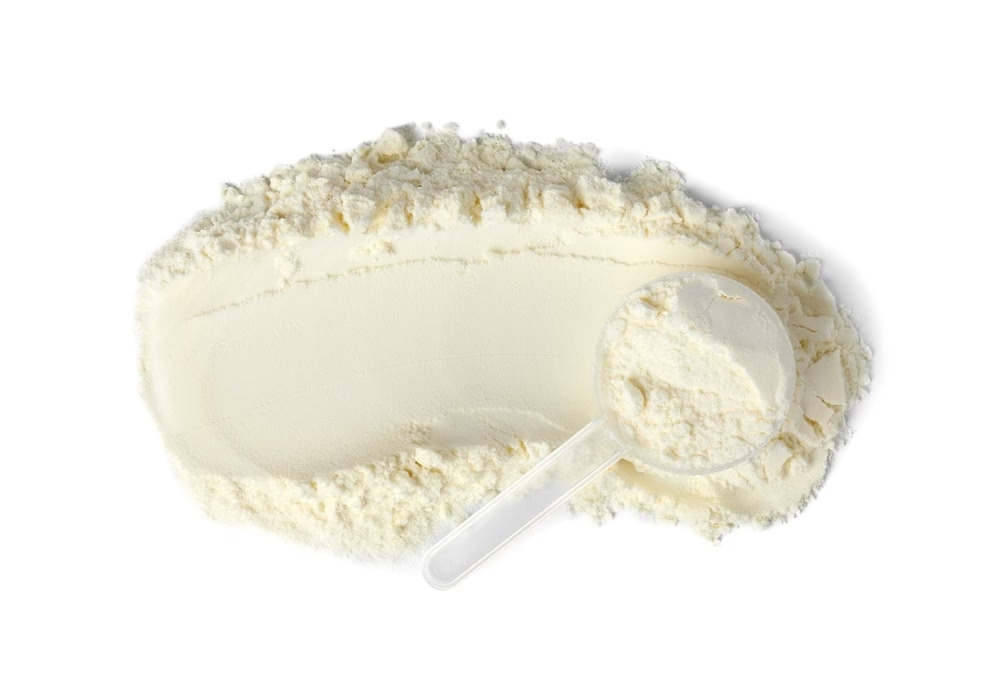
Taurine is usually described as an amino acid, although technically it is an amino sulfonic acid. Products sometimes call it L-taurine, but that is the same ingredient; taurine is the standard name. Unlike the amino acids in protein, it is not used to assemble new muscle tissue.
It exists freely throughout the body, with high concentrations in skeletal muscle, the heart, brain and eyes. It helps regulate calcium movement, fluid balance, bile-acid formation, nerve signalling and the stability of cell membranes. It also appears to help control inflammatory and oxidative processes.
This is where the muscle claim comes from. Calcium is central to muscle contraction, and taurine helps regulate how calcium moves within muscle cells. Taurine also appears to protect cells under physical and metabolic stress.
All true. None of it proves that a healthy man swallowing taurine will become stronger or more muscular.
Your body can make taurine from other sulfur-containing amino acids, and you obtain it from animal foods, particularly shellfish, fish and meat. It can become conditionally essential in particular stages of life or medical circumstances, but there is no established recommended daily intake for healthy adults.
Does taurine give you energy?
Not in the way most people mean it. Taurine is not a stimulant. It does not work like caffeine and should not produce the familiar increase in alertness, heart rate or willingness to reorganise your sock drawer before breakfast.

Its association with energy comes partly from energy drinks and partly from its role in cellular function. Most energy drinks combine taurine with caffeine, sugar and other ingredients, which makes it difficult to credit taurine for whatever happens next.
Taken alone, taurine may have a small effect on physical performance rather than a noticeable stimulant effect.
Does taurine improve exercise performance?
The answer has shifted from “probably not” to “possibly, by a little”.
A 2025 systematic review and meta-analysis combined 23 randomised trials involving 308 participants. It found that a single pre-exercise dose of taurine produced a small-to-moderate improvement in overall performance.
The signal appeared more promising for aerobic endurance, strength and power, and agility or coordination. Evidence for anaerobic capacity and muscular endurance remained inconsistent. The studies were small and differed in exercise type, dose, timing and participant characteristics, creating substantial variation in the results.
An earlier review of endurance research found possible benefits from doses between 1 and 6 g, but it could not establish a clear relationship between the dose and the result. Meanwhile, individual studies have produced everything from a modest improvement to no effect and, in one small trial, worse maximal force in some participants.
That puts taurine well below caffeine and creatine monohydrate in the sports-supplement pecking order. It might shift performance at the margins. It is not likely to rescue poor conditioning, short sleep or a training plan assembled from motivational reels.
Does taurine build muscle or increase strength?
There is no convincing human evidence that taurine increases muscle growth. Taurine is present in muscle and involved in contraction, but it is not incorporated into muscle protein. It does not provide the amino-acid building blocks supplied by dietary protein, and it does not have creatine’s evidence for improving strength and lean mass alongside resistance training.
Some laboratory and animal studies show improved muscle-force production or fatigue resistance when muscle taurine is manipulated. Translating that into a useful supplement effect in humans has proved difficult.
The practical distinction is simple: taurine may help the machinery operate, but adding more taurine does not necessarily make the machinery larger or more powerful.
If muscle and strength are the goals, adequate protein, progressive resistance training and creatine remain the priorities.
The better case may be recovery
Taurine’s role in cell protection and oxidative stress has made recovery another popular claim.
Small trials have reported lower soreness and reduced blood markers associated with muscle damage following hard eccentric exercise. Possible explanations include better calcium control inside muscle, less cell-membrane disruption and a reduction in some oxidative and inflammatory responses.
However, the evidence is not consistent. A placebo-controlled trial in long-distance triathletes found that 3 g per day for eight weeks did not improve performance, inflammation or markers of muscle damage. Reviews of the sports literature reach a similarly untidy conclusion: recovery benefits are plausible, but not dependable.
Taurine therefore sits in roughly the same place as many second-tier recovery supplements. There is enough evidence to remain interested, but not enough to promise that it will prevent the stiff-legged toilet descent after a savage leg session.
What about its antioxidant benefits?
Calling taurine an antioxidant is broadly reasonable, but it can give the wrong impression.
Taurine is not simply a free-radical sponge. It appears to protect cells through several indirect mechanisms, including supporting mitochondrial function, stabilising membranes and forming taurine chloramine, a compound that can help moderate excessive inflammatory activity.
A small clinical trial in women aged 55 to 70 found that 1.5 g of taurine daily for 16 weeks increased taurine concentrations and helped preserve levels of the antioxidant enzyme superoxide dismutase. The trial involved only 24 women, so it supports a mechanism rather than establishing a broad anti-ageing treatment.
Reduced oxidative stress can be useful. Eliminating oxidative stress is neither possible nor desirable, and an improved blood marker does not automatically mean better health, performance or lifespan.
The metabolic-health evidence is more interesting
Taurine may have a more credible role in cardiometabolic health than in muscle building.
A 2024 meta-analysis of 25 randomised controlled trials, involving 1024 participants, found modest improvements in several risk markers. Compared with control groups, taurine reduced systolic blood pressure by about 4 mmHg, diastolic pressure by about 1.5 mmHg, fasting blood glucose by roughly 5.9 mg/dL and triglycerides by about 18.3 mg/dL.
Those numbers are potentially useful, but the participants were a mixed group ranging from healthy people to patients with diabetes, obesity, heart disease and other medical conditions. Study doses ranged from 0.5 to 6 g per day and treatment lasted anywhere from five days to a year. Variation was high for some outcomes, and most trials did not provide enough information about allocation concealment.
The benefits may be greater in people who begin with elevated blood pressure, glucose or triglycerides. Taurine should not be treated as a substitute for prescribed medication, exercise, weight management or a decent diet.
Is taurine a longevity supplement?
This is where the story became exciting and then considerably less tidy.
A major 2023 study published in Science reported that taurine levels declined with age and that supplementation extended lifespan in mice while improving several measures of health in mice and monkeys. The findings generated predictable headlines about an inexpensive anti-ageing supplement.
The lifespan result was in mice, not humans. The monkey study examined health measures rather than lifespan, and the human data were observational.
Then a 2025 Science paper examined people aged 26 to 100, as well as monkeys and mice, and found that circulating taurine generally increased or remained unchanged with age. Differences between individuals were greater than age-related changes, and associations with muscle strength and health were inconsistent.
That does not prove taurine has no healthy-ageing role. It does mean the neat story of “taurine falls with age, so replace it and live longer” is not established. A 2026 human trial is now testing 3 g per day for six months against metabolic and biological-ageing markers, but the published paper is the trial protocol, not the results.
At this point, taking taurine to extend human lifespan is an experiment, not an evidence-based strategy.
Dose and safety
Exercise studies commonly use 1 to 6 g, either as a single pre-exercise dose or daily over several weeks. There is no established optimal dose, and the 2025 performance meta-analysis did not reveal a simple rule that more taurine produces a better result.
The European Food Safety Authority has identified 6 g per day as an observed safe level for adults. Trials generally report few adverse effects, although gastrointestinal discomfort, nausea or headaches are possible.
Because taurine may reduce blood pressure and blood glucose, men taking medication for hypertension or diabetes should discuss supplementation with their doctor. The same applies to people with kidney disease, significant heart or liver conditions, or anyone planning to take high doses for long periods.
Also check the rest of the label. A taurine capsule and a highly caffeinated energy drink containing taurine are not the same proposition. If you’re working out what else belongs on that shelf, this is a good place to start.
Editorial source list
- Deng et al. 2025: acute taurine and exercise-performance meta-analysis
- Waldron et al. 2018: taurine dose and endurance-performance review
- Lim et al. 2018: acute taurine and maximal muscle contraction
- Martinez Galan et al. 2018: performance and muscle damage in triathletes
- Abud et al. 2022: controlled trial of antioxidant activity in women aged 55–70
- Tzang et al. 2024: metabolic-syndrome meta-analysis
- Singh et al. 2023: taurine deficiency as a driver of ageing
- Fernandez et al. 2025: is taurine an ageing biomarker?
- Chu et al. 2026: protocol for a human taurine and biological-ageing trial
- EFSA: observed safe level of 6 g per day