

Not long ago, entering a fitness race generally meant being able to be a bit of a unit. You had to run, lift, climb a rope and look reasonably composed while doing all three. That barrier is disappearing.
Australia’s Spring fitness calendar includes events with no running at all, a global competition conducted inside local gyms, obstacle races for kids, a repeatable hybrid fitness test and a 25 km functional fitness ordeal for people who have apparently run out of normal people’s problems.
The result is a competitive fitness scene with more formats, more entry points and considerably more inventive ways to make your legs stop working.
Between August and October, five very different events will offer five answers to the same question: how fit are you when someone starts the clock?
1–2 August: DEKA Trifecta Weekend, Shepparton
How much race do you actually want?
Developed by the founders of the Spartan Race, DEKA is a gamified indoor fitness circuit that tests functional strength, endurance, and grit. If you are curious about fitness racing but cannot decide whether you want to run one mile, 5 km or not at all, DEKA Shepparton has thoughtfully put all three options under one roof.
The two-day event will be held at the Museum of Vehicle Evolution, or MOVE, in Kialla, just outside Shepparton. Instead of another anonymous exhibition hall, athletes will compete among displays of classic cars, trucks, motorcycles and historic machinery. Be great for socials and kids.
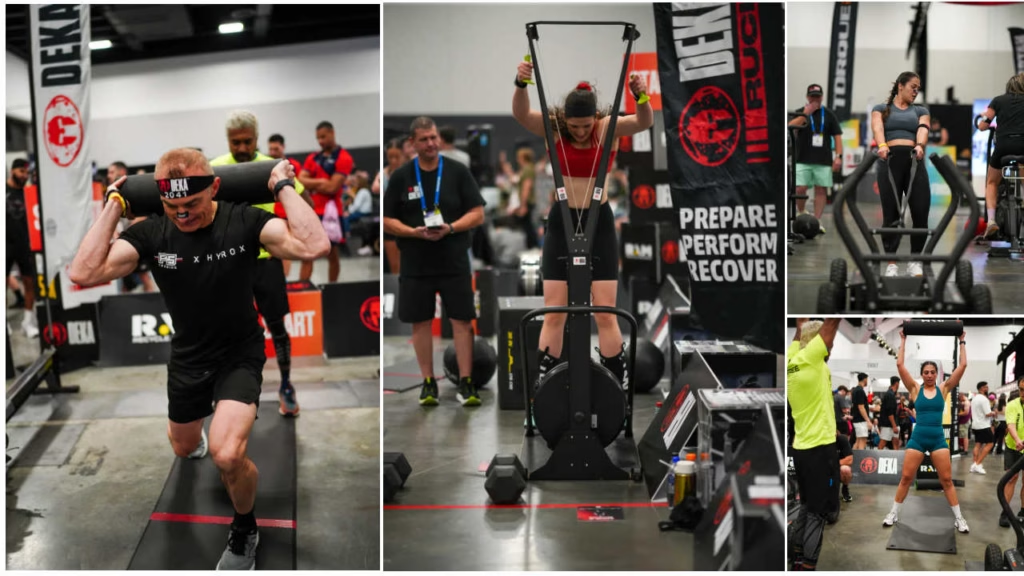
There will be something strange about pushing a weighted sled beside a beautifully restored truck that has enjoyed a much easier retirement than you have. Every standard DEKA event uses the same 10 functional fitness zones. What changes is the amount of running between them.
DEKA STRONG removes the running entirely. You complete the 10 zones in order, making it the logical choice for regular gym-goers who want to compete but do not consider running an essential part of the human experience.

DEKA MILE combines the 10 zones with a total of one mile, or about 1.6 km, of running. It provides an achievable entry point for someone wanting to try hybrid racing without committing to a full 5 km event.
DEKA FIT is the established competitive format, combining 5 km of running with the same 10 zones. It demands enough running ability to expose the lifters and enough strength work to interrupt the runners.
Then there is DEKA FIT ULTRA, being staged in Australia for the first time. It consists of 25 km of running and 50 functional zones, effectively five DEKA FIT races joined together by a complete disregard for moderation. The official event page lists an average finishing time of about five and a half hours for the Ultra. That is no longer a hard workout. It is temporary insanity.
More Info: https://au.spartan.com/en/race/detail/10648/overview
Best for: Almost anyone, depending on the format.
Bad idea for: Entering the Ultra because the other options “didn’t sound hard enough”.
2 August: BFT PODIUM Series
Can a global competition happen inside your local gym?
Body Fit Training (BFT) is launching the PODIUM Series, an inaugural global fitness competition where pairs compete in four high-intensity functional zones simultaneously across hundreds of local studio locations on Sunday.
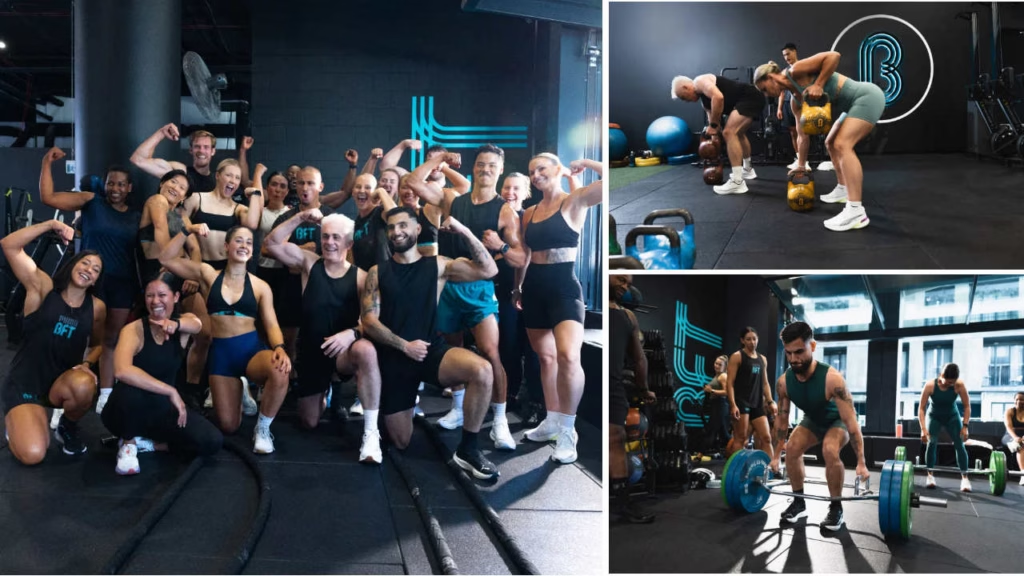
Rather than asking athletes to travel to a major arena, the Australian-founded training franchise will run its first PODIUM Series across participating BFT studios. According to BFT, the competition will take place simultaneously in hundreds of locations across more than 10 countries. You do not need to be a BFT member to enter. You will, however, need a partner.
PODIUM is contested in teams of two, with men’s, women’s and mixed divisions. Rookie, Open and Pro categories allow competitors to choose a level that roughly corresponds with their ability rather than being fed into the same machine as full-time hybrid athletes.
The competition consists of four 15-minute zones:
- Strength
- Conditioning
- Strength endurance
- Finisher
Results will be recorded on an official live leaderboard, allowing teams to compare their performance with competitors elsewhere. The format and divisions are confirmed on BFT’s official PODIUM page.
That global comparison is the interesting part. BFT is removing much of the travel, mud, intimidating arena and logistical nonsense associated with race weekends. You compete in a familiar studio, but your result suddenly sits beside performances from around the world.
It also gives people a chance to discover an important truth about team competition: suffering with a friend is more enjoyable, right up until that friend fails to complete the agreed number of repetitions.
More Info: https://www.bodyfittraining.au/
Best for: Training partners who want a first competition without organising an entire weekend around it.
Bad idea for: Partners whose communication already deteriorates during shared flat-pack furniture assembly.
8–9 August: Spartan Melbourne Urban
Do you want to race, play or suffer collectively?
One week later, Spartan returns to Werribee Racecourse with enough formats to accommodate competitive racers, first-timers, children and adults who would rather not know what is about to happen to them.
The main events are the 5 km Sprint, featuring 20 obstacles, and the 10 km Super, with 25 obstacles. The Werribee course is promoted as relatively flat and fast, making it a less savage introduction than some of Spartan’s more mountainous events.

That does not mean easy. Flat ground simply allows you to arrive at the obstacles more quickly.
The weekend also includes a Kids Race over approximately 1–3 km. It has become one of the event’s major attractions and provides children with the rare opportunity to crawl through mud while adults actively encourage them.
The more unusual option is the four-hour Hurricane Heat.
Unlike a conventional race, the Hurricane Heat is a team-based endurance event built around unpredictability. Participants complete physical tasks and challenges without receiving a detailed course plan in advance. Pace matters, but so do teamwork, resilience and the ability to remain useful when tired and uncomfortable.
The Sprint and Super tell you roughly how far you will run and how many obstacles stand between you and lunch. The Hurricane Heat is less courteous.
More Info: https://au.spartan.com/en/races/melbourne2026
Best for: Anyone who wants more adventure and less predictability than a standard road race.
Bad idea for: People who become irritated when a workout is not written on the whiteboard before the warm-up.
11–13 September: Deadly Fitness Test, Sydney
Do you want an event or an honest benchmark?
Deadly Dozen returns to the AusFitness Expo in Sydney from 11–13 September, but this time you do not need to complete the organisation’s full race to find out where you stand.
The Deadly Fitness Test, or DFT, is a shortened hybrid challenge alternating running with functional strength exercises. It represents roughly half the main Deadly Dozen track race and is completed against the clock.

The concept is deliberately uncomplicated. There are no highly technical movements and no specialist obstacle skills to learn. You run, complete the prescribed work and keep going until the clock gives you a number you may or may not wish to discuss. The appeal is repeatability.
A big obstacle race can be an experience. The DFT is closer to a calibration. It provides a benchmark time that can inform your training and, eventually, give you something concrete to beat.
Deadly Dozen originated in the UK and was founded by former British Army physical training instructor Jason Curtis. It made its Australian debut in 2025 and will again form part of the Sydney AusFitness Expo program in September.
More Info: https://www.deadlydozen.com/
Best for: Anyone who wants a clear fitness score rather than another vague sense that the workout went “pretty well”.
Bad idea for: People who prefer their weaknesses to remain theoretical.
10 October: Spartan Wollongong Stadion
How badly can a stadium expose your conditioning?
By October, competitors should have recovered sufficiently to make another poor decision.
Spartan’s Stadion format arrives in Wollongong on 10 October, using the city’s 22,000-seat coastal stadium as the course. The event is listed on Spartan Australia’s official 2026 calendar.
Stadium racing creates a different problem from a trail or road event.
Flat running allows you to settle into a rhythm. A Stadion course keeps breaking it. You accelerate along a concourse, climb another flight of stairs, change direction, descend, complete an obstacle and then discover a fresh staircase that was apparently not included in the architectural drawings.
The Wollongong event will also include a Doubles Open category. Racing with a partner can distribute parts of the workload, but it does not necessarily make the event easy. Both athletes still need to move efficiently, communicate under fatigue and resist the urge to conduct a detailed performance review halfway up the grandstand.
The coastal location should at least provide an excellent view while your quadriceps submit their resignation.
More Info: https://au.spartan.com/en/races/wollongong2026
Best for: Strong runners, stair enthusiasts and pairs who train well together.
Bad idea for: Anyone who has spent the year avoiding the StairMaster on principle.