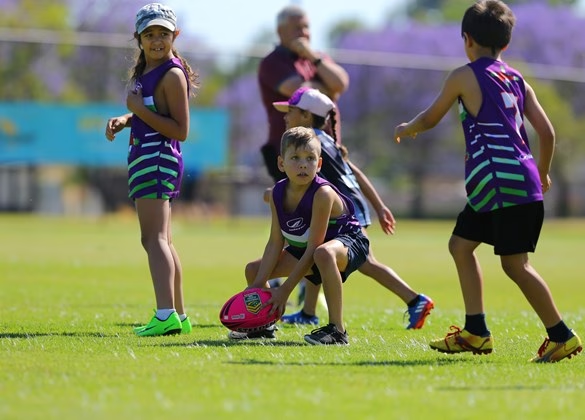


A Touch Football field can feel deceptively small until you have spent several minutes sprinting forward, retreating in defence, changing direction and trying to throw an accurate pass while breathing through your ears.
Touch football is not a steady running sport. It is a series of short, explosive efforts separated by brief periods of incomplete recovery. You accelerate, stop, change direction, get back onside and do it again. Meanwhile, the ball keeps moving and every decision still matters.
That combination changes how you should train.
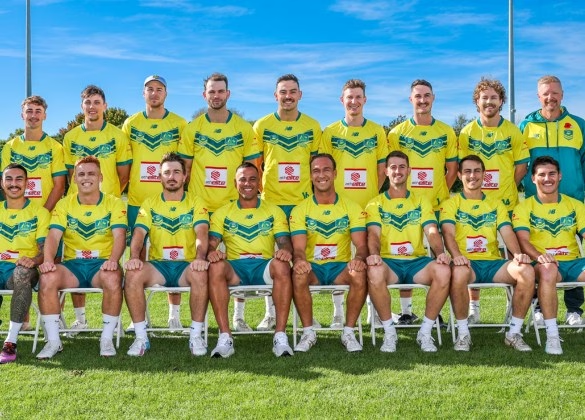
We spoke with Wayne Grant, High-Performance Manager for the (@touchfootballaustralia) Australian national Touch Football teams, about the fitness qualities that matter, how players should approach preseason and why being fast in a straight line is only part of the equation.
Build Your Aerobic Base Before the Season
The first requirement is not glamorous: arrive with a reasonable aerobic base.
Aerobic fitness helps you recover between high-intensity efforts. It also allows you to maintain your work rate as a match or tournament wears on. Without it, your first few sprints may look impressive, but the gaps between them become longer and the quality of your movement and skills begins to fall away.
Wayne explains:
“Developing a good aerobic fitness base is critical before a season or major tournament. Because Touch seasons are short and played year-round, the time spent on aerobic fitness is less than in other codes. After that, the focus quickly shifts to speed endurance.”
This does not mean spending months doing nothing but long, slow runs. The aim is to establish enough cardiovascular fitness to support the more specific work that follows.
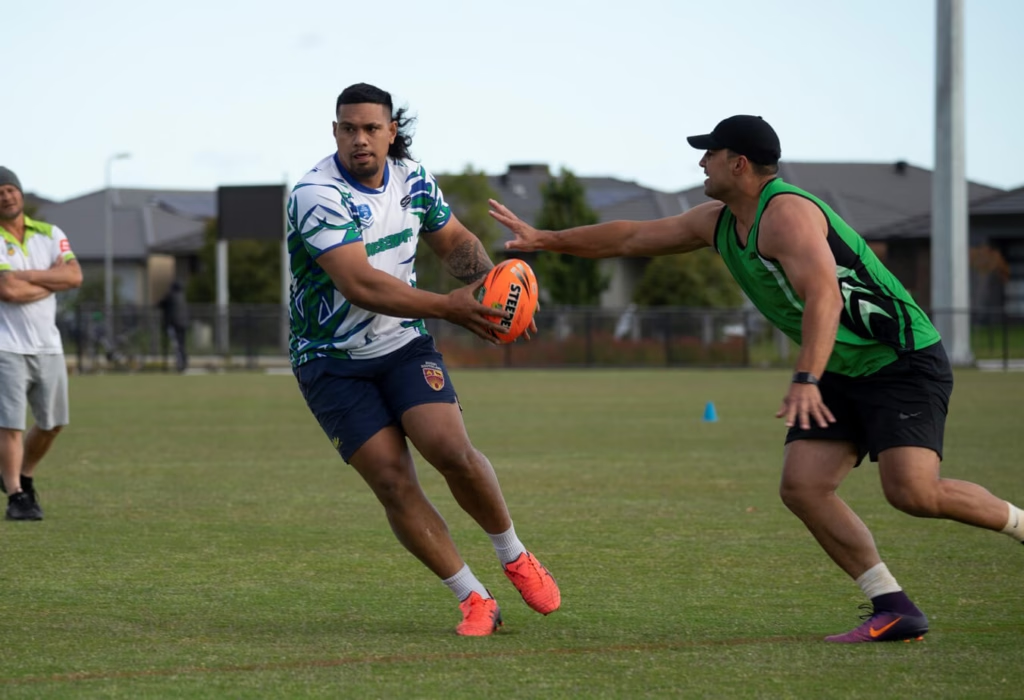
During the early preseason, that might include two or three aerobic sessions each week using comfortable running, tempo intervals or other continuous conditioning. As the season approaches, some of that volume should give way to faster, more game-specific training. The base is the foundation. It is not the finished product.
Why Speed Endurance Matters
Touch Football repeatedly asks players to produce high-intensity efforts without fully recovering between them.
A player may accelerate into attack, support the ball carrier, retreat quickly in defence and then be required to sprint again almost immediately. A conventional running program can improve general fitness, but it will not completely prepare you for this stop-start pattern.
This is where speed endurance becomes important: the ability to repeat fast efforts while limiting the drop-off in speed from one effort to the next.
A useful session should contain short sprints, changes of direction and incomplete recovery. The objective is not simply to record one fast sprint. It is to remain effective after several of them.
Touch Football Speed-Endurance Drill
- Mark out a 20-metre area.
- Sprint hard to the far marker and return.
- Rest for 20 to 30 seconds.
- Repeat four to six times.
- Rest for two or three minutes.
- Complete two or three sets.
The precise distances and recovery periods should be adjusted to your current fitness. Your speed will naturally fall slightly, but the session should stop before your running mechanics disintegrate completely.
You are training repeated quality, not practising how to stagger around badly.
Acceleration Is More Important Than Top Speed
Most decisive movements in Touch happen before a player has enough room to reach maximum running speed.
That makes acceleration particularly valuable. Your first two or three steps can create space, close down an attacker or put you in position to support a teammate.
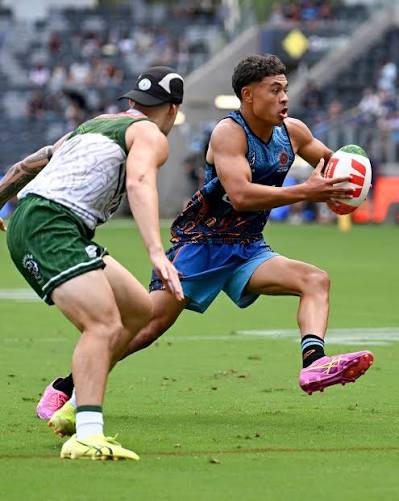
Touch players must also accelerate from less-than-perfect positions. You may begin upright, low to the ground, holding the ball, picking it up or turning after a change of possession.
Wayne says:
“Touch requires speed from various positions—off the ground, while holding the ball, or picking it up. Backwards speed, in particular, is a differentiator. Players often retreat at speed for over 50 meters continuously, requiring stronger hamstrings compared to other sports.”
Sprint practice should therefore involve more than lining up in a comfortable starting position and running straight ahead.
Practise Accelerating
- From standing, walking and jogging starts
- After touching the ground
- While carrying the ball
- Immediately after picking up or rolling the ball
- After turning through 90 or 180 degrees
- In response to a partner’s movement or call
These starts are less tidy than track sprinting, but considerably closer to what happens in a game.
Do Not Ignore Backwards Speed
Fast backwards movement is one of the physical qualities that separates Touch from many other field sports.
Defenders repeatedly retreat while watching the attacking team, maintaining their spacing and preparing to drive forward again. This places different demands on the calves, quadriceps, hamstrings and hips than ordinary forward running.
It is not enough to run backwards as quickly as possible and hope your feet keep up. The movement needs to be trained progressively.
Begin with controlled backwards runs over 10 to 20 metres. Stay balanced, use short steps and avoid leaning too far behind your base of support. Once the movement becomes comfortable, add faster repetitions, changes of direction and a forward acceleration at the end.
A simple drill is:
- Retreat backwards for 10 metres.
- Plant under control.
- Accelerate forward for 10 metres.
- Walk back and repeat four to six times.
Hamstring, calf and lower-body strength also matter. Romanian deadlifts, split squats, calf raises and hamstring curls can help build the physical capacity required, but strength work should support the movement rather than replace practising it.
Train With the Ball While You Are Tired
This is where Touch Football conditioning becomes different from generic fitness training.
Passing and catching when fresh is useful. Passing and catching after several hard accelerations is what the game requires.
From the beginning of preseason, Wayne integrates the ball into conditioning and agility work.
“Executing high-level skills at speed and under fatigue is key,” Wayne emphasizes. “Ball-handling is prioritized more in Touch than in many other codes, and it’s incorporated into agility training to mimic game scenarios.”
The point is not to make every drill unnecessarily complicated. It is to prevent fitness and skill from becoming two completely separate parts of training.
Three-Player Passing Drill
- Player one accelerates for 10 to 15 metres carrying the ball.
- Player one passes to player two and continues in support.
- Player two accelerates and passes to player three.
- The group turns and repeats in the opposite direction.
- Continue for 30 to 45 seconds, then rest.
As fatigue builds, watch the quality of the passes. Dropped balls, poor timing and passes behind the receiver expose the point at which skill begins to deteriorate.
That is valuable information. Touch fitness is not just the ability to keep running. It is the ability to remain useful.
Measure the Right Kind of Fitness
The Glycolytic Agility Test has been used in Touch and rugby league to assess a player’s ability to sustain high-intensity movement and changes of direction for roughly 40 to 50 seconds.
It should be treated primarily as a fitness test rather than a magic conditioning drill. Performed periodically under the same conditions, it can show whether your ability to repeat hard directional efforts is improving.
A general beep test can also provide information about aerobic capacity, while 10-metre and 20-metre sprint times help measure acceleration. However, no single score captures the full physical demands of Touch.
A player can test well and still struggle if they cannot pass, make decisions or move efficiently under fatigue.
A Practical Touch Football Training Week
The following is an MFO application of Wayne’s principles rather than his prescribed national-team program. Club sessions, match commitments, training history and injury status should all affect the final workload.
Early Preseason
- One easy aerobic run of 30 to 45 minutes
- One tempo or aerobic interval session
- One acceleration and agility session
- Two full-body strength sessions
- One Touch skills or team-training session
Closer to the Season
- One short aerobic maintenance session
- One repeated-sprint or speed-endurance session
- One acceleration, backwards-running and agility session
- One or two strength sessions
- One or two ball-based team sessions
- Match play where available
Avoid stacking every hard session together. Repeated sprinting, directional work and matches all load the calves, hamstrings and groin. More high-intensity work is not automatically better if you are too sore or fatigued to move properly.
In a nutshell, build the aerobic base first. Then shift the emphasis towards acceleration, repeated-speed endurance, backwards movement and ball skills performed under pressure.