
Will Tennyson’s latest video is currently titled I Investigated The World’s Rarest Genetics (0.0001%). That is a formidable YouTube hook, probably tweaked for SEO like his other videos, but it is not an accurate description of the 39-minute film.
There is no DNA testing, no identified genetic mutation and no evidence explaining where the “0.0001%” figure came from. The video’s own description still calls it I Survived 100 Hours With Fittest Men On Earth. That original title is much closer to what Tennyson filmed.
He visits three-time World’s Strongest Man Tom Stoltman, two-time Open Mr Olympia Derek Lunsford and 2025 CrossFit Games champion Jayson Hopper. He eats their food, attempts their workouts and hams it up in his charming style and discovers that being “the best” can mean three remarkably different things.
That does not make the video worthless. In fact, it illustrates something more useful than a vague claim about genetics: training specificity.
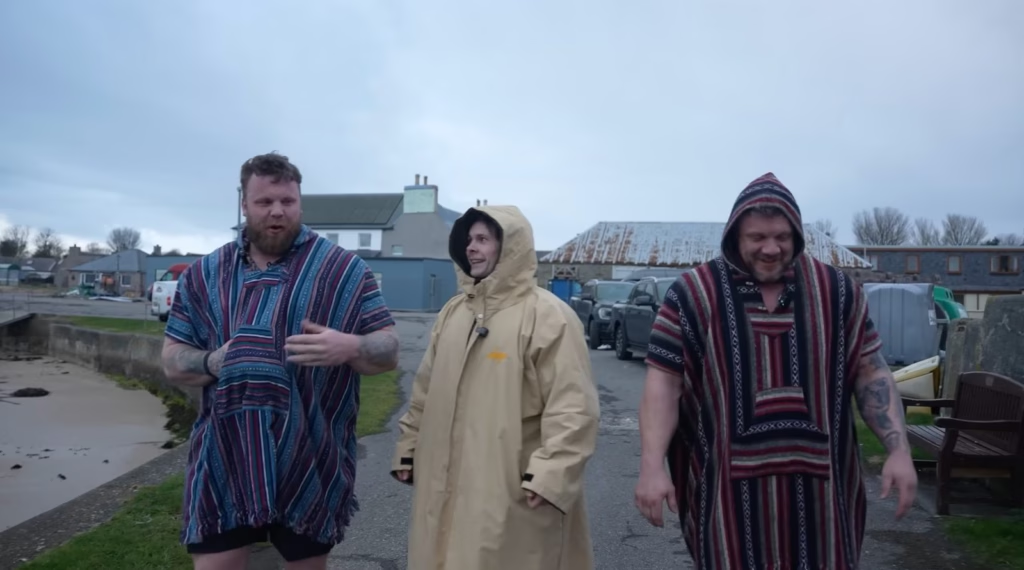
Tom Stoltman trains to move things that should not move
Tom Stoltman is a three-time World’s Strongest Man, winning the competition in 2021, 2022 and 2024. The competition’s official site continues to list him as a three-time champion. (World’s Strongest Man)
At close to 181kg, Stoltman reportedly eats approximately 8,000 calories per day. His breakfast in the video includes eight eggs, bacon, toast and beans, with considerably more food appearing throughout the day.
This is not a diet an ordinary gym-goer should imitate. It is fuel for an exceptionally large professional athlete whose sport rewards absolute strength.
The training reflects that goal. Tennyson and Stoltman perform an every-minute-on-the-minute clean and press workout. Tennyson uses approximately 84kg while Stoltman works with around 150kg. They also practise strongman-specific events including the monster dumbbell and bag toss.
Repetitions stay low. Rest and preparation matter. The movements resemble the tasks Stoltman faces in competition.
He is not training primarily for visible abs, a fast 5km or general health. He is training to produce enormous force in highly specific events.
Screenshot: YouTube/Will Tennyson
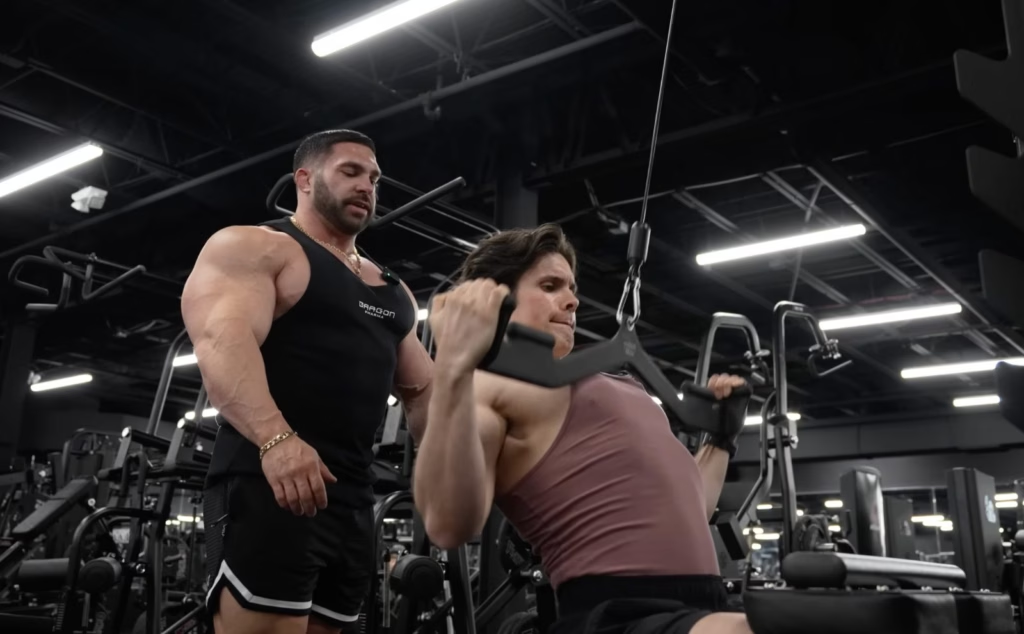
Derek Lunsford trains to build visible muscle
Derek Lunsford won the Open Mr Olympia in 2023 and 2025, after previously winning the 212 Olympia in 2021. Calling him a “three-time Mr Olympia” is technically defensible across the two divisions, but “two-time Open Mr Olympia and former 212 champion” is more precise. (Mr Olympia winners, 212 Olympia winners)
Lunsford weighs approximately 114kg at only 168cm tall in the video. His competition weight is reportedly closer to 109–110kg.
His routine bears little resemblance to Stoltman’s.
Food is measured carefully. Meals are organised around macronutrients. Cardio helps him manage body composition, while resistance training uses more repetitions, more total volume and multiple exercises targeting the back and biceps.
Tennyson describes sets of 10–15 repetitions, forced repetitions and partial repetitions after full repetitions become impossible.
The objective is not to lift the heaviest possible weight once. It is to expose the target muscles to enough demanding work to stimulate growth while controlling body composition closely enough to display that muscle on stage.
One qualification is important: training to complete muscular failure is not mandatory for growth. A systematic review found no clear hypertrophy advantage to reaching momentary failure compared with stopping short. Hard sets matter, but every set does not need to become a survival test. (PubMed)
Screenshot: YouTube/Will Tennyson
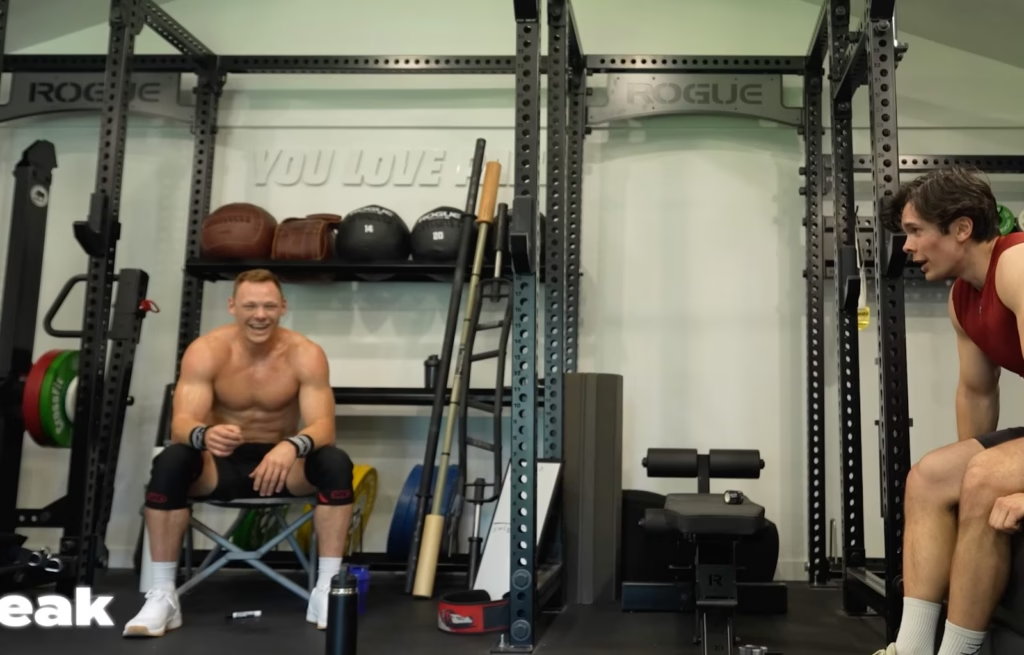
Jayson Hopper trains to be capable of almost anything
Jayson Hopper won the men’s division at the 2025 CrossFit Games. CrossFit’s official records list him first in 2025 and sixth in 2026, so he should be described as the 2025 champion rather than the current champion. (CrossFit Games)
Hopper reportedly eats just under 6,000 calories per day and tells Tennyson his resting heart rate is 38 beats per minute.
His training day combines mobility, plyometrics, power cleans, speed squats, conditioning and technical skill practice. One circuit includes an Echo bike, burpees, box jumps and repeated squats with a 45kg sandbag.
After lunch, Hopper returns for another session involving handstands, butterfly pull-ups, skipping and snatches.
Where Stoltman specialises in maximum strength and Lunsford specialises in muscular development, Hopper needs breadth. He must be strong, powerful, aerobically fit, technically competent and able to keep performing under fatigue.
That range comes with a trade-off. Research suggests concurrent strength and endurance training can improve both qualities, although men may experience a small reduction in lower-body strength development compared with strength training alone. (PubMed)
That is not an argument against hybrid training. It is evidence that you cannot maximise every physical quality simultaneously.
Screenshot: YouTube/Will Tennyson
So where do genetics enter the story?
They probably matter enormously. Elite strongmen, bodybuilders and CrossFit competitors are unlikely to represent average human potential.
Body structure, muscle-fibre characteristics, height, appetite, recovery capacity and responsiveness to training can all influence sporting success.
But this video cannot tell us how much of each athlete’s performance came from genetics. It does not compare their DNA, establish the prevalence of any physical trait or separate inherited advantages from years of specialised training.
What it does show is the interaction between favourable traits, enormous workloads, carefully managed nutrition and prolonged commitment to one sport.
The shared ingredient is not a secret exercise. It is specificity backed by consistency.
The sensible version for men aged 35–65
Do not copy the calories, session length or training volume of a professional athlete. First decide what you actually want your body to do.
- For strength: prioritise several major lifts, use heavier loads, take longer rests and practise those movements consistently.
- For muscle: accumulate challenging sets across the week, control each repetition and generally finish with one to three good repetitions still available.
- For all-round fitness: combine two or three strength sessions with two aerobic sessions and one carefully scaled conditioning workout.
Choose one primary goal for the next eight to twelve weeks. The other qualities can be maintained without trying to maximise everything at once.
The useful lesson hiding behind the title
Tennyson begins the video by describing himself as neither the biggest, strongest nor fittest man in the gym.
After attempting all three routines, he still does not become any of those things. That is precisely the point.
Tom Stoltman, Derek Lunsford and Jayson Hopper are not interchangeable examples of “good genetics”. They are products of different sports, different selection pressures and years of training for different outcomes.
You do not need their genetics or their lifestyles to learn from them.
You need a clear target, a training method that matches it and the patience to keep doing the work after the novelty disappears. Stay strong, gentlemen.