
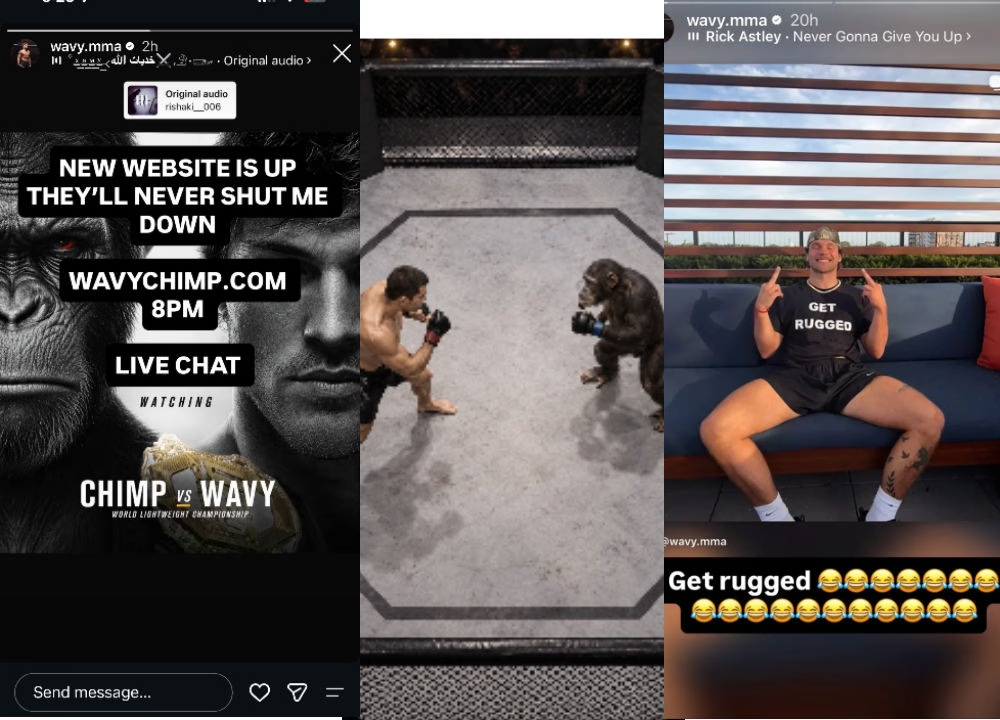

Around 1,482 people were reportedly logged into the live chat, waiting to see whether a New Zealand fighter with a single professional win was actually about to get into a cage with a chimpanzee.
The countdown reached zero. There was no cage. There was no fight. There was never a chimp.
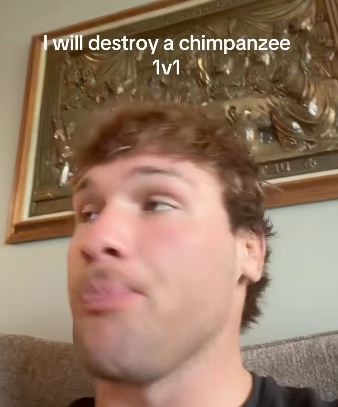
Instead, Cole “Wavy” Johnson posted a photo of himself throwing up both middle fingers, wearing a t-shirt reading “Get rugged”, and thanked everyone for playing. The man-vs-chimp fight was a hoax, and specifically a crypto one, from start to finish.
MFO called this five days earlier. In our original story, we pointed out that “a countdown timer on a promotional page proves someone built a countdown timer. It doesn’t prove a chimpanzee is coming.” That held up better than most sports journalism manages.
The warning signs, in hindsight
None of what makes a fight real ever turned up. No venue. No promoter. No jurisdiction. No animal handler. No welfare approval. No sanctioning body. No purse anyone could actually verify.
Johnson filled the gaps with just enough detail to keep the story alive: teeth and claws left in, tranquiliser staff on standby, a country he “couldn’t name.” That’s the outline of a stunt, not the paperwork of an event, and treating it as unconfirmed rather than real was the only responsible call available at the time.

The crypto machinery underneath it
A single-purpose website appeared in the days before the advertised 8pm Central Time slot on 11 September, complete with a livestream page and a “betting arena” tracking two tokens, $WAVY and $CHIMP. One has since turned up on a Solana risk-checker carrying a moderate-risk rating, which is crypto-speak for know what you’re doing before you touch this.
You don’t need to understand blockchain to get the point. Attention that could have gone toward “is a chimpanzee about to be hurt” got rerouted toward two speculative tokens instead, while the internet argued over whether the fight was real. “Get rugged” wasn’t just an insult on a t-shirt. It was the punchline the whole site had been building toward.

The unexpectedly decent turn
Here’s the part that complicates the story rather than resolving it. Johnson’s caption thanked his followers for playing and pointed them toward chimpanzee habitat conservation. The link in his bio, which had spent a week driving traffic to a fake fight, now goes to the Jane Goodall Institute — worth naming correctly, since several accounts of this story got it wrong as the “Jane Goodall Foundation,” which isn’t the organisation’s name.
That’s a genuinely better outcome than the one everyone feared, an animal used for entertainment. But there’s a difference between “he gave the money to charity” and what can actually be established: he swapped a promotional link for a donation page and told people to give directly.
He did not give away a half-million-dollar purse. As far as anyone can establish, the purse never existed. Whether Johnson personally donated anything, whether the Institute saw a single extra dollar this week, and whether he had any financial stake in $WAVY or $CHIMP are all questions nobody has answered on the record.
What the chimp never got to say
Strip away the countdown clock and the token chart and the trick here wasn’t complicated. Make a claim outrageous enough that arguing about it becomes more compelling than fact-checking it, then let every publisher who takes the bait supply free marketing for the reveal. It worked. It usually does.
The chimpanzee was imaginary. The attention was real, and for one week, it was worth more than the truth.
Did Cole Johnson fight a chimpanzee?
No. Cole “Wavy” Johnson revealed that the advertised 11 September fight was a hoax. He subsequently directed followers to a Jane Goodall Institute donation page, but there is no verified evidence that he donated any supposed fight or cryptocurrency proceeds himself.