

A good ab workout takes about 20 minutes, two or three times a week. It isn’t 200 crunches a night. Your abs are muscles like any others: they get stronger when you make them work harder over time, they need rest between sessions, and they do more than one job. They bend your spine, stop it bending when something pushes on you, and help you twist and side-bend. The routine below covers all of that, with a version for beginners and a harder one for when the first gets easy.
- The workout: five or six moves done as a circuit, 3–4 rounds, about 20 minutes
- Cover four jobs: bending (crunches, leg raises), resisting movement (planks, Pallof press), side-bending and rotation
- How often: two or three times a week, like any other muscle group
- How to progress: slower reps, longer holds, harder versions or added weight; not hundreds more reps
- The catch: ab work strengthens the muscle but doesn’t burn the fat over it; visible abs come from losing fat
What a complete ab workout covers
Most men train the one movement they can see working in the mirror: the crunch. That trains one job of the rectus abdominis, the six-pack muscle. But the muscles around your middle work as a team, and a complete session gives each of their jobs a move:
- Bending forward (flexion): crunches, reverse crunches, leg raises.
- Resisting movement (anti-extension and anti-rotation): planks, dead bugs, ab wheel rollouts, the Pallof press. Your trunk holds still while something tries to move it, which is what it does when you lift, run or take a hit.
- Side-bending and resisting it: side planks, suitcase carries.
- Rotation: bicycle crunches, cable or band rotations.
If you want the case for why this matters beyond looks, we went through the research on balance, jumping and throwing in core training: does it still matter?.

The 20-minute ab workout (beginner)
Do the five moves back to back with as little rest as you need to keep good form. Rest 60–90 seconds after the last one, then go again. Three rounds take about 15 minutes; four take about 20.
| Exercise | Reps or time |
|---|---|
| 1. Dead bug | 10 each side |
| 2. Reverse crunch | 12 |
| 3. Front plank | 30 sec |
| 4. Side plank | 20–30 sec each side |
| 5. Bicycle crunch | 10 each side |
How to do them
- Dead bug: lie on your back, arms pointing at the ceiling, knees bent at 90° above your hips. Press your lower back into the floor and keep it there while you slowly lower one arm behind your head and the opposite leg towards the floor. Return and swap sides.
- Reverse crunch: lie on your back, knees bent. Curl your hips off the floor and bring your knees towards your chest, then lower slowly. Don’t swing your legs: the curl comes from your abs.
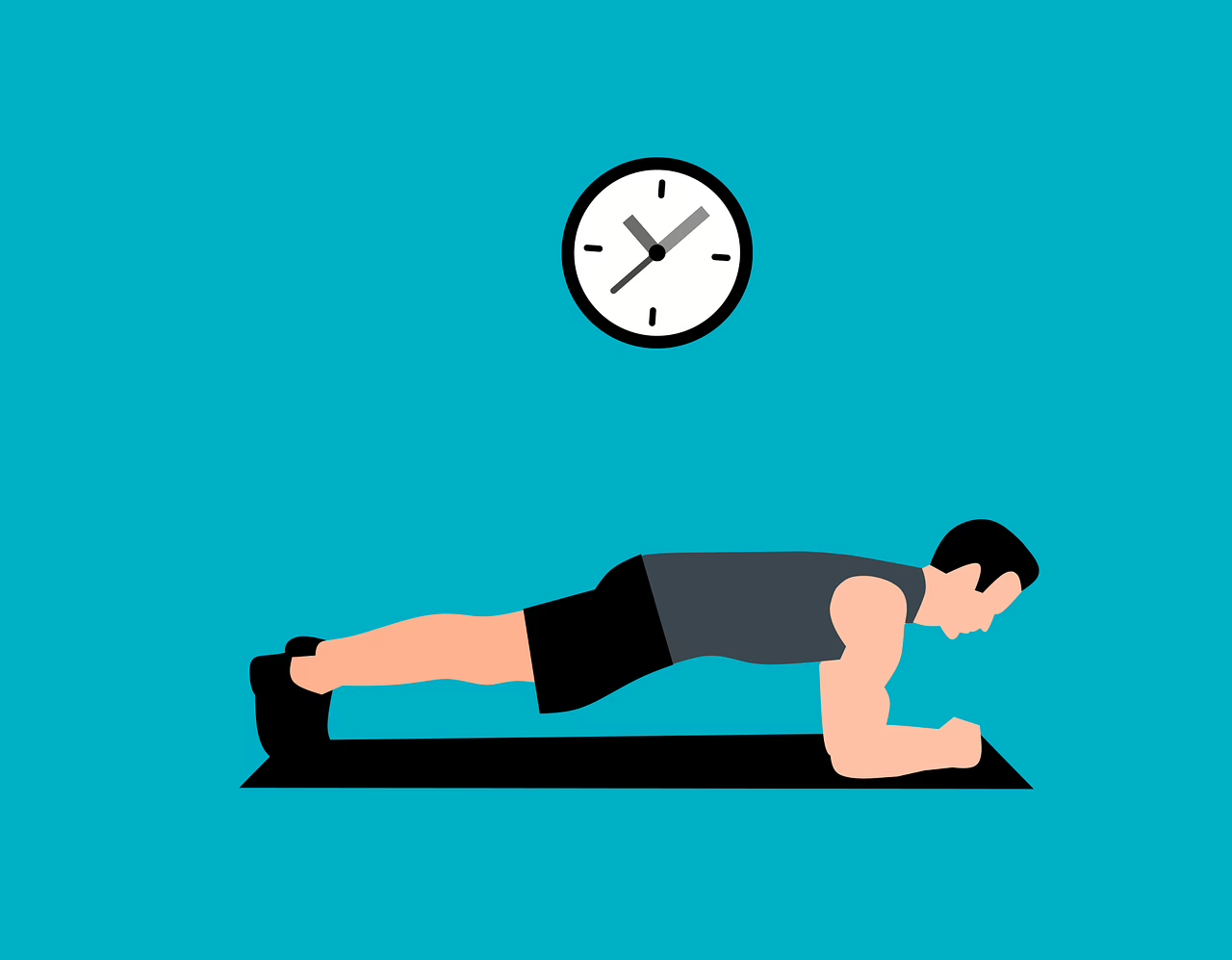
- Front plank: forearms on the floor, elbows under shoulders, body in a straight line from head to heels. Squeeze your glutes and brace as if someone’s about to poke you in the stomach. Stop the set when your hips sag.
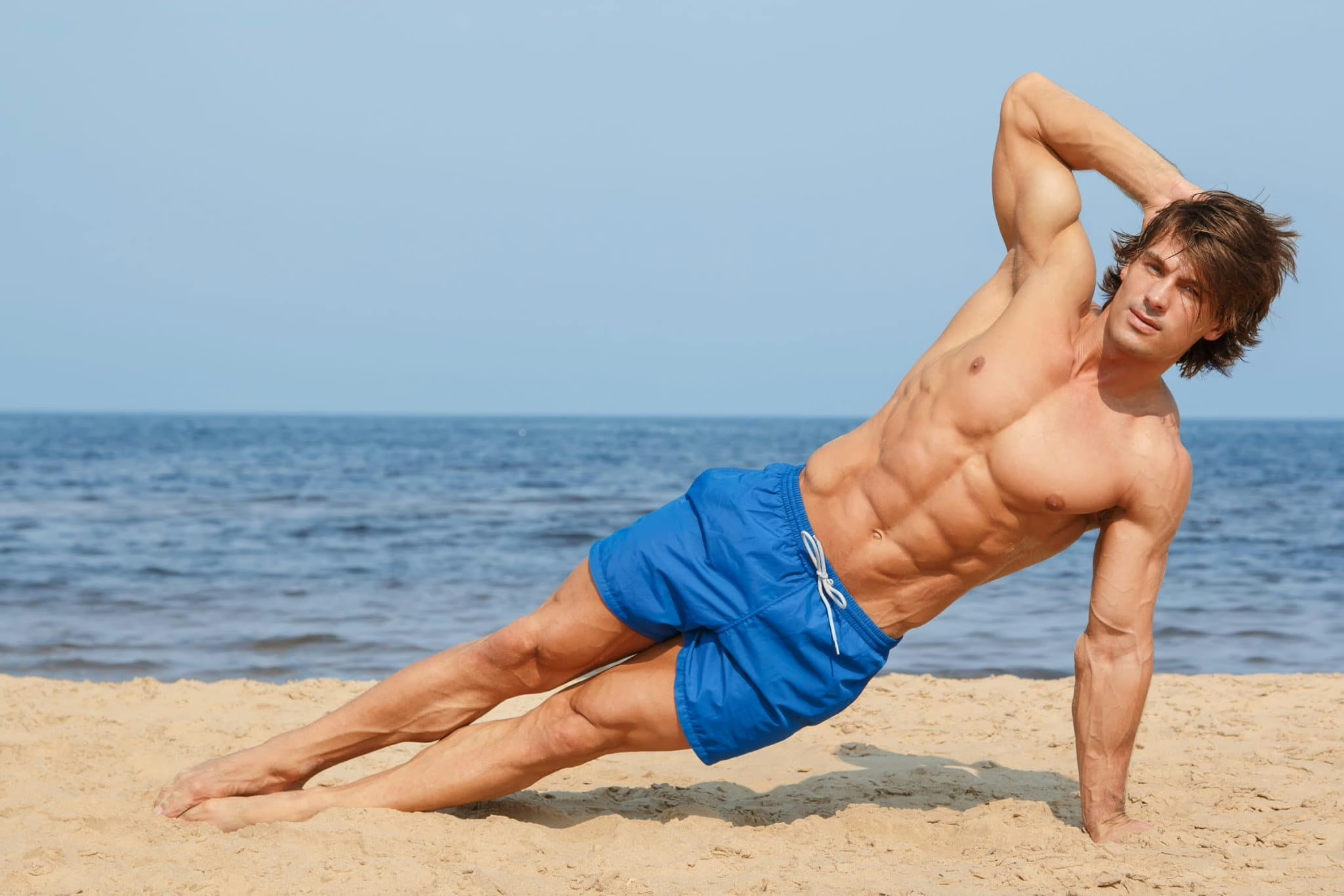
- Side plank: on one forearm, feet stacked, hips lifted so your body makes a straight line. Too hard? Bend your knees and plank from them.
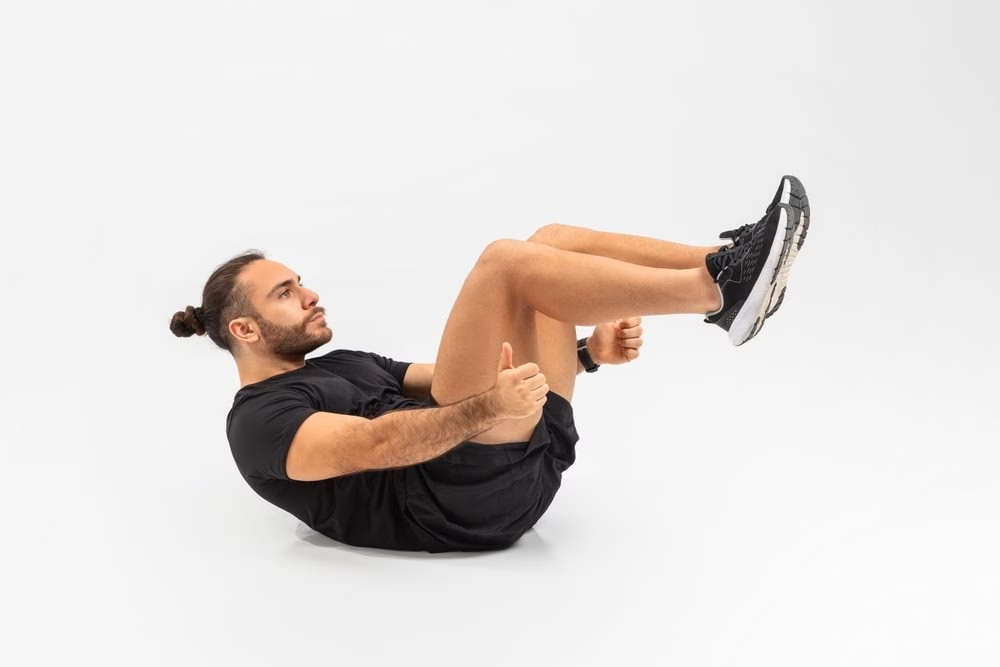
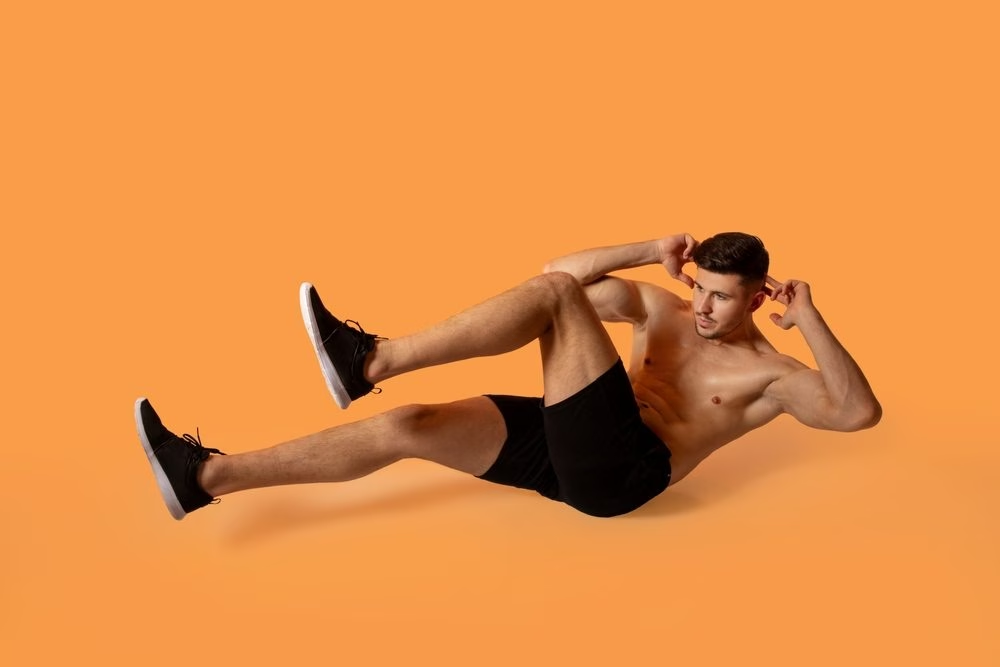
- Bicycle crunch: on your back, hands lightly by your temples. Bring one elbow towards the opposite knee as the other leg straightens, then switch. Slow and controlled beats fast and sloppy. Our bicycle crunch guide covers the form and the common mistakes.
The harder ab workout
When you can do four rounds of the beginner workout with good form, move to this one. It uses a chin-up bar, an ab wheel, a cable machine or band, and a dumbbell or kettlebell. Do 3–4 sets of each move, resting about a minute between sets, or run it as a circuit like the beginner version.
| Exercise | Reps or time |
|---|---|
| 1. Hanging leg raise | 8–12 |
| 2. Ab wheel rollout | 8–10 |
| 3. Weighted crunch or cable crunch | 10–12 |
| 4. Pallof press | 10 each side |
| 5. Suitcase carry | 30 m each side |
| 6. Hollow hold | 20–30 sec |
How to do them
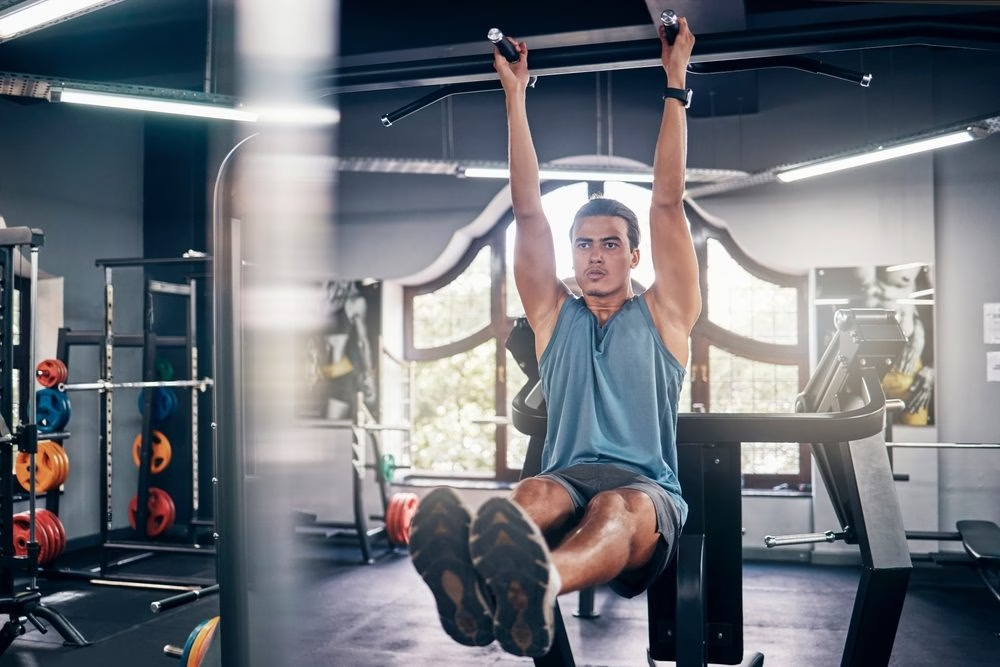
- Hanging leg raise: hang from a bar and raise your legs, curling your pelvis up at the top. Start with bent knees. If your grip gives out first, work on your dead hang.
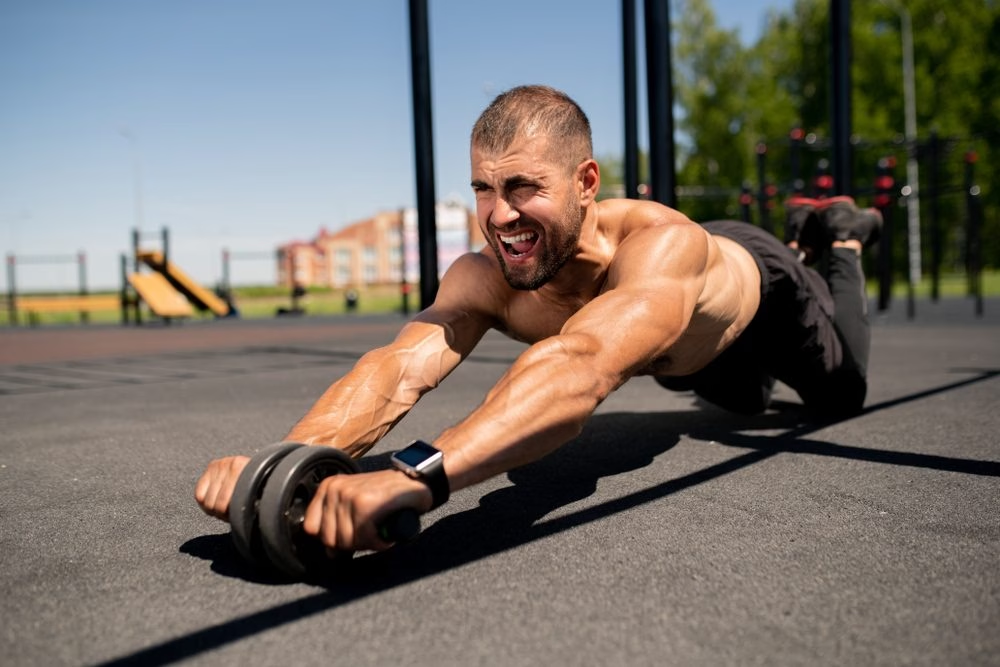
- Ab wheel rollout: kneel with the wheel under your shoulders. Roll forward only as far as you can without your lower back sagging, then pull back with your abs. Go further as you get stronger.
- Weighted crunch or cable crunch: a crunch with a plate on your chest, or kneeling at a cable with a rope behind your head, curling your ribs towards your hips. Adding weight is how you keep progressing without endless reps.
- Pallof press: stand side-on to a cable or a band anchored at chest height. Hold the handle at your chest and press it straight out, without letting it twist you. Hold for a second, bring it back.
- Suitcase carry: walk with a heavy dumbbell or kettlebell in one hand, standing tall without leaning towards the weight. Swap hands.
- Hollow hold: on your back, press your lower back into the floor, then lift your shoulders and straight legs a few centimetres. Arms by your sides make it easier; overhead makes it harder.
Ready for more? The dragon flag is the classic test of the whole front of your body, and our 10 best core exercises has more moves to rotate in.
How often should you train abs?
Two or three times a week. That’s the standard for training any muscle group: the American College of Sports Medicine’s position stand on resistance training recommends 2–3 days a week for beginners (ACSM, 2009), and Australia’s physical activity guidelines ask adults to do muscle-strengthening work on at least two days a week (Department of Health). Tack the workout onto the end of two of your gym sessions, or do it on its own at home.
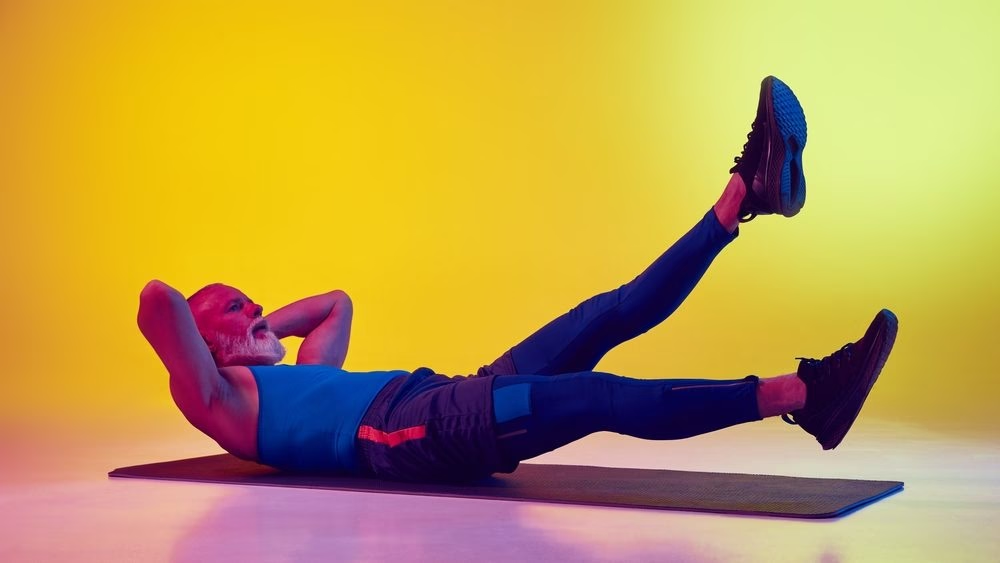
Daily ab work isn’t needed. If you train them hard enough to improve, they need recovery like your chest or legs. If you can do them every day without feeling it, they’re too easy: make them harder rather than more frequent.
Will an ab workout give you a six-pack?
Not on its own. Ab work builds the muscle, but it doesn’t burn the fat sitting on top of it. In one controlled trial, 24 untrained adults did seven ab exercises five days a week for six weeks. Their abdominal endurance improved, but their belly fat, waist measurement and skinfolds didn’t change compared with a group that didn’t train (Vispute and colleagues, 2011). A 2021 meta-analysis of 13 studies and 1,158 people came to the same conclusion: training a muscle didn’t take fat off the area over it, whoever did it and whatever the programme (Ramirez-Campillo and colleagues).
So the workout makes your abs stronger and thicker, which helps them show sooner, but whether you see them comes down to body fat, and that’s mostly diet. We cover how lean you need to be to see a six-pack, and why some men get four or eight instead of six, in a separate guide.
Common mistakes
- Pulling on your neck. Hands rest lightly by your temples; the lift comes from your ribs curling towards your hips.
- Swinging. Momentum on leg raises and fast crunches takes the work off your abs. Slow down, especially on the way back.
- Only doing crunches. Add the bracing, side and rotation moves.
- Sagging planks. A long plank with your hips dropped trains your patience, not your abs. Hold a good position for less time.
- Chasing reps instead of difficulty. Once you can do 20 easy reps, change the move or add weight.
- Holding your breath. Breathe out as you curl or press; keep breathing through holds.
Ab workout FAQ
Can I do an ab workout every day?
You can, but you don’t need to. Two or three hard sessions a week, with rest between, is what’s recommended for any muscle group. If daily ab work feels easy, the workout isn’t hard enough to change much.
Can I do this ab workout at home?
Yes. The beginner workout needs nothing but a mat. For the harder one at home, swap the hanging leg raise for a lying leg raise, the cable crunch for a crunch holding a weight, and use a band for the Pallof press.
Are planks better than crunches?
Neither is better: they train different jobs. Planks train your abs to hold your spine still; crunches train them to bend it. A complete workout does both.
How long until I see results?
You’ll feel stronger within a few weeks. Seeing your abs depends on how much fat you have to lose; our six-pack guide explains how lean you need to be.
Do squats and deadlifts work your abs?
Your trunk has to brace hard to hold a heavy bar, so they help, but they’re not a replacement for direct ab work if you want your abs stronger and more defined. Do both. For a bodyweight programme that covers the whole body, try our 28-day military calisthenics plan.
Sources: Vispute, Smith, LeCheminant and Hurley (2011), Journal of Strength and Conditioning Research; Ramirez-Campillo and colleagues (2021), Human Movement; American College of Sports Medicine position stand (2009), Medicine & Science in Sports & Exercise; Australia’s physical activity and exercise guidelines for adults. Checked 28 October 2026.