

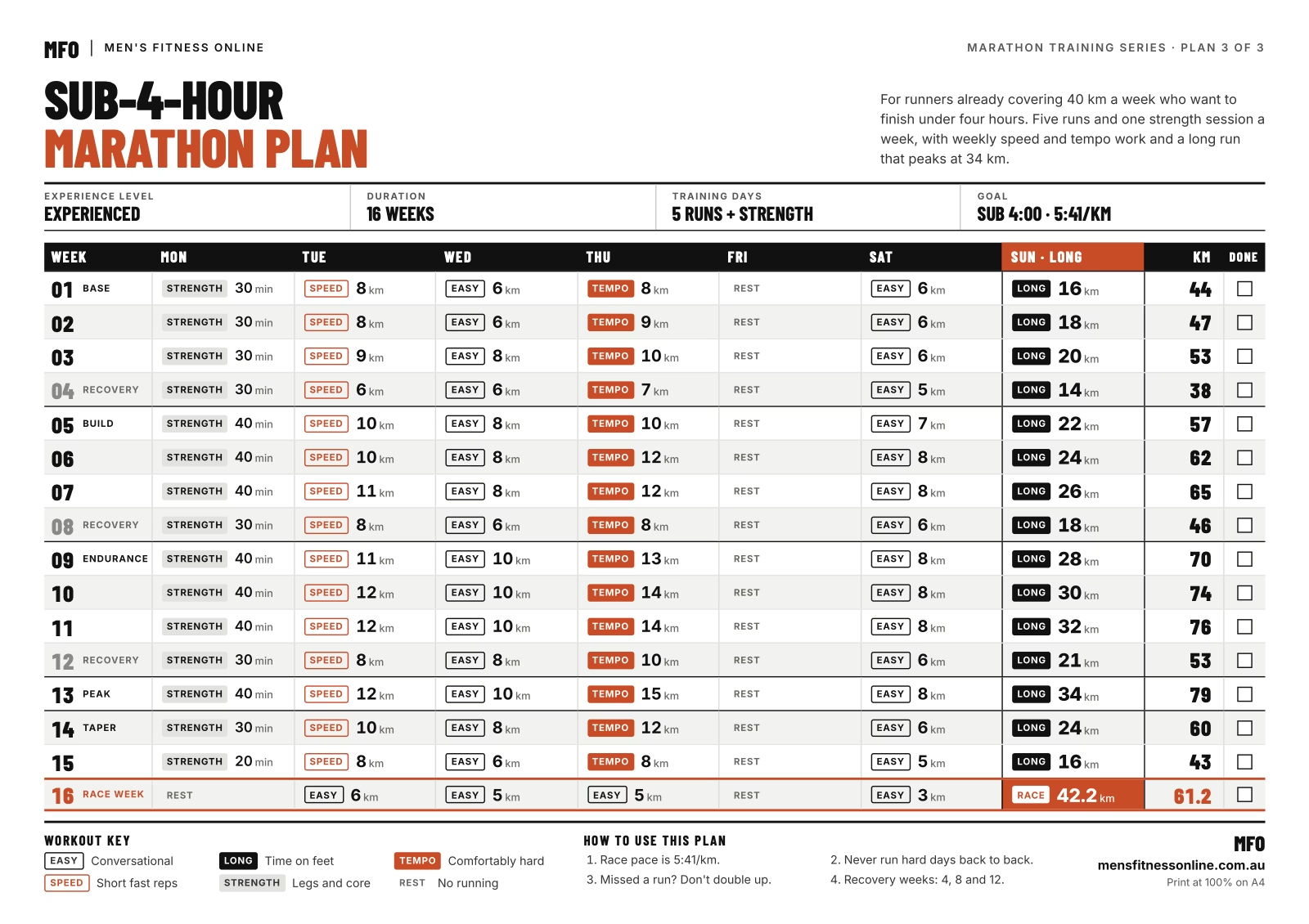
This is a free 16-week sub-4-hour marathon training plan: five runs and one strength session a week, with a speed session and a tempo run every week and a long run that peaks at 34 km. It’s written for runners already covering about 40 km a week who want to finish under four hours. Download it as a printable PDF and tick off each week.
- Level: experienced
- Goal: under 4 hours, an average of 5:41 per km
- Length: 16 weeks
- Each week: 5 runs + 1 strength session (20 to 40 minutes)
- Start: 44 km a week, with a 16 km long run
- Peak: week 13, 79 km, with a 34 km long run
- Taper: weeks 14 to 16 (60 km, 43 km, then race week)
- Recovery weeks: 4, 8 and 12
- Cost: free PDF, sent to your inbox
- 16-week beginner planFirst marathon. From 24 km a week, 4 runs.
- 12-week planAlready running about 30 km a week. 4 runs.
- Sub-4-hour plan (this page)About 40 km a week, aiming under 4 hours. 5 runs.
Who this plan is for
Running under four hours means averaging 5:41 per kilometre for 42.2 km. This plan is for runners who already cover about 40 km a week and are comfortable with a 16 km long run, because week 1 asks for 44 km over five runs, including a speed session and a tempo run.
A recent race result is the best guide to whether sub-4 is realistic. A widely used prediction formula, Riegel’s, puts a 1:55 half marathon at about 4:00 for the full distance, but treat that as a best case: most runners slow more than the formula expects over the last 10 km of a marathon. If your half marathon is well over two hours, or this is your first marathon, start with our 16-week beginner plan or the 12-week plan. If you’re new to hard training, over 45, or have a heart condition or other medical history, check in with your GP first.
The 16 weeks, week by week
The plan moves through four blocks of four weeks. The last week of the first three blocks drops back so your body can absorb the work.
- Base (weeks 1 to 4): speed and tempo sessions from the first week, with the long run climbing from 16 to 20 km.
- Build (weeks 5 to 8): strength sessions grow to 40 minutes, tempo runs reach 12 km and the long run goes from 22 to 26 km.
- Endurance (weeks 9 to 12): the biggest training block, with long runs of 28, 30 and 32 km and weeks of 70 to 76 km.
- Peak and taper (weeks 13 to 16): week 13 peaks at 79 km with a 34 km long run, then volume drops to 60 km and 43 km before race week.
| Week | Long run | Week total |
|---|---|---|
| 1 (base) | 16 km | 44 km |
| 2 | 18 km | 47 km |
| 3 | 20 km | 53 km |
| 4 (recovery) | 14 km | 38 km |
| 5 (build) | 22 km | 57 km |
| 6 | 24 km | 62 km |
| 7 | 26 km | 65 km |
| 8 (recovery) | 18 km | 46 km |
| 9 (endurance) | 28 km | 70 km |
| 10 | 30 km | 74 km |
| 11 | 32 km | 76 km |
| 12 (recovery) | 21 km | 53 km |
| 13 (peak) | 34 km | 79 km |
| 14 (taper) | 24 km | 60 km |
| 15 | 16 km | 43 km |
| 16 (race week) | Race: 42.2 km | 61.2 km |
The sessions, and how fast to run them
- Easy (Wednesday and Saturday): 60 to 90 seconds per km slower than race pace, so roughly 6:40 to 7:10 per km. It will feel too slow. That’s the point: easy runs let you recover for the hard sessions.
- Speed (Tuesday): short, fast repeats with full recovery, for example 6 to 10 × 400 m or 5 × 800 m. The session distance includes your warm-up and cool-down.
- Tempo (Thursday): comfortably hard. You can speak a few words at a time, but you wouldn’t want to chat. As the weeks go on, try running part of it at your 5:41 race pace to learn how it feels.
- Long run (Sunday): mostly at easy pace. Use the 30, 32 and 34 km runs to rehearse race-day shoes, kit, breakfast and fuelling.
- Strength (Monday, 20 to 40 minutes): legs, hips and core. Squats, lunges, step-ups, calf raises, glute bridges and planks cover it.
Friday is the only full rest day, so look after it. You can move days to suit your week, but never put two hard sessions (speed, tempo or long run) back to back.
Pacing a sub-4 race
Exactly four hours is an even 5:41 per km and 2:00:00 at halfway, which leaves no margin. Many runners aim for an even 5:35 to 5:38 per km, which puts them through halfway a minute or two under two hours with a little in hand for drink stations and the final kilometres. If your race has a 4-hour pacer, running with the group takes much of the guesswork out. Above all, don’t bank time in the first 10 km: going out too fast is the classic way to miss a sub-4.
For context, a sub-4 finish puts a man ahead of the median for every age group in the 2024 data in our guide to average marathon times.
The taper
After the week 13 peak, weekly volume drops from 79 km to 60 km, then 43 km, while the speed and tempo sessions stay in, just shorter. That fits the research: a 2007 meta-analysis by Bosquet and colleagues found the best results came from a taper of about two weeks in which training volume dropped by 41 to 60%, without cutting intensity or how often athletes trained. For the final seven days, see our guide to preparing for a running event one week out.
Fuelling for under four hours
The Melbourne Marathon’s nutrition guidance says 30 to 60 g of carbohydrate an hour is enough for most marathon runners. For events longer than about 2.5 to 3 hours, the Australian Institute of Sport allows up to 90 g an hour, but only if your gut is used to it. A sub-4 race sits right in that range, so practise on every long run from week 5: a typical gel has around 20 to 25 g of carbohydrate (check the label).
Missed sessions and when to back off
- Missed a run? Let it go. Don’t add it to the next day, and if you miss a hard session, don’t squeeze it in next to another one.
- Missed a week? Repeat the last week you completed, then carry on.
- Sore in one spot (a shin, knee, foot or Achilles) and getting worse as you run? Stop, rest a few days and see a physio if it doesn’t settle. At 70 km-plus weeks, small niggles grow quickly.
- Struggling to hit the paces? Run the sessions by effort rather than the watch, and adjust your race goal rather than forcing it.
FAQ
What pace is a sub-4-hour marathon?
5:41 per kilometre (about 9:09 per mile) for 42.2 km, or about 2 hours at halfway.
How many kilometres a week do you need for a sub-4 marathon?
This plan runs from 38 to 79 km a week, averaging about 58 km. Some runners go under four hours on less, but regular weeks in the 60s and 70s make the last 10 km much more manageable.
What’s the longest run in this plan?
34 km, in week 13, three weeks before race day.
Is there a printable PDF?
Yes, free: one A4 landscape page plus a print-friendly version. Enter your email in the box above and we’ll send both straight over. Print at 100%.