
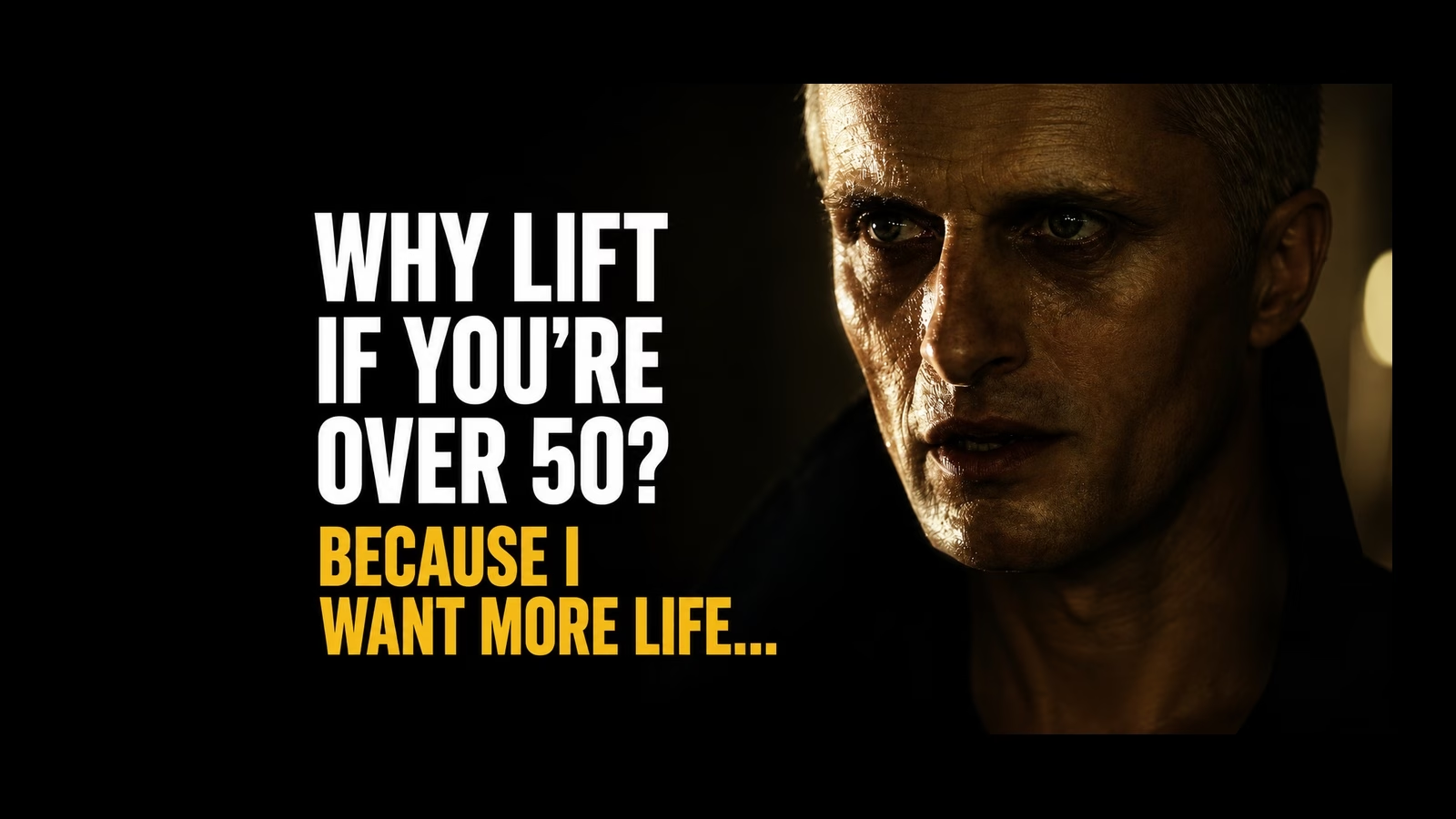

Roy Batty could have been speaking for entire Gen X when he stared down his soon-to-be-dead creator in Blade Runner and said: “I want more life, fucker.”
Strip away the sci-fi, the rain and the existential robot angst, and that is not a bad fitness philosophy for middle age. (Fun ironic fact: Rutger Hauer, who played Roy Batty, died in 2019, the same year his character dies in Blade Runner.)
Every sane man want more years, but not just more years on the back end, but more useful years. The back nine should be even better because you know shit now. Good years, full of laughter, sex travel, more surfing, sex — yeah I know said it twice — and carrying the shopping in one trip because, frankly, that still matters. Not weekends where your back doesn’t let you go out because you moved a pot plant.
There is a way. Lift.
A long-term study published in the British Journal of Sports Medicine followed more than 147,000 adults for up to 30 years and found that 90–119 minutes of resistance training a week was associated with a 13 per cent lower risk of death from any cause compared with doing none. That same weekly amount was also linked with a 19 per cent lower risk of cardiovascular death and a 27 per cent lower risk of neurological disease death, after adjusting for aerobic activity.
That is the bit worth paying attention to. We are not talking about living in the gym. We are talking about roughly two hours a week. You probably spend more time than that on your phone in a single day.
The interesting part is that the benefit appeared to plateau around 120 minutes a week. More training was not necessarily better. Consistent training seemed to be the sweet spot.
For most men, that could mean three 30–40 minute strength sessions. It could mean two solid full-body workouts. It could mean short sessions fitted around walking, cycling, swimming, running or whatever else keeps you sane. The World Health Organization already recommends adults do muscle-strengthening activity involving all major muscle groups on at least two days a week, alongside regular aerobic activity.

He started at 51 and 160kg
Brazilian former farm worker Almir Rogério da Silva did not begin his transformation as a lifelong bodybuilder. At 51, he weighed 160kg, had dangerously high blood pressure and was taken to hospital after becoming ill during a night shift.
He sought nutritional help, simplified his diet, combined resistance training with cardiovascular exercise and reportedly lost about 80kg. He later stepped onto a bodybuilding stage and became known online as Vovô Bodybuilder. His transformation is extreme, but the most useful parts of it are surprisingly ordinary.
The 30-Minute “More Life” Workout
Do this three times a week in your lounge room, garage or backyard. Bodyweight is enough to start. Add a cheap Kmart kettlebell or dumbbell when it gets too easy and you’re golden.
1. Goblet Squat or Bodyweight Squat
Reps: 8–12
Why: Trains legs, hips and the basic ability to get up and down without moving like an old deckchair.
Scale it: Start with bodyweight. Add a kettlebell or dumbbell held at chest height.
2. Push-Up
Reps: 6–12
Why: Builds chest, shoulders, triceps and basic upper-body strength.
Scale it: Hands on a bench, kitchen bench or wall if floor push-ups are too much. Feet elevated if they’re too easy.
3. Kettlebell Romanian Deadlift
Reps: 10–12
Why: Trains hamstrings, glutes and the hinge pattern that saves your back when you pick things up.
Scale it: Use a kettlebell, dumbbell, backpack or two shopping bags. Keep the back long and push the hips back.
4. One-Arm Row
Reps: 8–12 each side
Why: Hits the lats and mid-back, which most men lose if they only walk, run or ride.
Scale it: Use a kettlebell, dumbbell, backpack or resistance band. Pull the elbow back, not the hand up.
5. Loaded Carry or March
Time: 30–45 seconds
Why: Trains grip, core, posture and the useful kind of strength: carrying awkward stuff without folding.
Scale it: Hold one weight at your side and march on the spot. Swap sides halfway. Too easy? Walk.
6. Plank or Dead Bug
Time: 30–45 seconds
Why: Teaches the trunk to brace, not just flop around while your limbs do the work.
Scale it: Start with a dead bug if planks annoy your back. Progress to longer holds or shoulder taps.
For men over 40 and 50, this matters because the fitness game quietly changes.At 25, you can get away with a lot. Bad sleep. Bad training. Random sport. No warm-up. A diet that looks like a dare. By 45 or 50, the bill starts arriving. You may still feel young in your head, but the body begins negotiating in smaller print.
Strength training after 50 is not vanity. It is infrastructure.
Age-related muscle loss is real. Research has found muscle mass can decline by roughly 3–8 per cent per decade after 30, with the rate of loss increasing after 60. That does not mean decline is inevitable in some gloomy, fatalistic way. It means your body needs a reason to keep what it has. That reason is resistance.
Weights. Machines. Kettlebells. Resistance bands. Bodyweight work. Loaded carries. Squats. Hinges. Rows. Presses. Pulls.
That is why strength training is not just about bigger arms or a wider back. A 2021 systematic review and meta-analysis found resistance training improved muscle strength and physical performance in older adults with sarcopenia, which is the age-related loss of muscle mass and function. Other research has linked resistance training with benefits for bone mineral density in older adults, which matters because ageing well is not just about living longer. It is about staying harder to break.
Two hours a week is not much. But over months and years, it becomes a different body. Roy Batty wanted more life. Most men over 50 do too. The difference is, you do not need a creator to give it to you. You need a barbell, a plan and the patience to keep showing up. It also explains a lot about why some older blokes are ridiculously strong well past the age you’d expect.
Strength can start with showing up
Not every Still Strong story begins with a heavy barbell. In Florida, 92-year-old Milton H. has reached 500 Pure Barre classes. His exact training history and health results have not been published, but the milestone makes one part of long-term fitness impossible to miss: the program that works is the one you can keep returning to.
Want the fundamentals nailed down first? Our 10 strength training tips that will never die is the best place to start.