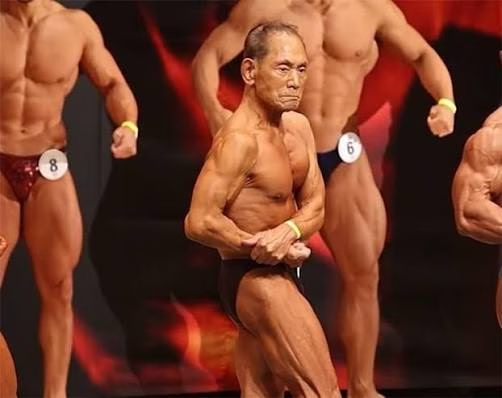

On 30 August, in a conference hall in Hiroshima, Toshisuke Kanazawa won the 85-and-over class at the 38th Japan Masters Bodybuilding Championships. He had turned 90 the day before. It was his 17th Japan Masters title, according to the official results coverage, and his 19th national title overall once you count the two Mister Japan crowns he won as a young man.
Embed from Getty ImagesThe Guardian, which interviewed him in his Hiroshima gym, reports that he beat seven other men on the day. He says it won’t be his last.
The easy way to tell this story is as a miracle. The more useful way is to look at what he’s stopped doing, because a 90-year-old who is still winning has had to change his training a great deal to keep doing it.
From the pool to Mister Japan
Kanazawa was born in 1936 in Shimane prefecture, on Japan’s west coast. His first sport was swimming, and he was good enough at the 1500 m freestyle in high school to think about the Olympics until a muscular problem ended that plan.
He turned to bodybuilding instead, and won Mister Japan in 1960, at 24, and again three years later. In 1967 he placed fourth at the Mr Universe contest in Montreal. Then, in his mid-30s, he retired.
Why he came back at 50
The comeback had little to do with trophies. His wife lived with a chronic illness, and Kanazawa told the Guardian he had noticed how much he had let himself go since stepping off the stage. “I wanted to show her that anything was possible,” he said.
He returned to competition at 50. Seven years later he won the national masters title, and he considers that period his physical peak. He has since won six World Masters titles after turning 80, and still runs his own gym in Hiroshima.
If a late return sounds familiar, it should. We’ve covered men like Phil Earley, who started bodybuilding at 57. Kanazawa is the same story told over 40 years.
What he’s changed
This is the part worth paying attention to. Kanazawa no longer does squats or bench presses, and uses machines rather than free weights for his training. “I do what’s best for me and my body at this age,” he told the Guardian.
He also says recovery takes longer than it used to, so he rests properly between sets and aims for about seven hours of sleep a night. He has cut his protein shakes from six a day to three because he can’t stomach that much liquid any more.
What hasn’t changed is the volume. He trains for about two hours a day, six days a week. That’s a competitive bodybuilder’s schedule, roughly 12 hours a week, and it isn’t where anyone should start. It’s what one man has built up to over seven decades.
He gave up meat and fish decades ago, eats a lot of brown rice, natto, miso soup and eggs, has never smoked or drunk alcohol, and describes himself as “100% natural”, meaning drug-free. That’s his own description, and we haven’t seen it independently confirmed (natural bodybuilding has a long-running trust problem, which is why at least one competition now makes athletes sit a lie-detector test). Nor is there any way to say whether his diet, his training or simple good fortune explains why he’s still competing at 90. He says he has never been seriously ill, which is a head start most people don’t get.
What the research says about lifting as you age
You lose muscle and strength with age, and the loss speeds up in later life. The good news is that muscle stays trainable for much longer than most people assume.
In a 1990 study published in JAMA, researchers put 10 frail nursing-home residents with an average age of 90 through eight weeks of high-intensity strength training. The nine who finished increased their strength by an average of 174%, added about 9% to their thigh muscle and walked noticeably faster.
You don’t need Kanazawa’s workload to benefit, either. A 2022 review in the British Journal of Sports Medicine found that 30 to 60 minutes of muscle-strengthening activity a week was linked to a 10–20% lower risk of death from all causes, with no clear extra benefit beyond that. It’s an observational finding, so it shows an association rather than proof, but it’s a useful reminder that two sessions a week counts.
The World Health Organization recommends muscle-strengthening work on at least two days a week for adults, and for over-65s adds balance-focused training on three or more days. The US National Strength and Conditioning Association’s position statement on older adults goes further on the detail: two to three sessions a week, a few multi-joint exercises per major muscle group, loads that build over time, and some faster, power-focused work. It also notes that training to failure hasn’t been shown to add benefit for older people.
Put Kanazawa’s changes next to that research and the lesson isn’t to copy his routine. It’s that he kept the habit and changed how he does it. If barbell squats bother your back, a leg press still trains your legs. If you’re sore for three days, add a rest day rather than stopping altogether. For more on this, read our pieces on lifting and longevity and on which lifts men over 50 should reconsider.
Until the day he dies
Kanazawa’s concern isn’t really about bodybuilding. He told the Guardian he worries that too many older Japanese people give up the things they did when they were younger, and let their legs weaken because they assume it’s inevitable.
His own plan is simpler. “I want to be a bodybuilder until the day I die,” he said. At 90, with another national title, he’s making a decent case for it.