Creatine has had a resurgence of late. What was once a staple of 90s bodybuilding has quietly become one of the most widely used supplements across gyms, sports, and increasingly, general health conversations. People are taking it for muscle, for cognitive function, for sleep, for ageing. Sales are up. The conversation has moved mainstream thanks to the numerous studies proving its efficacy.
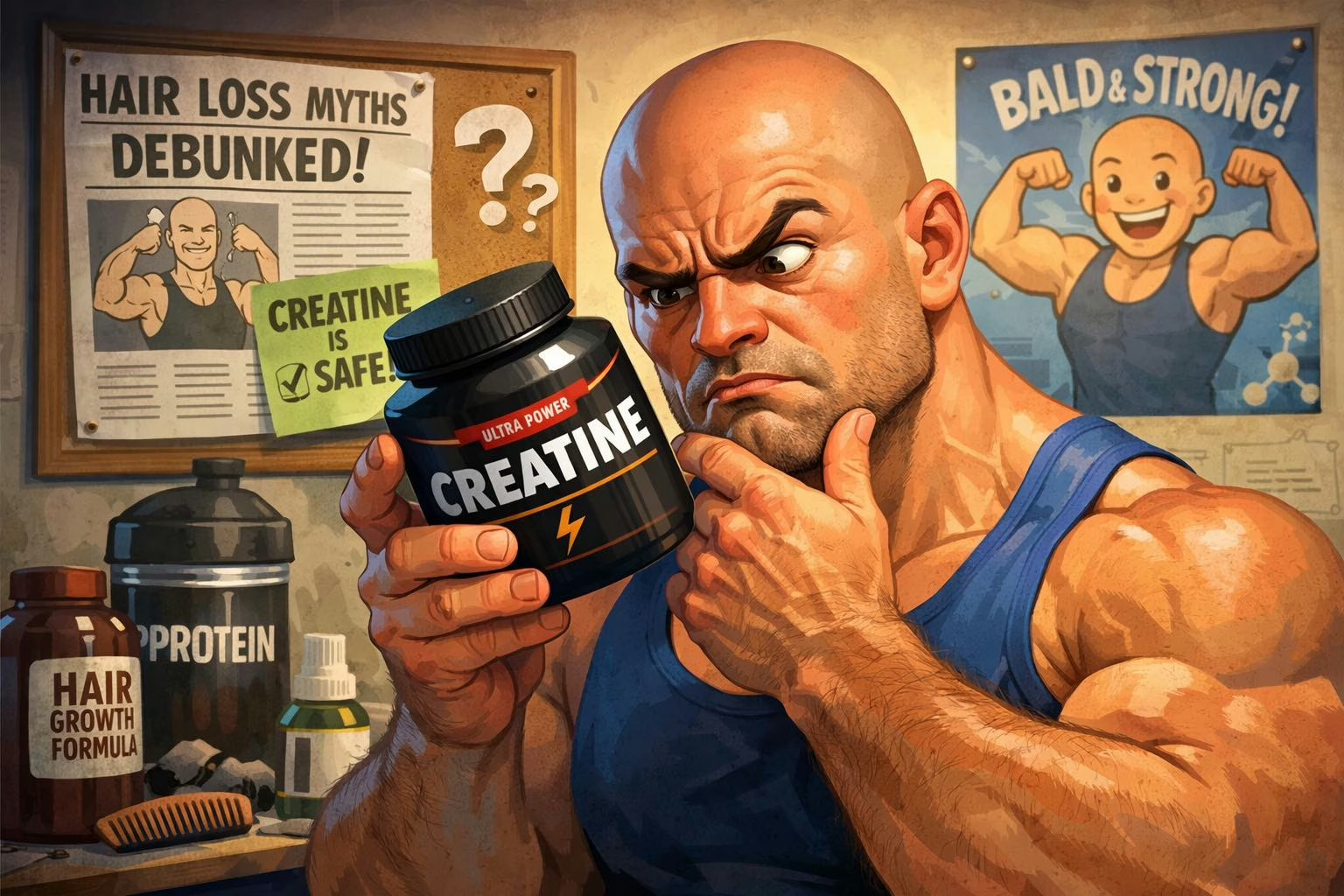
And with that has come the old rumour, back with fresh legs: creatine causes hair loss. Don’t take it if you’re already thinning. A mate stopped using it because he noticed his hairline shifting.
It’s one of those claims that sounds plausible enough that nobody questions it. But when you actually look at the evidence, the story is a lot less clear.
Where the claim comes from
The entire creatine-hair loss theory traces back to a single study published in 2009. Researchers at Stellenbosch University in South Africa looked at rugby players taking creatine over three weeks. They found that DHT — dihydrotestosterone, the hormone linked to male pattern baldness — increased by around 56% in the creatine group.
That’s the study. That’s it. One study. Never replicated.
To be fair, it wasn’t a bad study — it was reasonably well-designed for its size. But a single trial with 20 rugby players is not enough to conclude that creatine will make you go bald.
What DHT Actually Does
DHT is a more potent derivative of testosterone. It’s produced when testosterone gets converted by an enzyme called 5-alpha reductase. High DHT is associated with male pattern baldness — specifically in men who are genetically predisposed to it.
The key phrase there is genetically predisposed. DHT doesn’t cause hair loss in men who aren’t already sensitive to it. If you’re not going to go bald, elevated DHT probably isn’t going to change that.
So even if creatine does raise DHT — which, again, only one study has shown — the real question is whether that rise is enough to meaningfully accelerate hair loss in men who are already susceptible.
Nobody has studied that directly.
What the rest of the research says
Multiple studies have looked at creatine supplementation and testosterone levels. The consistent finding is that creatine does not significantly raise testosterone. Some show a small, transient increase. Most show nothing meaningful.
The 2009 DHT study is an outlier. Several studies since have measured androgens in creatine users and not found the same effect.
It’s also worth noting that the rise in DHT found in that study — while statistically significant — may not be physiologically meaningful. DHT fluctuates naturally. Whether a short-term spike from creatine translates into any real-world hair loss hasn’t been demonstrated.
The honest answer
Here’s where things stand:
Creatine almost certainly does not cause hair loss in men who aren’t genetically prone to it. If you’ve got a full head of hair and no family history of male pattern baldness, there’s no credible evidence that creatine is going to change that.
If you are already losing your hair, or if your dad and grandfather were both bald by 40, the picture is less certain. Not because the evidence says creatine will make it worse — it doesn’t — but because the question hasn’t been properly studied in that population.
The honest answer is: we don’t know for sure, but the current evidence does not support avoiding creatine over hair loss concerns.
What creatine actually does
Since we’re here: creatine is one of the most well-researched supplements in existence. The evidence for its benefits is strong.
It increases phosphocreatine stores in your muscles, which helps regenerate ATP faster during high-intensity efforts. That translates to more reps, more power output, and over time, more muscle.
It’s cheap, safe, and it works. The standard dose is 3–5g per day. You don’t need to load it. No cycling required.
If you’ve been avoiding it because of a rumour that started with one small study in South Africa 15 years ago, you’ve probably been leaving performance gains on the table for no good reason.
One study found a rise in DHT. That study has never been replicated. No study has shown creatine directly causes or accelerates hair loss. If you’re worried about your hairline, genetics is doing far more work than your pre-workout stack.
Take the creatine.
FAQs
There is no direct evidence that creatine causes hair loss. One 2009 study found a rise in DHT — a hormone linked to male pattern baldness — but it has never been replicated, and no study has shown creatine directly causes or accelerates hair loss.
Researchers found that DHT levels increased by 56% in rugby players after a creatine loading phase. Testosterone levels did not change. The study involved only 20 participants and has not been replicated in subsequent research.
The research doesn’t say you should. However, since studies haven’t specifically tested creatine in men with male pattern baldness, the question remains open. If you’re concerned, speak to a dermatologist before supplementing.
The standard dose is 3–5g per day. You don’t need to load, and there’s no need to cycle it. Creatine monohydrate is the most researched and cost-effective form.