

There is nowhere to hide on a pull-up bar. No leg drive. No machine to blame. Just you, gravity and however many kilograms you brought with you.
Pull-ups expose the difference between the strength you think you have and the strength you can actually use. That is precisely why they are worth testing. Here is how many strict repetitions men should aim for at every age.
Pull-Up or Chin-Up — And Does It Even Matter?
Yes, it matters. And no, they’re not the same thing — even though blokes use the names interchangeably at the gym constantly, including people who absolutely should know better. Here’s the actual difference:
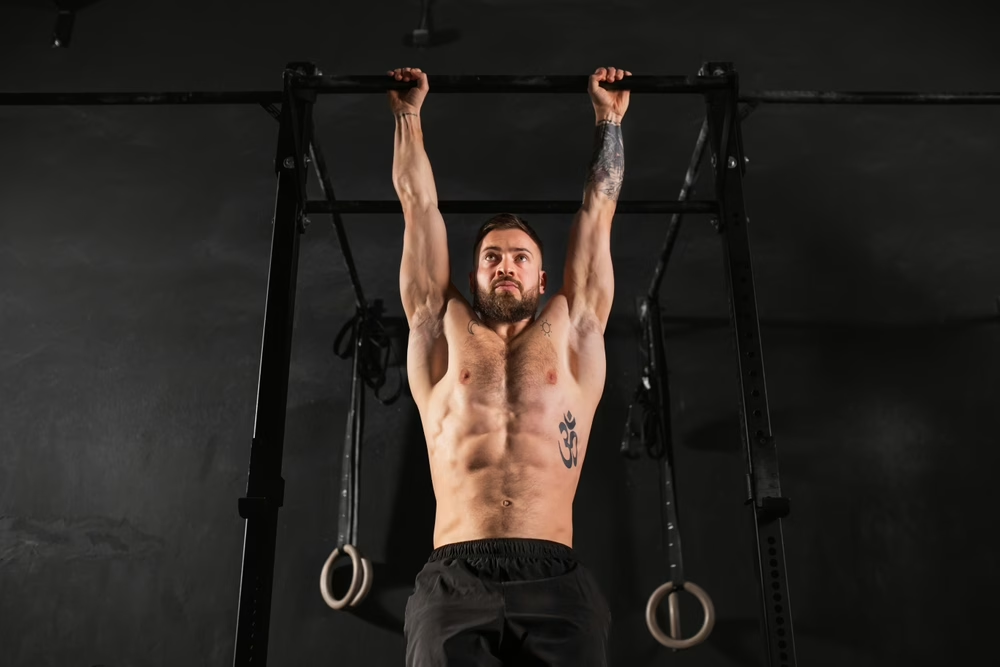
A pull-up uses an overhand grip — palms facing away from you — with hands roughly shoulder-width apart or wider. You’re pulling your chest toward the bar. The work is dominated by your lats and upper back, with your biceps playing a supporting role. It’s harder. Your arms are in a mechanically weaker position, which means your back has to do more of the heavy lifting.
A chin-up uses an underhand grip — palms facing toward you — typically shoulder-width. That simple flip changes everything. Your biceps are now in a much stronger pulling position, which means you can usually do more reps and the movement feels more natural, especially if you’re earlier in your training. You still hit the lats and upper back, but the bicep contribution is significantly higher.
WHICH ONE SHOULD YOU ACTUALLY DO?
Short answer: both, eventually. But here’s a practical guide:
- Starting out or rebuilding? Chin-ups first. The stronger arm position makes it easier to build confidence and early strength without stalling at zero for weeks.
- Want more back development? Pull-ups. The overhand grip forces your lats to do the real work and builds the kind of upper back thickness that actually shows.
- The standards in this article are based on the overhand pull-up — the harder of the two. If you’re counting chin-ups, take a rep or two off your mental tally to stay honest.
There’s also a neutral grip option — palms facing each other, usually on a V-bar or angled handles — which sits somewhere between the two in terms of difficulty and is easier on the shoulders. Worth knowing if yours give you grief.

What Actually Counts as a Rep?
Before you start mentally adding five reps to your total, we need to agree on what a real pull-up looks like. Because the version most men are counting isn’t it.
THE FORM CHECK
A legit pull-up means:
- Dead hang at the bottom — arms fully extended, no cheating the range
- Chin clearly over the bar — not approaching it, not kissing it. Over it.
- No swinging, kipping, or creative leg work — if your lower body is doing interpretive dance, it doesn’t count
Still think your number holds up? Good. Let’s keep going.
Pull-Up Standards for Men by Age
These aren’t numbers ripped from a military fitness manual. These are realistic benchmarks for men who train — or at least intend to.
How we set these benchmarks: There is no single population-wide pull-up standard for adult men. These are Men’s Fitness training benchmarks for healthy men, not medical cut-offs or population averages. For context, the 2026 US Marine Corps test requires most male age groups to complete 3–5 pull-ups for the minimum event score, while 18–23 earns the maximum score depending on age. Bodyweight, training history, injuries and technique all affect the result.
WHERE DO YOU RANK?
Ages 18–29
- 0–3 reps: You’ve got work to do, mate
- 4–8 reps: Average
- 9–14 reps: Solid
- 15+ reps: Properly strong
Ages 30–39
- 0–2 reps: Not there yet
- 3–7 reps: Average
- 8–12 reps: Strong
- 13+ reps: Top tier
Ages 40–49
- 0–2 reps: Starting from scratch
- 3–6 reps: Average
- 7–10 reps: Strong
- 11+ reps: Genuinely rare
Ages 50+
- 0–1 reps: Needs attention
- 2–5 reps: Average
- 6–8 reps: Strong
- 9+ reps: Outstanding
Now here’s the bit that stings a little: if you’re a healthy bloke in your 30s and you can’t string together five clean reps, you’re undertrained. Not doomed, not broken — just undertrained. There’s a difference, and it’s worth knowing.
Then There Is Gero Arias
At the end of 2024, Argentine creator Gero Arias completed 366 pull-ups while remaining on the bar. It was the final day of a challenge in which he added one repetition every day, producing a reported total of 67,161 across the year.
His high-volume repetitions should not be compared directly with the strict maximum test above. He divided the final effort into sets and rested while hanging from one arm. It remains an extraordinary endurance feat. Read the full story of Gero Arias, his catastrophic hand injury and his unlikely move into boxing.
Why Pull-Ups Matter
A strict pull-up is a clean test of relative upper-body strength: how effectively you can move your own body through space. It demands the lats, upper back, arms, grip and trunk to work together.
That makes it useful, but not magical. A poor result does not diagnose your health, and the research linking grip strength with longevity generally measures maximal handgrip with a dynamometer. Pull-ups tell you whether your pulling strength is keeping pace with your bodyweight. That is valuable enough without pretending the bar can predict your funeral.
The Uncomfortable Truth About Bodyweight
This is where the excuses tend to show up — and look, they’re not entirely wrong.
Pull-ups are physics. If you’re carrying extra weight, every single rep is harder. A lean 75kg bloke grinding out 10 reps is moving serious total load. A 100kg bloke getting up 3 reps is still strong — but the ratio tells a different story.
That’s what makes pull-ups uniquely uncomfortable. They don’t just test your strength. They test your strength and your condition at the same time.
Fun, right?
Stuck on Zero? Good. That’s Where You Start.
Here’s the thing about zero — it’s an honest starting point. Everyone was there at some point. The guys doing 15 reps didn’t start at 15.
FROM ZERO TO FIRST REP
Three things that actually work:
- Dead hangs — just hang from the bar and build grip strength and confidence
- Band-assisted or machine-assisted pull-ups — train the movement with less load
- Negatives — jump to the top position and lower yourself slowly. These are brutally effective.
Do this a few times a week. You’ll hit your first real rep faster than you think — most guys quit right before it happens.
Stuck in the Middle? Welcome to the Club
Five to eight reps is where most men live. It’s the fitness equivalent of “yeah, not bad.” It also happens to be exactly where progress stalls, usually because you’re doing the same thing every session and expecting different results.
HOW TO BREAK PAST 8
- Add weight — even a 5kg plate in a belt changes everything
- Do pull-ups first — not after you’ve already torched your arms on something else
- Build volume across the week — multiple shorter sets beats one big effort you never repeat
Strength doesn’t improve by accident. But it also doesn’t require a complicated plan.
Shoulder warning: Pull-ups create high forces through the shoulder over a large range of motion. If you have existing shoulder pain, do not simply add more repetitions. A neutral grip or assisted variation may be more comfortable, but persistent pain deserves assessment. Research has identified potentially unfavourable shoulder mechanics in wide-grip and reverse-grip variations, particularly for vulnerable shoulders.
The Simple Test Worth Taking Right Now
Next time you’re in the gym, do this one thing: one set, full effort, strict form. No elaborate warm-up ritual. No second chances. No “I wasn’t really trying.”
Whatever number you hit — that’s your truth. Write it down. Now you’ve got something you can improve. You don’t need to be a pull-up machine. You don’t need to bang out 20 reps or start filming yourself for Instagram.
But you should be able to control your own bodyweight for a handful of clean reps. That’s not a high bar — no pun intended. It’s a basic measure of the kind of strength that actually means something. The kind that holds up when there’s nowhere to hide.
Now go find a bar.