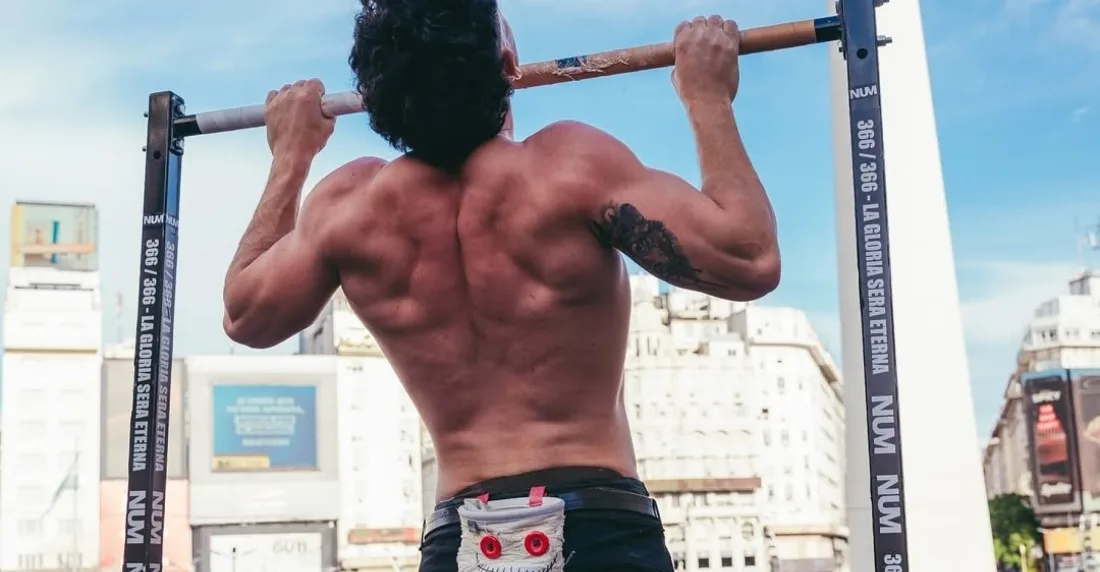

Gero Arias seems built without an off switch: relentless, single-minded and capable of enduring almost anything. Yet outside the Spanish speaking world, the young Argentine remains largely unknown.
In 2024, the young creator set himself a beautifully simple challenge: one pull-up on 1 January, two on 2 January, then one more every day until the end of the year. Unfortunately, 2024 was a leap year. On 31 December, in front of a crowd near the Obelisk in Buenos Aires, he finished with 366.
Add the year together and you get 67,161 pull-ups.
That was enough to make Arias a phenomenon across the Spanish-speaking internet. Then the story took a considerably darker turn. In March 2025, he fell roughly 10 metres while climbing with his father. A rock struck his left hand and amputated parts of his index and ring fingers.

Seventeen months later, he stepped into a boxing ring in Seville and beat the most successful fighter in the history of La Velada del Año, an enormous creator-boxing event organised by Spanish streamer Ibai Llanos.
At 172 cm and 76.9 kg, Arias gave away 10 cm in height to Viruzz. It did not matter. He knocked the Spaniard down in the opening round and won by unanimous decision, ending Viruzz’s unbeaten run at the event. You may never have heard of him. A few hundred million people most certainly have.
The challenge he failed first
The 67,161-pull-up year was not Arias’s first attempt. He tried the same escalating challenge in 2023 and made it to day 281. His hands eventually gave out and he dropped from the bar. Most people would have accepted 281 consecutive days of increasing pull-ups as a perfectly respectable result and found a hobby involving fewer blisters. Arias started again on 1 January 2024.
As the numbers climbed, the challenge became a travelling performance. He completed repetitions near the Eiffel Tower and Colosseum, hung from a structure over crocodile-filled water and performed 300 pull-ups from the Puente Nuevo bridge in Ronda, about 100 metres above the gorge, in the rain.

For the final session in Buenos Aires, reports say Arias remained on the bar for close to an hour. He divided the 366 repetitions into smaller groups and rested while hanging from alternating arms, but did not return to the ground. It is an astonishing feat of grip, muscular endurance, pain tolerance and bloody-minded persistence.
It is not, however, the same as doing 366 textbook pull-ups without stopping.
Did all 366 pull-ups count?
This is where the internet removes its tracksuit and puts on a judge’s blazer. Under the strict standard we use in our pull-up benchmarks for men, each repetition begins from a dead hang, finishes with the chin clearly over the bar and contains no kip or leg swing.
Footage from Arias’s high-repetition sessions has attracted the predictable arguments about shortened range and whether every repetition should count. Fatigue also changed the movement as the sessions progressed. His rules allowed him to rest while remaining on the bar, so the final 366 should not be confused with an unbroken military-style maximum test.
Nor could Men’s Fitness verify repeated reports that the achievement is an official Guinness World Record. It is safer to call it a documented year-long challenge unless Guinness confirms otherwise.
None of that makes 67,161 repetitions ordinary. It simply describes the feat accurately.
What would that many pull-ups do to your body?
During the final week alone, Arias completed 2,541 pull-ups. By November he was doing more than 300 every day.
That is far beyond the volume required to build a strong back. Once your muscles have received enough useful work, adding hundreds more repetitions produces diminishing returns while your hands, elbows and shoulders continue paying the bill.
A study of street-workout athletes found that 62.4 per cent reported an injury during the previous year. The shoulder was the most commonly injured area, tendinopathy was the most frequent diagnosis and overtraining was the cause participants cited most often. It was a small observational study, so it cannot tell us that pull-ups caused every injury, but it shows where extreme calisthenics volume tends to collect its debts.
Arias’s hands showed the cost throughout the challenge. Torn calluses and blood on the bar became part of the spectacle. His later finger injury was unrelated to pull-ups, caused by the climbing fall rather than his training, but it threatened the physical ability on which he had built his name.
Then he adapted.
From the pull-up bar to the boxing ring
On 25 July 2026, Arias faced Viruzz at La Cartuja stadium in Seville. The event reached more than eight million peak concurrent viewers across platforms, with roughly 80,000 people in the stadium.
Viruzz had won his five previous appearances. Arias put him down in the first round, kept the pressure on and took a 5–0 decision from the judges.
Pull-up endurance does not automatically make someone a boxer. Boxing demands footwork, timing, defence, repeat sprint fitness and the ability to remain useful while another man is hitting you. But Arias already possessed two qualities that transfer rather well: an enormous tolerance for repetitive work and an unusual willingness to stay uncomfortable.
After the decision, naturally, he called out Jake Paul. Apparently moderation was never likely to become part of the story.
Gero Arias: the essentials
| Real name | Gerónimo Arias |
| Age | 22 at La Velada del Año VI in July 2026 |
| Height | 172 cm |
| Competition weight | 76.9 kg |
| Nationality | Argentinian, from San Luis |
| Reported 2024 pull-ups | 67,161 across 366 days |
| Final-day total | 366, completed in sets while remaining on the bar |
| Boxing result | Defeated Viruzz by unanimous decision, 5–0, on 25 July 2026 |
Important qualification: the pull-up challenge was extensively filmed and reported, but Men’s Fitness could not verify claims that it is an official Guinness World Record.
Should you try the challenge?
Yeah, but you’ll probably give up. So Nah.The intelligent part of Arias’s idea is the gradual progression. The unintelligent part for almost everyone else is turning that progression into a daily maximal test with no planned recovery and no upper limit.
Borrow the structure, not the extremity:
- Test your maximum number of strict pull-ups.
- Train the movement two or three times each week.
- Keep most sets several repetitions short of failure.
- Accumulate clean repetitions across multiple sets.
- Increase weekly volume gradually, not indefinitely.
- Reduce the work if your elbows, shoulders or hands begin complaining.
If you cannot perform one clean repetition, start with assisted pull-ups, slow negatives and dead hangs. If you can do five, work towards 10. If you can already do 15 strict repetitions, start adding weight. You will get better at pull ups. Pull-ups also anchor our back workout if you want them in a full session.
Arias’s real lesson is not that everyone should do 67,161 pull-ups. It is that a simple idea, pursued relentlessly, can change the direction of a life. Just give your tendons the occasional day off.